Viral Hooks
Trending short videosDesigner fixes catchall tray flaws
C

@craighillcompany

Instagram · Talking Head Edit

@craighillcompany Sometimes new designs hold onto old features that are no longer necessary. Your typical catchall has a lip, is largely flat, and is made from a hard material. This works great as a food tray, but for a catchall tray, it's not ideal. Your stuff is rarely "caught" neatly and the loud noise is not nice to hear, especially at night. So, we made some tweaks to create the tray we wanted by our bedside tables and near our front doors. The Little Cloud Tray softly catches your pocket dump (or other valuable things) and keeps it all organized until another day returns. Let us know what you think. Do you miss the lip?

View original on Instagram

The edit1 shot · 0 text
Shots1:14

Performance

Views
4.4M
Likes
98.6K
Comments
487
Engagement
2.3%
Outlier
1×
Length · 14 Aug 2025
1:14

Video #19407 · Talking Head Edit

Designer fixes catchall tray flawsfrom @craighillcompany

[01]

Overview

The creator systematically deconstructs the design flaws of traditional catchall trays, specifically the lip, flat surface, and noise, before revealing their own solution: a cork tray designed to solve these issues. He demonstrates the functional improvements of the new design through direct comparisons and sound tests.

[02]

Simple outline

  1. 1Identify logical design flaw
  2. 2Demonstrate structural correction
  3. 3Highlight sensory pain point
  4. 4Reveal material solution

[03]

Related videos

[04]

Classification

Concepts
Origin StoryProduct Showcase
Elements
B-Roll CutawayASMR sounds

[05]

Hook analysis

What stops the scroll in the first 3 seconds

Verbal hook · 45%

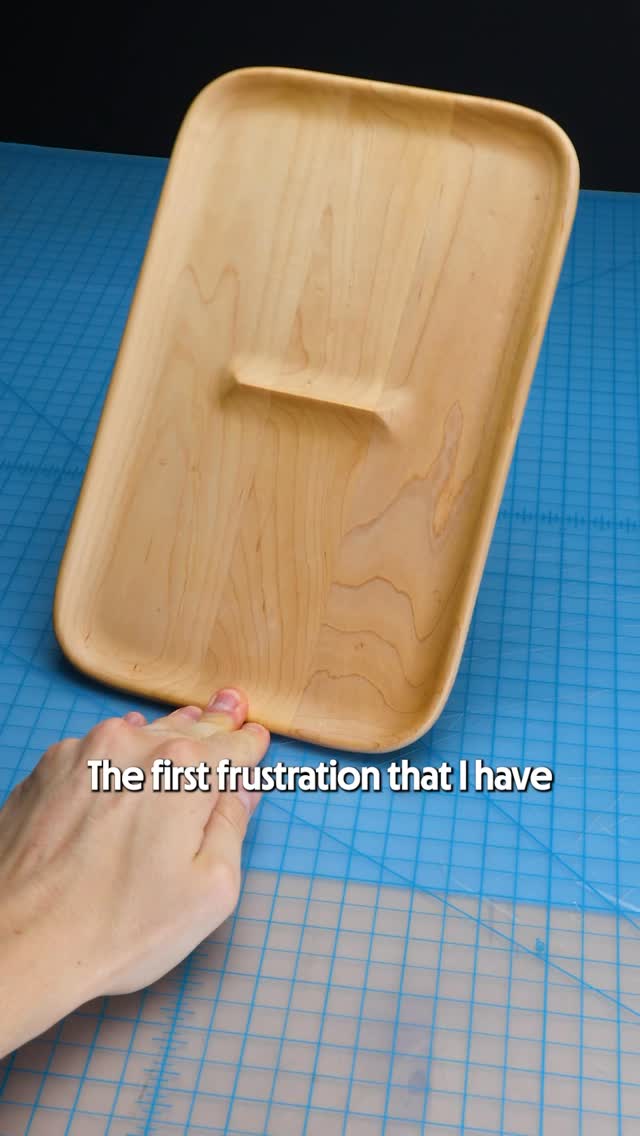
The first frustration that I have with the traditional catchall tray is that they have a lip.

Visual hook · 55%

A wooden tray is spun rapidly on a blue cutting mat, creating immediate motion and visual interest.

[07]

Hook and payoff

The promise the opener makes, and how the video pays it back

Hook

The Counter-Intuitive Critique: The creator immediately attacks a standard feature of a common object, framing it as a 'frustration' rather than a benefit.

Payoff

The Material Resolution: The final solution is revealed not just as a shape change, but a material change (cork) that solves the sensory problem, delivering a satisfying 'soft' conclusion.

[08]

Narrative framework

The structural pattern this video runs on

Framework

The Iterative Perfection Arc

Systematically deconstructing a common object by identifying specific flaws and applying immediate design interventions until a 'perfect' final form is reached.

  1. 1

    The Logic Gap

    Explains why the standard feature exists (mobility) versus how the object is actually used (stationary), creating a logical paradox.

  2. 2

    The Structural Intervention

    Visually demonstrates the first physical correction (filling the void/removing the lip) to solve the logical paradox.

  3. 3

    The Functional Pivot

    Identifies a secondary issue with the new form (flatness doesn't 'catch') and applies a shape-based correction (deepening the walls).

  4. 4

    The Sensory Fail

    Introduces a visceral, auditory problem (loud noise) using a jarring sound effect to create immediate viewer discomfort.

Themes

  • Form follows function
  • Solving everyday annoyances
  • Material innovation

Techniques

  • Sound comparison
  • Problem-solution structure
  • Visual contrast

Trends

  • Designer commentary
  • Satisfying organization

Post caption

Sometimes new designs hold onto old features that are no longer necessary. Your typical catchall has a lip, is largely flat, and is made from a hard material. This works great as a food tray, but for a catchall tray, it's not ideal. Your stuff is rarely "caught" neatly and the loud noise is not nice to hear, especially at night. So, we made some tweaks to create the tray we wanted by our bedside tables and near our front doors. The Little Cloud Tray softly catches your pocket dump (or other valuable things) and keeps it all organized until another day returns. Let us know what you think. Do you miss the lip?

Transcript

The first frustration that I have with the traditional catch all tray is that they have a lip. It's taking the bad surface and folding it up to create some molds to allow your fingers to get underneath rank quickly and easily move it. But for a catch all, to me, the whole point is that it's stationary. The lip is not only unnecessary because you're not gonna be moving this from room to room, but it also reduces the kind of overall stability. And so the very first simple intervention, filling that volume to create the solid block, not only does it make it actually a more kind of stable object, there's no longer this implication of mobility. So with that lip gone, it brings us to my next frustration. They usually have these short walls, predominantly this big flat surface, isn't actually so great that catching your things as you're coming home at the end of the day. What we wanted to do was an overall more rounded form, a deeper container, which creates a little bit higher walls, increases the kind of catch area, something that you can toss your stuff into and reliably know that it's gonna contain it. But there's still one remaining frustration, frustration, and that is I want something that is not gonna be loud and not gonna be delicate, which brings me to the material that we selected to make this tray in. Tier. It gives you this soft catch every single tier, unlike the traditional wooden catchall.