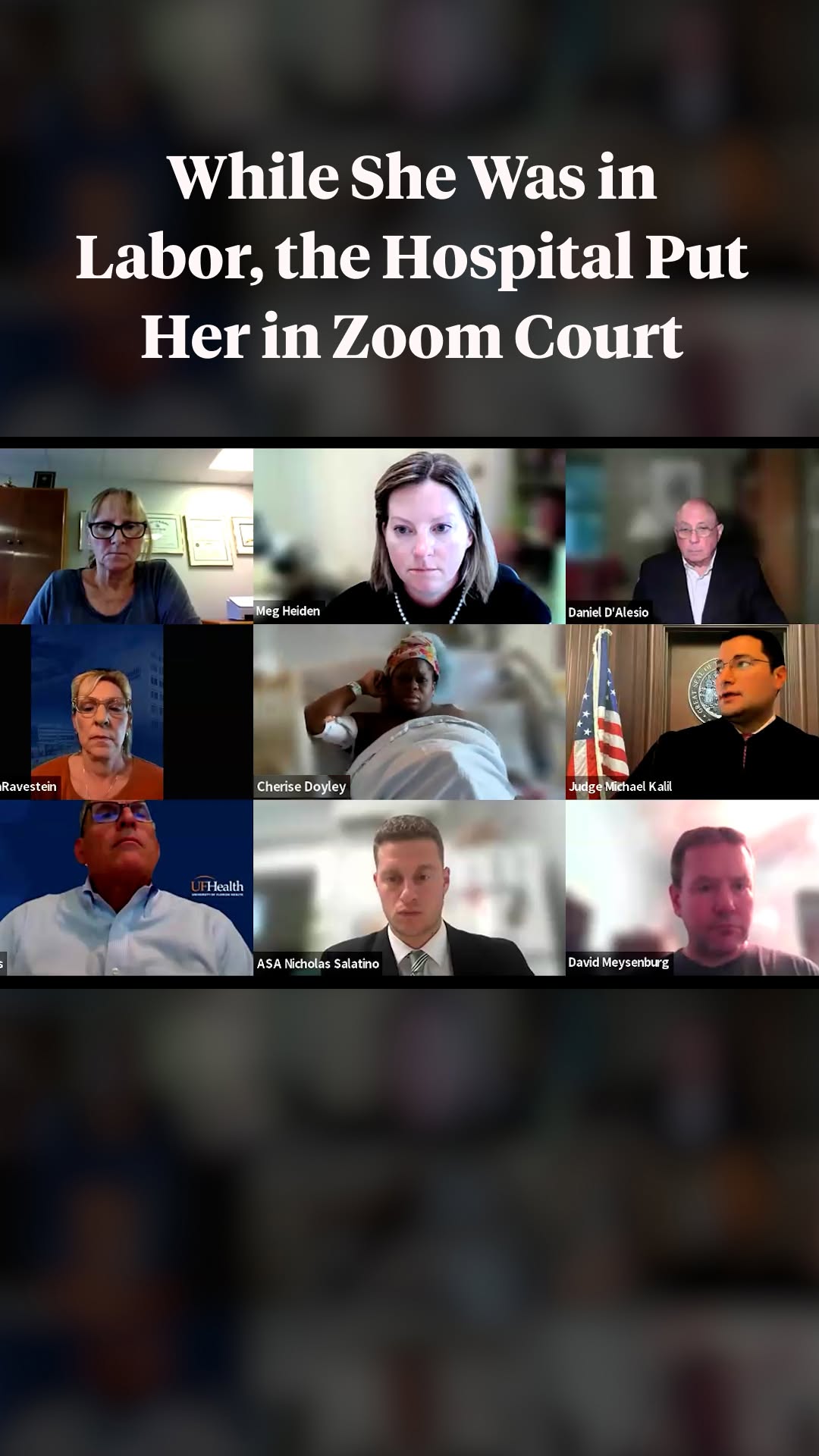
@propublica Cherise Doyley, a mother of three, was in labor at a Florida hospital when a nurse brought her a tablet. On the screen were a judge and several lawyers, doctors and hospital staff. Doyley wanted to have a vaginal birth. They wanted to force her to undergo a cesarean section.
Doyley, a professional doula, had had three prior C-sections — including one that resulted in a hemorrhage. She hoped to avoid another serious complication and lengthy recovery.
In labor and in a Zoom court hearing, Doyley had no lawyer or advocate and no one to explain to her what was going on. After three hours of testimony, the judge ruled that she could keep trying for a vaginal birth unless there was an emergency.�
Overnight, doctors wheeled her into surgery. The baby was delivered by C-section.
ProPublica reporter Amy Yurkanin obtained a video recording of Doyley’s court hearing. Watch Doyley undergo this legal ordeal and argue for her own medical choices from a hospital bed.
Raw footage of hospital court hearingfrom @propublica
[01]
Overview
The video presents a raw Zoom recording of a court hearing taking place while a mother is in labor in a hospital bed. The patient argues with a judge and doctors against being forced to have a C-section, citing her rights, lack of legal representation, and racial disparities in healthcare. The video concludes with a series of text overlays over a static portrait, detailing the outcome of the medical procedure and providing a call-to-action to read the full investigative report.
She refused a C-section. The hospital took her to court — while she was in labor.
Verbal hook · 25%
It's a real judge in there?
Visual hook · 10%
A grid of multiple people on a Zoom call, including a woman in a hospital bed wearing a hairnet, immediately establishing a serious, real-life medical and legal scenario.
[06]
Hook template
Steal this for your own video
She refused [medical procedure]. The [institution] took her to [legal venue] — while she was [vulnerable moment].
— She refused chemotherapy. The state took her to family court — while she was recovering from surgery.
— She refused the medication. The school district took her to a hearing — while she was in the ICU.
— She refused the psych hold. The hospital took her to probate court — while she was sedated.
[07]
Hook and payoff
The promise the opener makes, and how the video pays it back
Hook
Immediate presentation of a high-stakes, David-vs-Goliath scenario using stark text overlays combined with raw, primary source footage.
Payoff
A transition to a polished visual of the subject accompanied by a direct call-to-action to consume the full, detailed investigation.
[08]
Narrative framework
The structural pattern this video runs on
Framework
The Primary Source Exposé
Leveraging raw, real-time documentation of a high-stakes conflict between an individual and an institution to build outrage, followed by an epilogue that drives to a larger investigation.
1
The Institutional Threat
An authority figure formally states the action being taken against the protagonist, establishing the power dynamic and the immediate stakes.
2
The Vulnerable Defense
The subject articulates their position, highlighting their lack of resources, their fundamental rights, and the personal consequences of the institutional action.
3
The Systemic Escalation
The subject connects their specific, personal struggle to a broader societal or systemic issue, deepening the narrative's relevance and viewer outrage.
4
The Immediate Resolution
The authority figure delivers a ruling or decision, providing a temporary climax to the recorded conflict.
5
The Reality Check
A shift in format (e.g., text screens) reveals the ultimate outcome of the situation, often subverting the immediate resolution and showing the true impact.
6
The Human Cost
A final return to the raw footage showing the lasting emotional or psychological toll on the protagonist, cementing empathy.
Themes
medical ethics
patient rights
racial disparities in healthcare
legal intervention in medicine
Techniques
screen recording
editorial text graphics
static image with text
Trends
investigative journalism on social media
exposing systemic issues
raw footage storytelling
Post caption
Cherise Doyley, a mother of three, was in labor at a Florida hospital when a nurse brought her a tablet. On the screen were a judge and several lawyers, doctors and hospital staff. Doyley wanted to have a vaginal birth. They wanted to force her to undergo a cesarean section.
Doyley, a professional doula, had had three prior C-sections — including one that resulted in a hemorrhage. She hoped to avoid another serious complication and lengthy recovery.
In labor and in a Zoom court hearing, Doyley had no lawyer or advocate and no one to explain to her what was going on. After three hours of testimony, the judge ruled that she could keep trying for a vaginal birth unless there was an emergency.�
Overnight, doctors wheeled her into surgery. The baby was delivered by C-section.
ProPublica reporter Amy Yurkanin obtained a video recording of Doyley’s court hearing. Watch Doyley undergo this legal ordeal and argue for her own medical choices from a hospital bed.
Text overlays
title · beginning
She refused a C-section. The hospital took her to court — while she was in labor.
contextual · beginning
Judge Michael Kalil
contextual · beginning
Cherise Doyley
informational · end
Doyley had three prior C-sections, including one that resulted in hemorrhage. After three hours of testimony — all while Doyley lay in her hospital bed — the judge ruled that she could keep trying for a vaginal birth unless there was an emergency.
informational · end
Overnight, doctors said, the baby's heart rate dropped for seven minutes. Doyley woke to her hospital bed being wheeled into surgery. The baby was delivered by C-section.
informational · end
The next day at 8 a.m., nurses again put Doyley in front of a tablet for a final hearing.
title · end
They Didn't Want to Have C-Sections. A Judge Would Decide How They Gave Birth.
branding · end
by Amy Yurkanin, ProPublica, with photography by Sarahbeth Maney for ProPublica
call-to-action · end
Head to the link in our bio to read more.
informational · end
The state attorney's office for the 4th Judicial Circuit declined to comment on Cherise Doyley's case, citing medical privacy, but in an email a spokesperson said the office may intervene to protect unborn children and others when lifesaving treatment is refused.
informational · end
At the hearing, Dr. Erin Burnett said Doyley likely couldn't safely deliver vaginally, warning of risks like uterine rupture. Dr. John Davis added that the hospital avoids unnecessary C-sections but said Doyley's condition required intervention. Hospital staff noted concern for the baby's welfare.
informational · end
Doctors and the hospital declined further comment, citing privacy even though Doyley had signed a waiver allowing the hospital to discuss the case with ProPublica. The hospital did not address her claim that race played a role in her care. Judge Michael Kalil also declined to comment, citing judicial ethics and the need to preserve fairness and neutrality.
Transcript
It's a real judge, you know? My name is Michael Khalil. I'm a circuit court judge here in Jacksonville, Florida. The state of Florida has filed a petition for declaratory judgment. They're asking for an emergency c section best granted by the court. I have not had a chance to be able to consult my own legal representation, and I'm trying to understand how you are taking my rights away as a patient to be able to decide my own care to give me an emergency c section against my will. Best let me ask you about that. What about the rank to the child? Anytime you go into childbirth, whether you do a vaginal or a c section, there is inherent risk to the mother and the baby. I have other children out here in the world that need me. If I die from a c section, nobody on this call is gonna take care of my children. Well, you have a new doctor coming on. I don't know if you No. They don't have nobody African American that they can give me? Better me ask it. I don't know that tier it I don't find that race really has has, damn much to do with this, ma'am. It does have much to do with it because historically, black people do better when they have health care providers that look like them. There's nobody black in here. I'm so tired of this. I'm I'm over this whole situation. Like Mhmm. Y'all are gonna make me have have level three tracing, how bad y'all are stressing me out. Miss D'Olive, that's what's going to be entered. I'm gonna circulate this order, this proposed order to the other attorneys better this in today, not requiring anything except for rank emergency basis. Thank you so much, your honor. Yeah. I appreciate you spending two hours on a Sunday going through my medical history and fighting for my vagina and my Alright. This is retraced. Tell them I don't wanna be home. Alright. Y'all gonna have your own meeting. I wanna see my child.
Raw footage of hospital court hearing | Viral Hooks