@versojobs
Instagram · Skit
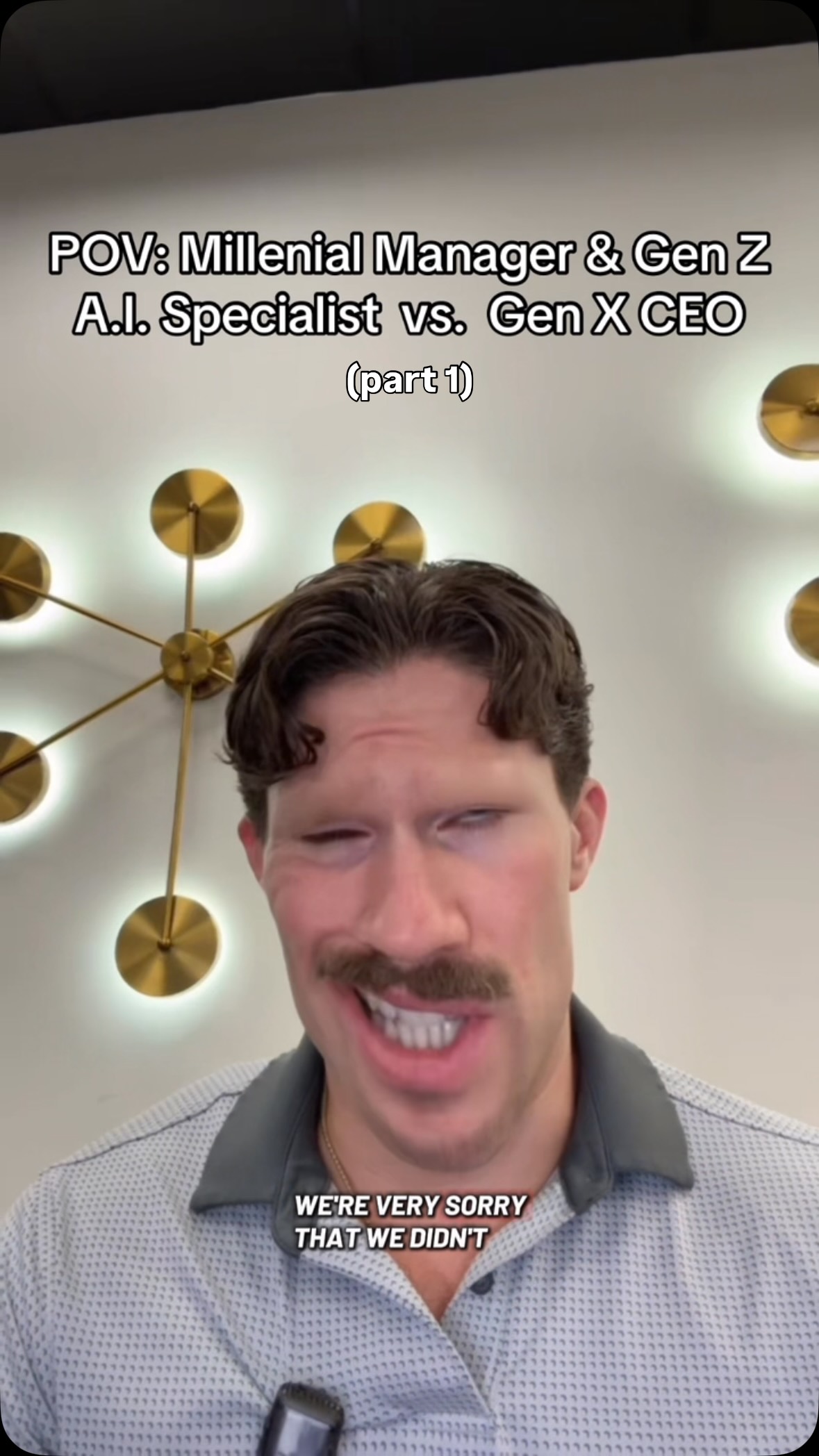
@versojobs Ep. 37 (Part 1) | “Offline” #corporate #skit #drama #workplace #tech

@versojobs
Instagram · Skit
@versojobs Ep. 37 (Part 1) | “Offline” #corporate #skit #drama #workplace #tech
Performance
Video #41868 · Skit
[01]
The creator performs a three-character skit where a Gen X CEO confronts a Millennial Manager and a Gen Z AI Specialist for not communicating about a new technology. The conversation quickly pivots from the initial issue to the younger employees' complaints about the company's rigid culture and the ineffectiveness of its numerous meetings. The CEO dismisses their concerns, leading to a tense standoff that ends with the Gen Z employee attempting to retreat before being stopped by the Millennial manager, creating a cliffhanger for the next part.
[02]
[03]
 324.3K44.3×Generational clash in corporate meeting@versojobs · Stereotype Satire
 266.8K1.8×Comedic video call character skit@johnnyhilbrant · Stereotype Satire
 429.6K15.7×Corporate jargon vs honest translation@roxycouse · Relatable Skit
 70.5K5.7×Startup vs legacy corporate skit@versojobs · Skit
 464.6K23×Relatable skit about manager role@roxycouse · Relatable Skit
 191.8K28.3×Gen Z translator corporate meeting skit@kinso.app · Relatable Skit
 1.7M1.3×Generational work stereotypes comedy skit@thejarrodbenson · Stereotype Satire
 297.2K1.9×Comedic skit on AI coding@clementetv_ · Relatable Skit
 73.9K5.1×Skit of a sales negotiation@versojobs · Skit
 715.8K14.8×Employee sarcastically explains low morale@roxycouse · Relatable Skit
 518.1K32×Skit parodying corporate meeting speak@versojobs · Relatable Skit
 279.4K36.6×Corporate meeting jargon parody skit@versojobs · Skit
[04]
[05]
What stops the scroll in the first 3 seconds
Title hook · 60%
POV: Millenial Manager & Gen Z A.I. Specialist vs. Gen X CEO
Verbal hook · 5%
Gentlemen.
Visual hook · 35%
The video opens with an intense, distorted close-up of the CEO character's face, creating an immediate sense of confrontation and visual intrigue. This is followed by rapid cuts between the three characters, each framed in a similar tight shot.
[06]
Steal this for your own video
POV: vs.
[07]
The promise the opener makes, and how the video pays it back
Hook
The video opens in media res on a tense interaction between a figure of authority and their subordinates, with on-screen text immediately framing the central conflict and character archetypes.
Payoff
The narrative concludes on a cliffhanger. Just as the conflict appears to be suppressed by authority, one character makes a final defiant statement that re-ignites the core problem, leaving the tension at its peak and promising a continuation.
[08]
The structural pattern this video runs on
Framework
The Systemic Flaw Confrontation
A dramatic skit where a specific workplace error is used as a catalyst to expose and debate a larger, systemic organizational flaw, escalating the conflict between established authority and a subordinate challenger.
The Apology & Interrogation
Subordinates attempt to apologize for a specific failure, but the authority figure rejects the apology and uses pointed questions to escalate the severity of the situation.
The Pivot to System
The subordinates re-frame their failure not as a personal mistake, but as a symptom of a larger, flawed organizational culture or process.
The Pain Point Debate
The subordinates identify a specific, highly relatable operational pain point as the root cause. The authority figure defends this practice, often using corporate jargon to legitimize it.
The Authority Play
Feeling their position challenged, the authority figure dismisses the subordinate's argument by invoking their own seniority, history, and established role, effectively shutting down the debate.
Ep. 37 (Part 1) | “Offline” #corporate #skit #drama #workplace #tech
title · beginning
POV: Millenial Manager & Gen Z A.I. Specialist vs. Gen X CEO
contextual · throughout
(part 1)
call-to-action · end
Part 2 is out now!!
Gentlemen? Charles? Hi, Charles. I'll let you two kick this off. Yeah. Look. First of all, we just wanted to say tier very sorry that we didn't communicate earlier on our interest in better signal. Right? And we really hope that Why didn't you? Well, we thought that, You thought it'd be better that I hear it from my son at home multiple weeks into the sales cycle? That was not at all our intention, really. It was just so early in the procurement process that, you know, we didn't wanna bother you. You didn't want to bother me by asking my input on a technology that could majorly impact the company. We, we were scared. I have tremendous respect for you and the rest of the tier, but Charles, the the culture here is not exactly receptive to new ideas. I've supported our AI good map every step of the way. You have. And it's been awesome. Truly. Best Better no one has any space here to address the real issue. And that is? The meetings. Our collaborative syncs. Yo. I really hate calling them meetings. Good. I've always loved our strategic huddles, but the reality is they're driving people away. What are you talking about? As I'm sure you're aware, employee turnover has been an increasingly glaring issue. It is. And we're continuing to improve our benefits and comp packages. And that's honorable. But when you look at why people are leaving, it's the culture. It's the waste of time and meetings. Why would our employees not appreciate our operational cadences? Because most of the time, they they don't accomplish anything. Do you really feel that way? I can't believe I'm saying this, but yes. Well, I strongly disagree. Frequent communication between stakeholders has always been critical for organizational alignment. Absolutely. And and I have the utmost respect for company tradition, but I'm worried that maybe it's gone too far. What are you trying to say? What I'm trying to say is, like, if we're gonna spend all of our time just aligning, you know, agreeing on inconsequential matters, how are we gonna progress as a business? You think I don't understand how to progress our business? I was here thirty years ago on the Ground Floor with Bob and Corey building LARP into what it is today. But you have one strong quarter tier, and you think you can flip the business on its head, install some AI software to tell me when I can and cannot schedule a touchpoint. We brought you in to command our technological roadmap, not play business consultant. Am I right? Right. Then I suggest you stick to what you do best. Fair enough. I'm sorry for having overstepped here. I appreciate your time. I'll see myself out. Good on. Hold on. No. No. This is exactly the problem.