@olivia.antongiovanni
TikTok · Yap
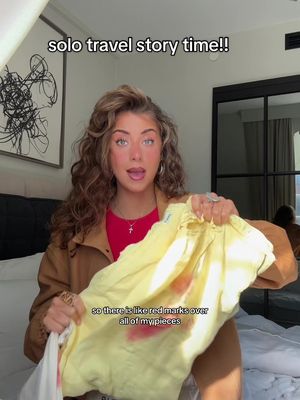
@olivia.antongiovanni my solo travel horror story 😭

@olivia.antongiovanni
TikTok · Yap
@olivia.antongiovanni my solo travel horror story 😭
Performance
Video #4394 · Yap
[01]
The creator tells a story about a series of travel mishaps on a solo trip to Copenhagen. She begins by explaining how a bottle of body oil exploded in her suitcase, ruining all of her clothes with oil and red dye. Needing a jacket for the cold weather, she goes to Zara and buys one, but due to her unfamiliarity with the Danish currency, she misunderstands the price and accidentally spends $640, a fact she only discovers after getting a notification on her phone.
[02]
[03]
 1.3M1.3×Creator shows extravagant post-breakup haul@chloeabeth4545 · Rapid Fire Listicle
 523.2KRelatable monologue about spending habits@julia.dicesare · Relatable Skit
 1.7M1.9×Tells luxury shopping story makeup@chloeabeth4545 · Pope In The Pool Multitask
 403KList of glamorous travel habits@veronafarrell_ · Rapid Fire Listicle
 332.5K10.1×Satirical monologue packing for family@jovkhann · Satirical Expertise
 2M2×Story of expensive rug return@jennaphipps · Storytime
 966.4K1.2×Satirical 'what I spend' vlog@chloeabeth4545 · Day In The Life
 961.1KNarrated luxury shopping day vlog.@chloeabeth4545 · Lifestyle Showcase
 189.6KCreator visits her dream bag weekly@oliviabarbulescu · Journey Documentation
 509.3K2.3×Vlog finding a gift fast@bradjcho · Journey Documentation
 3.1M176.9×Luxury shopping sticker shock skit@loewe · Skit
 1.2M13.7×Funny text overlay on shopping montage@chloeabeth4545 · Lifestyle Showcase
[04]
[05]
What stops the scroll in the first 3 seconds
Verbal hook · 75%
K. Not to be negative, but name something worse that could happen to you while traveling.
Visual hook · 25%
Medium shot of the creator speaking directly to the camera with expressive hand gestures, creating an immediate and personal connection.
[06]
Steal this for your own video
Not to be negative, but name something worse that could happen to you while .
[07]
The promise the opener makes, and how the video pays it back
Hook
The Audience Challenge Hook: Poses a direct question or challenge to the audience ('name something worse'), framing the subsequent story as an extreme or definitive example that demands attention.
Payoff
The payoff is the dual experience of the shocking numerical reveal followed by the final positive pivot, which leaves the viewer feeling both entertained by the drama and connected to the creator's resilience.
[08]
The structural pattern this video runs on
Framework
The Escalating Misfortune
A narrative structure that layers one relatable problem on top of another, leading to a shocking and ironic climax, before resolving with a positive emotional shift.
The Initial Disaster
Establishes the inciting incident—a common, relatable problem (a spill in luggage) that sets the story in motion and generates immediate empathy.
The Collateral Damage Reveal
Makes the initial problem tangible by showing physical evidence and quantifying the loss (ruined vintage clothes), raising the personal stakes beyond a simple inconvenience.
The Problem-Solving Pivot
The narrator accepts the first problem and identifies a new, immediate need it has created (needing a jacket), logically transitioning the story to its next, more consequential phase.
The Miscalculation Setup
Builds suspense by establishing the context for a major error, highlighting a key variable the narrator is unfamiliar with (foreign currency) and their incorrect assumption about the outcome.
The Shocking Reveal
The climax of the story, where the true, disproportionate consequence of the miscalculation is revealed through a specific, shocking number ($640), creating a peak moment of drama.
The Point of No Return
The narrator preemptively addresses the audience's most logical solution ('just take it back') and explains the ironic reason why it's not possible, trapping them in the consequence and heightening the sense of frustration.
The Absurdity Summary
The narrator recaps the full scope of the misfortune, emphasizing the irony (spending a fortune on a basic jacket they don't even like) and the emotional weight of the situation.
The Positive Resolution Pivot
The narrative concludes by shifting focus away from the negative events towards a positive outlook or a simple, grateful action, providing an emotionally satisfying and humanizing resolution.
my solo travel horror story 😭
K. Not to be negative, but name something worse that could happen to you while traveling. I get to Copenhagen on a solo trip. I open my suitcase, and I realized that the shower body oil that I had in my suitcase was completely empty. It was full, mind you. Okay. Completely full. Completely empty. It there is now oil over every single article of clothing, and I had a red dress in the bag too. So there is, like, red marks over all of my pieces, even, like, cool vintage pieces that I'm never gonna find again. Okay. So I deal with it. It's whatever. I have to throw these clothes away. There's no there's there's no fixing this. That's fine. I've I've come to terms with it. But I'm in Copenhagen, like, the coolest city better, so I wanted to look cool. And it's kinda good, and I don't have a jacket. And the one jacket I did have is oil stained, obviously. So I go to Zara Zara and I go to purchase a jacket the one I'm wearing and obviously it is a different currency here it's the Danish kroner I believe and I'm not familiar with it So she goes, that'll be 3,000. And I'm like, okay. It's Zara. I'm assuming this is maybe, like, a 150, maybe $200. I get back to my hotel when I get Wi Wi Fi, and I get a little notification on my Amex app of how much I just spent. $640. no, it's alright. And you think, woah. Why don't you just take it back, girl? Just take it back. I ripped off the tags immediately and put it on because I was cold. I was cold. I just spent $640 on a Zara jacket. Like, if I was gonna spend $640, I would have spent it on a cooler jacket. And I don't even have anything else to wear because my entire wardrobe is soaked in oil. Hundreds and thousands probably of dollars, soaked in oil. And I don't I'm not even sure I like this jacket, to be honest. I think I like the outfit better without it. But I'm so grateful to be here, and I can't wait to go to a bakery this morning.