@danny_fiftyfifty
Instagram · Faceless
@danny_fiftyfifty how to stop avoiding the work (hard-mode)

@danny_fiftyfifty
Instagram · Faceless
@danny_fiftyfifty how to stop avoiding the work (hard-mode)
Performance
Video #47457 · Faceless
[01]
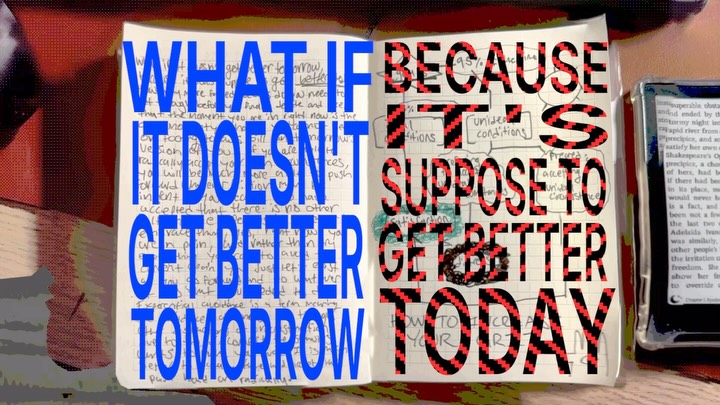
The creator poses a philosophical question about improvement and then uses a hand-drawn flowchart in a notebook to explain the psychological process of achieving goals under ideal vs. unideal conditions. He breaks down how accepting difficult circumstances leads to less stress and more satisfaction, then transitions to abstract 3D visuals to illustrate the disconnect between our imagined plans and reality.
[02]
[03]
 1.7MPhilosophical take on achieving goals@diewithoutregretss · Hot Take
 87.9KExplains how environment shapes habits@coachkyle · Breakdown
 310.8KPersonal story about finding direction@benhbader · Anecdotal Philosophy
 263.8K3.7×Creator breaks down the work-to-reward mindset shift needed to scale income dramatically@briarcochran · Anecdotal Philosophy
 2.4M8.9×Monologue on not settling in life@benhbader · Motivational Mantra
 373K3.1×Motivational monologue over workout montage@rexchexng · Brand Manifesto
 59.4KCinematic voiceover about enjoying life@therealdanielpark · Motivational Mantra
 191.9K6.4×Mindset advice with illustrative overlays@coachkyle · Breakdown
 190.1K2.1×Talking head mindset shift story@therealdanielpark · Anecdotal Philosophy
 80.1K3.6×Numbered list of mindset tips@angel.agree · Breakdown
 195.1K87.7×Historical figure success lesson@kolbykirschner · Case Study Reminder
 11M4587.8×Question answered with expert monologue@missy._.fit · Motivational Mantra
[04]
[05]
What stops the scroll in the first 3 seconds
Title hook · 50%
WHAT IF IT DOESN'T GET BETTER TOMORROW BECAUSE IT'S SUPPOSE TO GET BETTER TODAY
Verbal hook · 45%
What if it doesn't get better tomorrow because it's supposed to get better today?
Visual hook · 5%
A close-up shot of an open notebook with a detailed, hand-drawn flowchart and handwritten notes, creating an authentic and intellectual visual hook.
[06]
Steal this for your own video
WHAT IF IT DOESN'T BECAUSE IT'S SUPPOSED TO
[07]
The promise the opener makes, and how the video pays it back
Hook
A counter-intuitive philosophical question that subverts a common belief, immediately creating intellectual curiosity.
Payoff
The narrative structure strongly implies a payoff where the rest of the visual model is explained, providing a tangible strategy to bridge the gap between the ideal and the real, thus resolving the central conflict.
[08]
The structural pattern this video runs on
Framework
The Ideal vs. Real Framework
To deconstruct a common goal by first establishing the user's idealized vision for achieving it, then introducing the messy, unforeseen reality that creates conflict, all while using a visual diagram as a guide to a promised solution.
The Explanatory Model
Introduces a visual or conceptual model (a 'decision tree') that will serve as the anchor and roadmap for the entire argument, promising a structured solution.
The Universal Starting Point
Establishes a relatable foundation by focusing on a universal concept ('goals') and the viewer's idealized mental picture of how to achieve them.
The Concrete Ideal
Makes the abstract concept of an 'ideal path' tangible by providing a simple, universally understood example (e.g., better grades = more studying).
The Reality Intrusion
Pivots the narrative by introducing the central conflict: the gap between the idealized plan and the messy, unpredictable nature of reality and internal states.
The Conflict Illustrated
Grounds the abstract conflict in a specific, emotionally resonant scenario (planning to study but feeling 'brain foggy' or 'troubled'), making the problem deeply relatable.
how to stop avoiding the work (hard-mode)
title · beginning
WHAT IF IT DOESN'T GET BETTER TOMORROW
title · beginning
BECAUSE IT'S SUPPOSE TO GET BETTER TODAY
What if it doesn't get better tomorrow because it's supposed to get better today? I think the best way to explain this is by using a sort of decision tree, okay? So worst, you have your goals, right? Not only do you have your goals, you in your mind already have presumptions or an idea of how it will look like for you to achieve your goals. For example, if you have the goal to get better grades, you are imagining yourself spending more time to study, right? But what we often don't consider in that image is when our goals do not look like how reality actually shows up. For instance, if you were going to study, but for some reason, you are feeling internally troubled, you are feeling brain foggy, or you're feeling like a carb