@fineasjackson
Instagram · Talking Head Edit
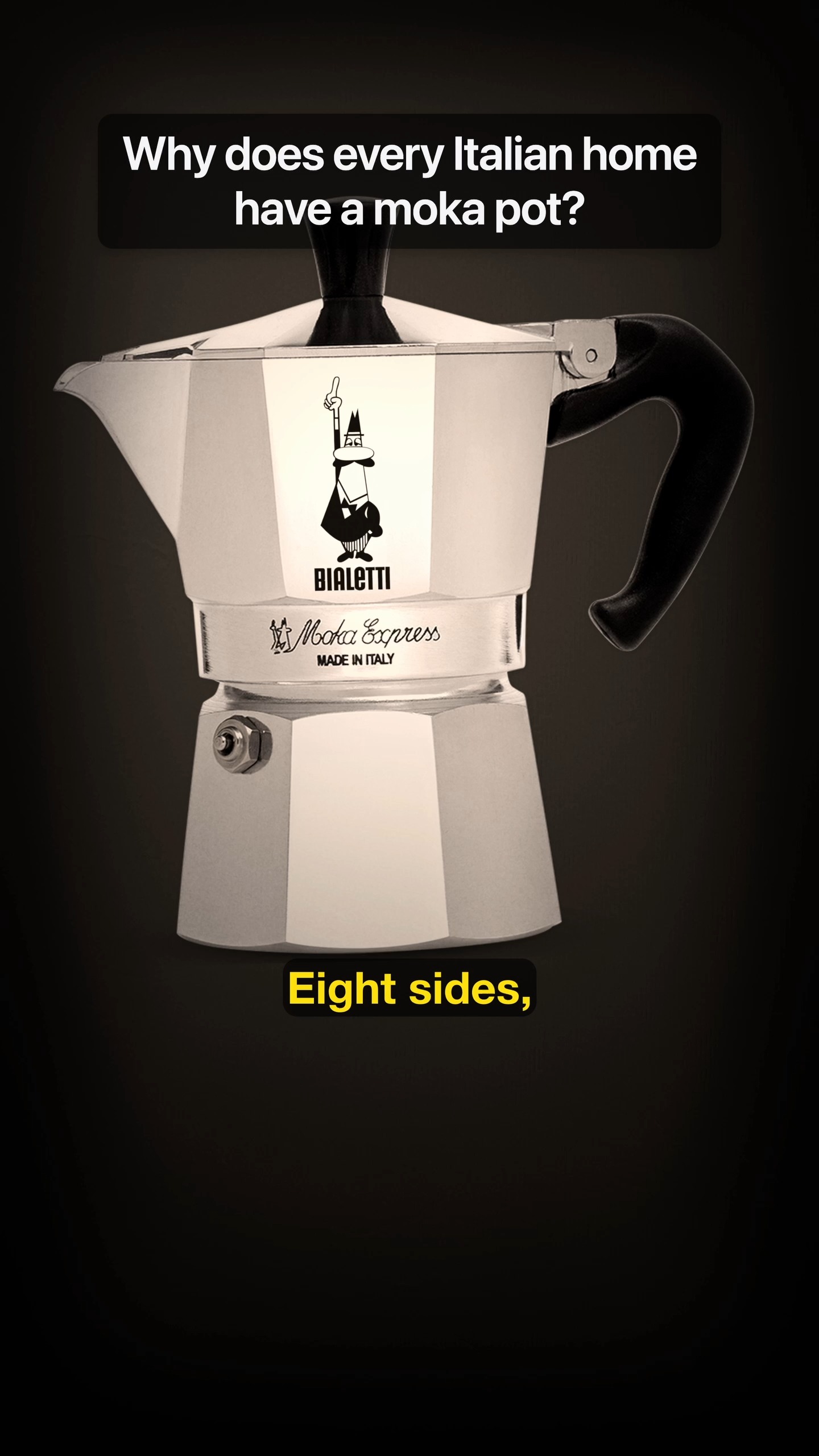
@fineasjackson This pot can’t make real espresso. Italy loves it anyway. Why?

@fineasjackson
Instagram · Talking Head Edit
@fineasjackson This pot can’t make real espresso. Italy loves it anyway. Why?
Performance
Video #50445 · Talking Head Edit
[01]
The creator narrates the historical origin story of the Bialetti Moka pot, explaining how Alfonso Bialetti invented it after being inspired by a washing boiler. He details how WWII impacted the business and family, and how his son Renato later turned the pot into a global icon through clever marketing and branding, cementing it as a cultural staple in Italian homes despite the rise of modern espresso machines.
[02]
[04]
[05]
What stops the scroll in the first 3 seconds
Title hook
Why does every Italian home have a moka pot?
Verbal hook
Look at this coffee pot.
Visual hook
Direct eye contact from the speaker in a cinematic studio setting, immediately cutting to a stylized, high-contrast graphic of a Bialetti Moka pot.
[07]
The promise the opener makes, and how the video pays it back
Hook
Introduce a ubiquitous item, highlight a contradiction between its technical quality and cultural popularity, and pose a central mystery to be solved.
Payoff
Summarize the massive scale of success and deliver a poignant concluding statement that redefines the product's true value as emotional rather than functional.
[08]
The structural pattern this video runs on
Framework
The Cultural Artifact Origin Story
Hooking viewers with a paradox about a famous item, then delivering a high-stakes historical narrative of its invention, near-loss, and ultimate cultural triumph through a clever pivot.
The Problem & Inspiration
Establish the historical context, the limitation of the era, and the unexpected everyday observation that sparked the invention.
The Flawed Launch
Show the initial creation of the product, but introduce a character flaw or limitation that prevents immediate widespread success.
The Existential Crisis
Introduce a massive external conflict that completely halts progress, separates key figures, and forces the literal burial of the idea.
The Emotional Resurrection
Resolve the external crisis with an emotional reunion, leading to the unearthing of the product and a renewed, aggressive commitment to its success.
The Paradigm Shift
Introduce a new external threat (technological advancement) that renders the product's original promise obsolete.
The Marketing Pivot
Detail how the creator leaned into the product's new reality, using innovative branding and marketing to sell an emotion or ritual rather than technical perfection.
This pot can’t make real espresso. Italy loves it anyway. Why?
title · beginning
Why does every Italian home have a moka pot?
contextual · beginning
Alfonso Bialetti 1918
contextual · middle
Moka Express 1933
contextual · middle
Armistice 1943
contextual · middle
Renato Bialetti 20 years old
contextual · end
Lever machine 1948
contextual · end
Renato Bialetti 1953
Good at this coffee pot. Eight sides, thin aluminum, and a little man with a mustache. Ask any coffee snob and they'll tell you it can't make real espresso. And yes, nine out of 10 homes in Italy have one. So how did the country that invented espresso fall in love with it? This is Chasing Beauty episode tier, and today we're looking at the mocha pot. In 1918, a metalworker named Alfonso Billetti came home to Italy after ten years casting aluminum in France and opened a small foundry. Back then, espresso came from big steam machines in cafes. If you wanted it, you had to go out. Alfonso wanted to bring espresso home. But how could you make it small enough for your kitchen counter? His wife, Ada, washed clothes in a big boiler with a pipe up the middle. When the water boiled, it shot up the pipe and rained over the clothes. Alfonso would watch that boiler for hours and it gave him an idea. He made a little pot that worked the same way. On the stove, steam pushes boiling water up through the coffee and out a pipe at the top. In 1933, he called it the Mocha Express and promised cafe espresso at home. But Alfonso was an inventor, not a salesman. He only sold it at local street markets alongside all his other pots and rank. And then the war came. In 1943, Italy broke its alliance with Germany. And overnight, German troops rounded up Italian soldiers. One of them was Alfonso's 20 year old son, Renato. With factories being stripped of metal for the war, Alfonso buried the molds for his pot in a field. So they couldn't take those too. A seal train took Renato to a prison camp in Germany. For two years, his family heard nothing. They thought he was dead. In late nineteen forty five, he finally made it home. He and his father stood stiff, each too proud to hug worst. Then they both broke down. Alfonso couldn't remember where he'd buried the molds. So father and son dug up the whole field together. Pulling those molds from the dirt, Renato saw how much that pot meant to his father. And after losing two years in a camp, he didn't wanna play small anymore. So he made a choice. Drop everything else the workshop made and put his father's pot in kitchens all around the world. And then, cafes changed. In 1948, new lever machines pushed water six times harder, topping espresso with a thick foam. Crema. Overnight, the mocha pot couldn't make real cafe espresso anymore. So Renato sold the ritual of home instead. In 1953, he gave the mocha his own face. A little man with a mustache holding up one finger. He put him on Coricello. The TV ads families watched before bed. Every night, that little man wagged his finger and promised how easy it was to make good coffee at home. His father sold 10,000 a year. Renato's factory was doing 4,000,000. Because it didn't need to be cafe espresso. It cost $20, never broke and made strong coffee on any stove in three minutes. Cafe espresso was for strangers at the bar. The mocha pot was what you put on the stove when someone you loved came home.