Viral Hooks
Trending short videosInvestigative photo essay on Afghanistan war crimes.
N

@nytmag

Instagram · Carousel
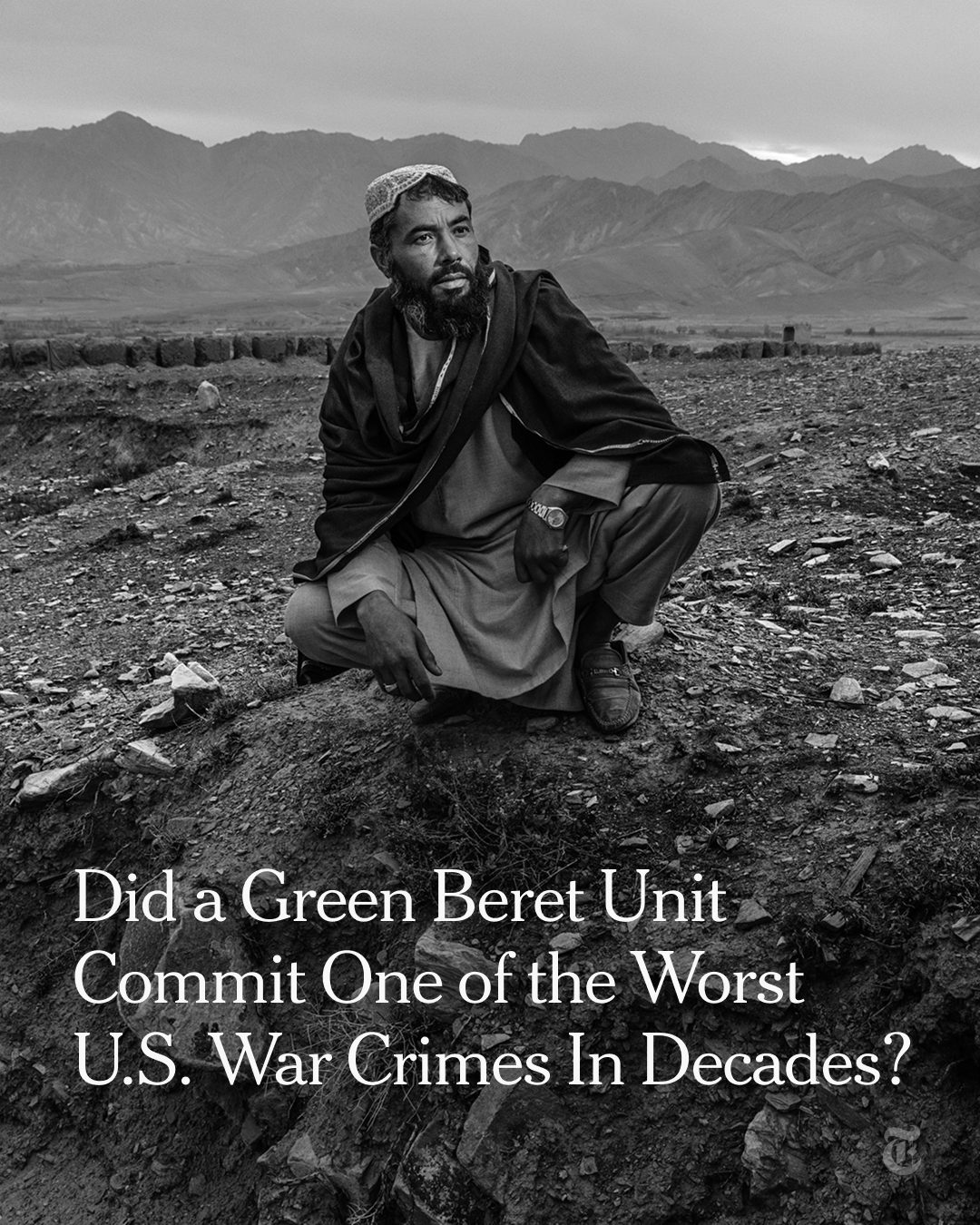
@nytmag Over the course of the war in Afghanistan, Green Berets were celebrated as heroes. But these U.S. Army soldiers were also dogged by accusations of lawless behavior and extrajudicial killings. In Nerkh, a farming district an hour outside of Afghanistan's capital of Kabul, residents accused them of disappearing and executing villagers — a group that became known as the Nerkh Nine. Their remains were found buried outside the former Special Forces base. The U.S. military dismissed the claims as insurgent propaganda; the military insisted that the people of Nerkh were liars. Investigations exonerated the team, whose leaders have denied any wrongdoing. But a trove of previously unreported evidence obtained by the Times suggests that the residents of Nerkh were telling the truth. Get the full story at the link in bio, part of a four-part investigation of the culture of lawlessness in the U.S. Special Forces. Photography by @victorblue.
View original on Instagram

The edit1 shot · 8 text
Shots Text

Performance

Views
447.3K
Likes
29.8K
Comments
677
Engagement
6.8%

Video #8395 · Carousel

Investigative photo essay on Afghanistan war crimes.from @nytmag

[01]

Overview

This is a photojournalistic carousel from The New York Times detailing an investigation into alleged war crimes by a U.S. Green Beret unit in Nerkh, Afghanistan. The series uses powerful black and white portraits of victims' families and atmospheric shots of the location, each accompanied by a text overlay, to build a narrative about the 'Nerkh Nine' and the lasting impact on their community.

[02]

Simple outline

  1. 1Hook with provocative allegation
  2. 2Establish the factual foundation
  3. 3Ground with survivor anecdote
  4. 4Showcase the human toll
  5. 5Drive to full investigation

[03]

Related videos

[04]

Classification

Format
Concepts
Narrative MontageEditorial Carousel
Elements
Text OverlayMood LightingIntimate Close-UpConsistent Visual Theme
Account

[05]

Hook analysis

What stops the scroll in the first 3 seconds

Title hook · 55%

Did a Green Beret Unit Commit One of the Worst U.S. War Crimes In Decades?

Verbal hook · 30%

Over the course of the war in Afghanistan, Green Berets were celebrated as heroes. But these U.S. Army soldiers were also dogged by accusations of lawless behavior and extrajudicial killings.

Visual hook · 15%

The first image presents a striking, high-contrast black and white photograph of a man in traditional attire crouching in a desolate, mountainous landscape. The dramatic lighting, somber mood, and photojournalistic quality immediately signal a serious and compelling story.

[07]

Hook and payoff

The promise the opener makes, and how the video pays it back

Hook

Pose a high-stakes, controversial question on the opening slide that challenges an established narrative or introduces a massive allegation.

Payoff

Conclude the visual sequence on a poignant emotional note, relying on the caption to reveal new evidence and provide a clear call-to-action to consume the full investigation.

[08]

Narrative framework

The structural pattern this video runs on

Framework

The Investigative Photo-Essay Teaser

Hook the reader with a massive, controversial allegation, establish the undeniable facts of the event, and then use a sequence of intimate, humanizing portraits to build emotional weight before driving to a full investigation.

  1. 1

    The Factual Foundation

    Define the scope of the event, detailing the 'who, what, and where' to ground the initial provocative allegation in undeniable reality.

  2. 2

    The Survivor's Contrast

    Introduce a specific micro-story of someone directly involved, contrasting their survival with the loss of others to make the abstract stakes deeply personal.

  3. 3

    The Scene of the Crime

    Establish the physical location of the event, showing what it looks like in the present day to bridge the past and present.

  4. 4

    The Living Artifacts

    Deploy a rapid succession of slides featuring the faces and brief descriptions of the people left behind (family members, children), shifting the focus from the historical event itself to its lasting generational impact.

Themes

  • Injustice
  • Grief
  • War
  • Accountability
  • Memory

Techniques

  • Photojournalism
  • Portrait Photography
  • Environmental Portraiture
  • Black and White Photography

Post caption

Over the course of the war in Afghanistan, Green Berets were celebrated as heroes. But these U.S. Army soldiers were also dogged by accusations of lawless behavior and extrajudicial killings. In Nerkh, a farming district an hour outside of Afghanistan's capital of Kabul, residents accused them of disappearing and executing villagers — a group that became known as the Nerkh Nine. Their remains were found buried outside the former Special Forces base. The U.S. military dismissed the claims as insurgent propaganda; the military insisted that the people of Nerkh were liars. Investigations exonerated the team, whose leaders have denied any wrongdoing. But a trove of previously unreported evidence obtained by the Times suggests that the residents of Nerkh were telling the truth. Get the full story at the link in bio, part of a four-part investigation of the culture of lawlessness in the U.S. Special Forces. Photography by @victorblue.
Text overlays

  • title · photo_0

    Did a Green Beret Unit Commit One of the Worst U.S. War Crimes In Decades?

  • contextual · photo_1

    In 2012, at least nine Afghan men detained by U.S. Special Forces disappeared. Their remains were later found buried near the American base in Nerkh, and they victims became known as the Nerkh Nine.

  • contextual · photo_2

    Hikmatullah was taken to a military base occupied by U.S. and Afghan forces and later released. Two of his brothers were taken to the American side and never seen alive again.

  • contextual · photo_3

    In 2022, Taliban fighters seized Nerkh's district center. Across the road stood the former Special Forces base where the Nerkh Nine had been held.

  • contextual · photo_4

    Husna is the daughter of Sidiquillah, one of the Nerkh Nine victims.

  • contextual · photo_5

    Ahmadshah beside the grave of his his brother, Mohammad Qasim, a Taliban fighter who was killed after being detained by U.S. Special Forces in 2012.

  • contextual · photo_6

    Sulaiman is Mohammad Qasim's son.

  • contextual · photo_7

    Nagina and Asma, daughters of Mehrab Khan, one of the Nerkh Nine victims.