Viral Hooks
Trending short videosInvestigative news carousel about airborne bird flu
P

@propublica

Instagram · Carousel

@propublica After a bird flu outbreak tore through Midwestern barns, killing hens and spiking egg prices, the USDA didn’t investigate whether the virus was airborne. ProPublica did. Experts say our analysis offers a plausible explanation for how the wind could have helped spread the virus. To combat bird flu spread, other countries have authorized poultry vaccines, but the U.S. has held off amid political and economic opposition. 🔗 Tap the link in our bio to read the full story. 📸: Maddie McGarvey for ProPublica 📊: Chris Alcantara/ProPublica

View original on Instagram

The edit1 shot · 12 text
Shots Text

Performance

Views
325.8K
Likes
21.7K
Comments
404
Engagement
6.8%
Outlier
3.4×

Video #10185 · Carousel

Investigative news carousel about airborne bird flufrom @propublica

[01]

Overview

A ProPublica investigation revealing how bird flu likely spread via wind from a single farm to dozens of others, challenging the USDA's refusal to acknowledge airborne transmission or approve vaccines.

[02]

Simple outline

  1. 1Hook with systemic failure
  2. 2Expose the knowledge gap
  3. 3Reveal the core discovery
  4. 4Walk through data evidence
  5. 5Escalate the human stakes
  6. 6Close with accountability

[03]

Related videos

[04]

Classification

Format
Concepts
Case Study BreakdownNews Carousel
Elements
Text OverlayData Visualization GraphicAnnotation Overlay
Account

[05]

Hook analysis

What stops the scroll in the first 3 seconds

Title hook · 55%

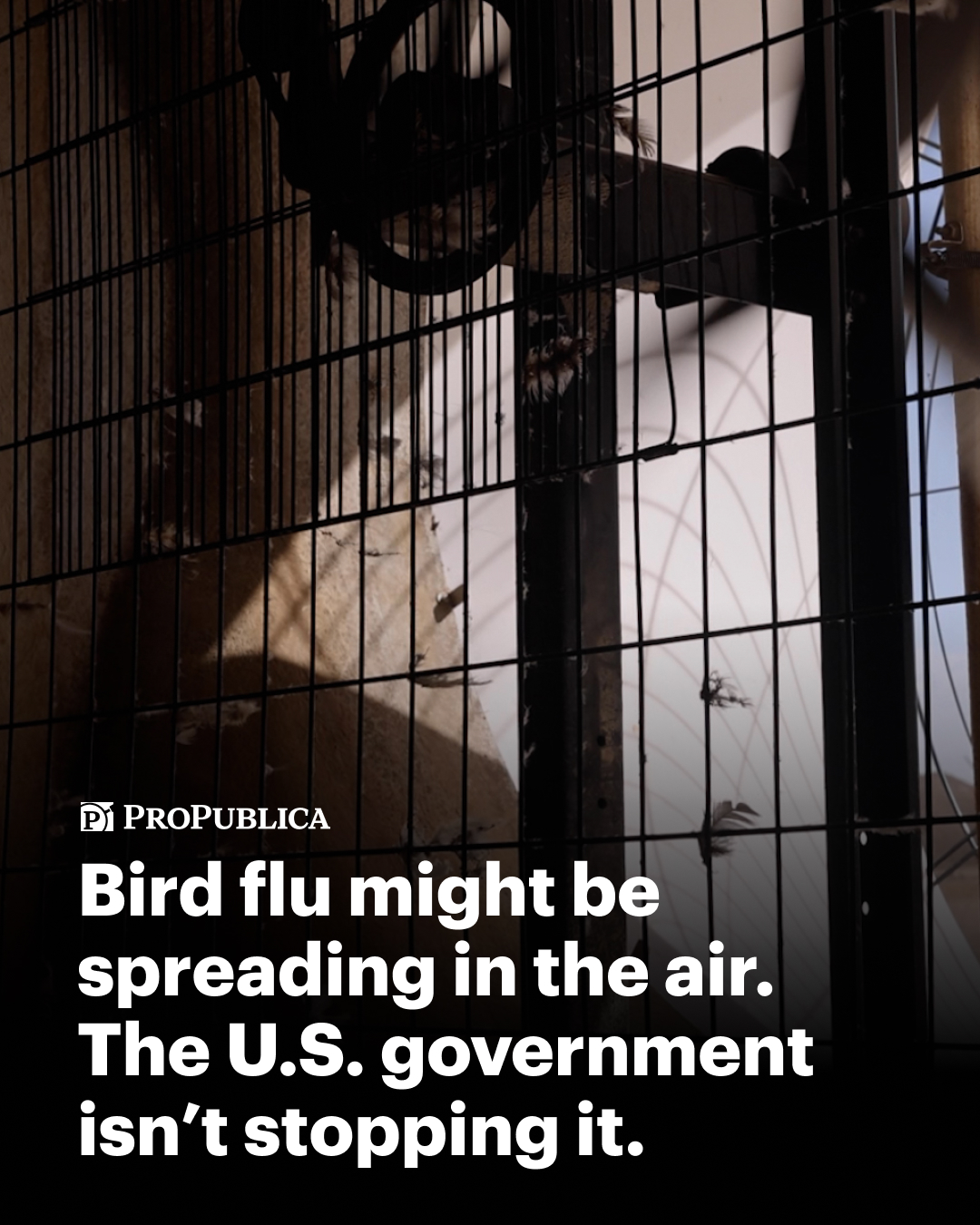
Bird flu might be spreading in the air. The U.S. government isn't stopping it.

Verbal hook · 30%

After a bird flu outbreak tore through Midwestern barns, killing hens and spiking egg prices, the USDA didn’t investigate whether the virus was airborne.

Visual hook · 15%

Dark, moody close-up of a farm ventilation fan with feathers caught in the grate, creating an immediate sense of contamination and foreboding.

[07]

Hook and payoff

The promise the opener makes, and how the video pays it back

Hook

Present a terrifying possibility or bold claim paired immediately with an institutional failure to address it.

Payoff

Present the official response (or lack thereof) to the findings to highlight accountability, followed by a clear CTA to consume the full investigation.

[08]

Narrative framework

The structural pattern this video runs on

Framework

The Investigative Exposé Arc

Hook the reader with a systemic failure, establish an investigative gap, walk through undeniable data-backed evidence step-by-step, escalate the stakes to a human level, and end with institutional accountability.

  1. 1

    The Context & The Gap

    Establish the scale of the problem, outline the flawed official narrative, and introduce the creator/investigator stepping in to find the truth.

  2. 2

    The Visceral Anchor

    Provide a stark visual representation of the problem's consequences to ground the abstract data in reality.

  3. 3

    The Credibility Flex

    Detail the rigorous methodology and diverse data sources used to uncover the truth, building absolute trust with the reader.

  4. 4

    The Ground Zero

    Pinpoint the exact origin of the issue, presenting the 'smoking gun' discovery that anchors the investigation.

  5. 5

    The Data Walkthrough

    Use a sequence of slides to visually and chronologically map the spread or escalation of the problem, proving the initial hypothesis with undeniable metrics.

  6. 6

    The Ultimate Stakes

    Pivot from the specific case study to the catastrophic broader implications if the issue remains unsolved, introducing a severe human threat.

Themes

  • Government accountability
  • Public safety
  • Environmental impact
  • Corporate responsibility

Techniques

  • Data mapping
  • Wind simulation visualization
  • Satellite imagery analysis
  • Investigative reporting

Trends

  • Visual journalism
  • Data storytelling
  • Explainer carousels

Post caption

After a bird flu outbreak tore through Midwestern barns, killing hens and spiking egg prices, the USDA didn’t investigate whether the virus was airborne. ProPublica did. Experts say our analysis offers a plausible explanation for how the wind could have helped spread the virus. To combat bird flu spread, other countries have authorized poultry vaccines, but the U.S. has held off amid political and economic opposition. 🔗 Tap the link in our bio to read the full story. 📸: Maddie McGarvey for ProPublica 📊: Chris Alcantara/ProPublica

Text overlays

  • title · photo_0

    ProPublica Bird flu might be spreading in the air. The U.S. government isn't stopping it.

  • informational · photo_1

    Earlier this year, a bird flu outbreak that began at a single Ohio farm spread to flocks with over 18 million hens, leaving them all dead. The USDA is convinced that bird flu can be curbed if farmers adopt safety practices: Sealing holes in barns and ensuring they don't track droppings on their shoes. But that playbook doesn't work if the virus is airborne, as industry leaders suspect. They've begged officials to deploy a vaccine for poultry. But the USDA hasn't done that or explored their theory. So ProPublica did.

  • contextual · photo_2

    Rows of buried chickens outside a poultry farm in Fort Recovery, Ohio, in May

  • informational · photo_3

    To trace how the virus rippled through more than 80 farms in Ohio and Indiana, we analyzed data on the genetics of the virus, satellite imagery, wind simulations, property records and trade notices. We also consulted with researchers whose peer-reviewed work previously found that the virus can spread on floating feathers and particles of dust.

  • contextual · photo_4

    Howe's Hens 500 feet

  • informational · photo_5

    We found that virus samples taken from outbreak sites shared a unique genetic signature. Their ancestry is traced back to one source in western Ohio: Howe's Hens.

  • informational · photo_6

    INDIANA OHIO Howe's Hens Our analysis found that over 200 farms raising chickens or turkeys were in the surrounding 12-mile radius, the ring that USDA establishes around an outbreak to look for where else the virus may have spread.

  • informational · photo_7

    INDIANA OHIO Howe's Hens The virus raged at Howe's Hens from at least Dec. 22 to Dec. 31, when all the birds on the farm had been killed. Using weather data from that period, we simulated where dust from the site could have blown.

  • informational · photo_8

    INDIANA OHIO Where the wind blew, the virus followed. Within three weeks, poultry tested positive at 17 farms, all but one within the plume. Farms downwind from Howe's Hens were about 20 times as likely to see outbreaks.

  • informational · photo_9

    INDIANA OHIO The virus continued to spread. By mid-March, it had hit 83 farms across six counties and two states, leaving over 20 million chickens dead, most no further than 15 miles from the first infected farm.

  • informational · photo_10

    To combat bird flu spread, other countries have authorized poultry vaccines. But the U.S. has held off amid political and economic opposition. Without a vaccine, experts say the virus poses an escalating threat. If a person catches bird flu while infected with a seasonal flu, the pathogens could mutate into a variant that infects large numbers of people. "The minute it transmits in humans, it's done," one expert said.

  • informational · photo_11

    Howe's Hens did not respond to a request for comment. A USDA spokesperson said it was "conjecture" to say vaccination would offer flocks better protection from airborne spread than its current strategy, which "remains rooted in real-time data, internationally recognized best practices and a commitment to transparency and continuous improvement." The agency told ProPublica it has made no decision on whether to vaccinate hens and has no timeline on when it might announce one — though it is "proactively assessing" the possibility. READ THE FULL STORY AT PROPUBLICA.ORG.

Investigative news carousel about airborne bird flu | Viral Hooks