Video #17213 · Speaker address
Using physics to describe feelingsfrom @chels.mov
The creator, an artist-scientist, explains her unique method of understanding emotions by applying physics principles. She uses 'fear' as an example, visually representing it as an animated character and describing its physical sensation as being like water, which she connects to Bernoulli's equation. She concludes with a call-to-action, inviting viewers to follow her interdisciplinary adventures.
- 1State a unique perspective
- 2Ground with a concrete example
- 3Explain via surprising analogy
- 4Validate with technical proof
ConceptsAnalogical Definition
ElementsGraphic OverlayImage Overlay
[05]
Hook analysis
What stops the scroll in the first 3 seconds
Title hook · 45%
The Physics of My Emotions
Verbal hook · 35%
One of my favorite parts about being an artist and a scientist is using physics to describe my emotions.
Visual hook · 20%
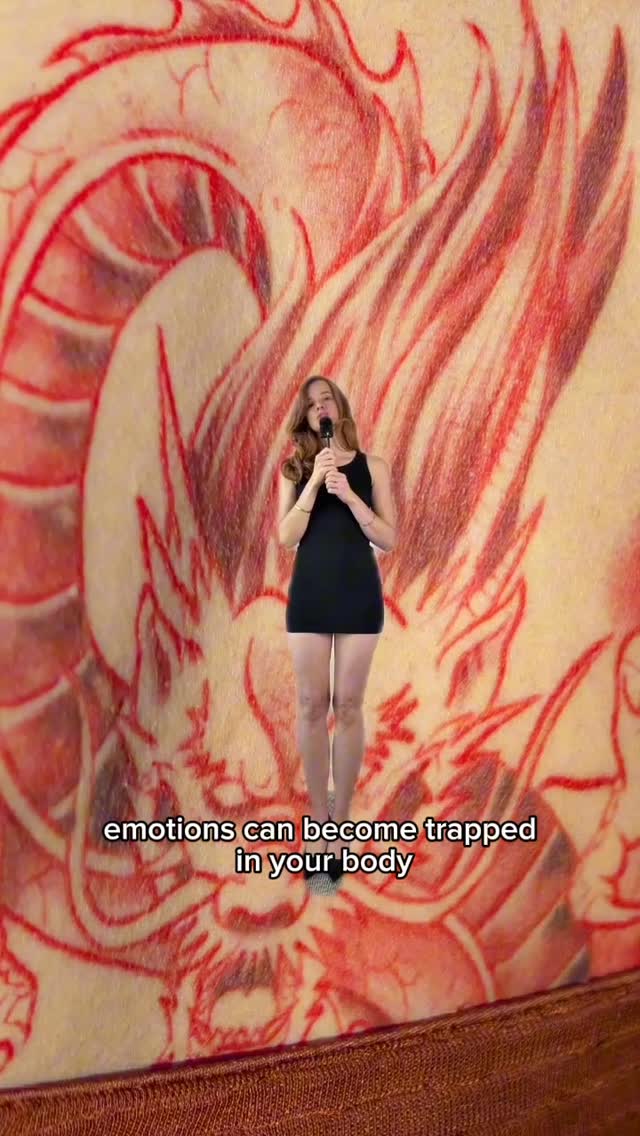
A woman sits on the floor holding a small, fluffy microphone on a stick, with colorful, animated doodles floating around her head, creating an unusual and visually engaging scene.
[07]
Hook and payoff
The promise the opener makes, and how the video pays it back
Hook
Introduce a novel, hybrid identity ('artist-scientist') and a paradoxical concept ('The Physics of My Emotions') that combines two unrelated fields, creating an immediate curiosity gap.
Payoff
A concluding statement that summarizes the unique perspective and includes a direct call to action, inviting the audience to explore more of this novel worldview.
[08]
Narrative framework
The structural pattern this video runs on
Framework
The Analogy Bridge
Fusing two disparate fields (e.g., art and science, cooking and architecture) to explain a common concept in a novel way, thereby establishing unique authority and creating an intellectual payoff for the viewer.
- 1
The Identity Premise
The creator states their unique, blended identity and introduces the core thesis: applying the lens of one specialized field to a universal human experience.
- 2
The Tangible Subject
A common, relatable concept (an emotion) is chosen as the subject for analysis and is given a simple, visual representation to make it concrete.
- 3
The Unconventional Analogy
The core of the video, where the creator links the tangible subject to a surprising principle from their secondary field of expertise (emotion as water physics).
- 4
The Sensory Justification
The creator describes the subjective, felt experience of the subject in a way that makes the unconventional analogy feel intuitive and relatable ('watery emotion that overwhelms').
- 5
The Technical Anchor
A specific, technical term, formula, or diagram from the secondary field is presented as evidence, lending credibility and intellectual weight to the analogy without requiring deep explanation.
Themes
- Self-expression
- Creativity
- Interdisciplinary thinking
- Emotional intelligence
Techniques
- Animated overlays
- Direct-to-camera address
- Analogical reasoning
Trends
- Educational content
- Personal storytelling
- STEM communication
Post caption
The physics of fear
#phd #stem #hopecore #emotion #emotional #science #motivation #deardiary #animation #sketchbook #psychology #mindset #philosophy #selflove #art #artist #sciencefun #artistscientist
Text overlays
Transcript
One of my favorite parts about being an artist and a scientist is using physics to describe my emotions. For instance, I have fear here, and I modeled it after a black cat. And I think fear takes on the physics of water. Whenever I'm afraid, I feel this watery emotion that overwhelms my brain and my chest, and it just fills every corner of my mind. And I would use Bernoulli's equation to define fear. Yeah. Those are my emotions. Follow for more of my adventures as both an artist and a sign.