Viral Hooks
Trending short videosGreenscreen DJ industry monopoly breakdown
M

@maxxrosenblum

Instagram · Greenscreen Talking Head

@maxxrosenblum Comment SMARTER and I’ll send you the full deep dive with every source Every club you’ve ever been to has the same setup in the booth. Ibiza. Berlin. Tokyo. Brooklyn. That basement spot your friend swears is underground. Doesn’t matter. Same brand. Same gear. Same Japanese corporation you’ve never heard of that recently renamed itself after brain waves. They own roughly 70% of the global DJ equipment market. In professional club installations that number is basically 100%. They own the most used DJ software. They tried to buy the second most used DJ software too — and regulators in New Zealand and the UK both blocked it because it would’ve given them 90% of all DJ software on earth. Meanwhile house music just had its biggest year in decades. Afro house grew 778% in a single year. Fred again is selling out stadiums. Everyone suddenly cares about dance music. But the venues that are supposed to deliver this culture to all these new fans are closing at a record pace. The UK’s late night economy is down 28% since 2020. And one of the non-negotiable costs of opening a club is a five-figure equipment purchase from essentially one supplier. It’s not evil. It’s a market too small for real competition locked in by network effects that have been compounding for 25 years. But it’s the kind of thing worth understanding if you’ve ever paid a cover charge or closed your eyes on a dance floor at 2am. #economics #musicbusiness #djing #housemusic

View original on Instagram

The edit1 shot · 11 text
Shots Text2:38

Performance

Views
276.7K
Likes
16.8K
Comments
840
Engagement
6.4%
Outlier
67.3×
Length · 21 Mar 2026
2:38

Video #21964 · Greenscreen Talking Head

Greenscreen DJ industry monopoly breakdownfrom @maxxrosenblum

[01]

Overview

The creator delivers a comprehensive greenscreen breakdown of how AlphaTheta (formerly Pioneer DJ) established a near-100% monopoly on global nightclub DJ equipment and software. He explains the history of their market dominance, the network effects that lock out competitors, and how the massive cost of this mandatory hardware is contributing to the rapid closure of nightlife venues despite the booming popularity of house music, ending with a call-to-action for viewers to comment for a deeper dive.

[02]

Simple outline

  1. 1State hidden industry monopoly
  2. 2Explain historical network effect
  3. 3Show failed competitor buyout
  4. 4Reveal real-world consequences
  5. 5Call to action

[03]

Related videos

[04]

Classification

Concepts
BreakdownCase Study Breakdown
Elements
Data Visualization GraphicDM / Comment-for-Info CTADynamic Word-by-Word CaptionsImage Overlay

[05]

Hook analysis

What stops the scroll in the first 3 seconds

Title hook · 45%

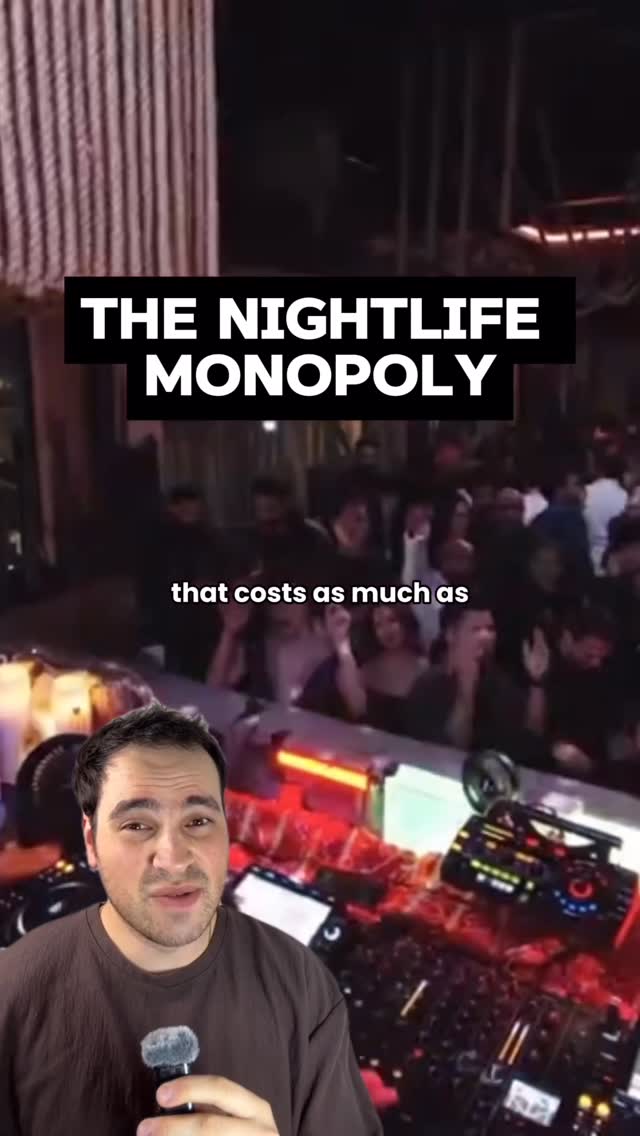
THE NIGHTLIFE MONOPOLY

Verbal hook · 50%

Every time you walk into a club, there's a setup in front of the DJ that costs as much as a down payment, and there's basically one Japanese company on Earth that makes it.

Visual hook · 5%

Greenscreen talking head of the creator pointing upward at a large, bold text graphic reading 'THE NIGHTLIFE MONOPOLY' overlaid on background footage of a crowded, neon-lit nightclub.

[06]

Hook template

Steal this for your own video

Every time you walk into a [popular venue or event], there's a [expensive hidden item] that costs as much as [relatable big purchase], and almost nobody knows [surprising monopoly fact] behind it.

  • — Every time you walk into a movie theater, there's a projection system that costs as much as a house, and almost nobody knows one company controls nearly every screen on Earth.
  • — Every time you walk into a casino, there's a software system running every slot machine that costs as much as a luxury car fleet, and almost nobody knows one company licenses it all.
  • — Every time you walk into a hospital emergency room, there's a patient monitoring setup that costs as much as a college education, and almost nobody knows a single company supplies most of the Western world.

[07]

Hook and payoff

The promise the opener makes, and how the video pays it back

Hook

Reveal a massive, hidden monopoly behind a relatable everyday experience.

Payoff

Question the status quo and offer a lead-magnet CTA for deeper engagement.

[08]

Narrative framework

The structural pattern this video runs on

Framework

The Hidden Monopoly Exposé

Expose a hidden corporate monopoly controlling a popular cultural niche, explaining its mechanics and real-world consequences.

  1. 1

    The Trend Context

    Establish current cultural relevance to justify the topic's importance.

  2. 2

    The Origin Story

    Explain the historical catalyst and smart strategy that created the monopoly.

  3. 3

    The Flywheel Effect

    Break down the self-sustaining network effect preventing competition.

  4. 4

    The Failed Coup

    Detail a recent high-stakes corporate move that threatened the market.

  5. 5

    The Real-World Stakes

    Connect corporate dominance to tangible negative outcomes for the culture.

Themes

  • Corporate monopolies
  • Creator economy infrastructure
  • Nightlife industry struggles
  • Network effects

Techniques

  • Greenscreen background replacement
  • Dynamic word-by-word captions
  • Data visualization
  • Comment-to-DM funnel

Trends

  • Educational deep dives
  • Comment-for-info automation
  • Business strategy breakdowns

Post caption

Comment SMARTER and I’ll send you the full deep dive with every source Every club you’ve ever been to has the same setup in the booth. Ibiza. Berlin. Tokyo. Brooklyn. That basement spot your friend swears is underground. Doesn’t matter. Same brand. Same gear. Same Japanese corporation you’ve never heard of that recently renamed itself after brain waves. They own roughly 70% of the global DJ equipment market. In professional club installations that number is basically 100%. They own the most used DJ software. They tried to buy the second most used DJ software too — and regulators in New Zealand and the UK both blocked it because it would’ve given them 90% of all DJ software on earth. Meanwhile house music just had its biggest year in decades. Afro house grew 778% in a single year. Fred again is selling out stadiums. Everyone suddenly cares about dance music. But the venues that are supposed to deliver this culture to all these new fans are closing at a record pace. The UK’s late night economy is down 28% since 2020. And one of the non-negotiable costs of opening a club is a five-figure equipment purchase from essentially one supplier. It’s not evil. It’s a market too small for real competition locked in by network effects that have been compounding for 25 years. But it’s the kind of thing worth understanding if you’ve ever paid a cover charge or closed your eyes on a dance floor at 2am. #economics #musicbusiness #djing #housemusic

Text overlays

  • title · beginning

    THE NIGHTLIFE MONOPOLY

  • informational · beginning

    Afro House grew 778% in a single year

  • branding · beginning

    that company is Alpha Theta formerly Pioneer DJ

  • informational · middle

    who roughly owns 70% of the DJ equipment market

  • informational · middle

    and in professional club installations that number is basically 100%

  • contextual · middle

    two to four CDJ 3000s and a DJM A9 mixer

  • informational · middle

    the rig that cost over $10,000

  • contextual · middle

    AlphaTheta tried to buy Serato

  • informational · middle

    which is 90% of all DJ software on earth

  • informational · end

    the UK's late night economy has dropped 28% since 2020

  • call-to-action · end

    comment smarter if you want this whole deep dive

Transcript

Tier you walk into a club, there's a better in front of the DJ that costs as much as a down payment, and there's basically one Japanese company on Earth that makes it. You see, worse music just became the second most downloaded genre in the world. Fred again is selling out stadiums. Avra Worse grew tier% in a single year. But nobody's talking about the fact that the entire global nightlife economy runs on one company's hardware. That company is Alpha Theta, formerly Pioneer DJ, who roughly owns 70% of the DJ equipment market. And in professional club installations, that number is basically a 100%. In fact, should you find your way into any booth, Nabeza, Berlin, Tokyo, Brooklyn, doesn't better, you're going to see the same better. Two to four CDJ three thousands and a DJM A9 mixer, the rig that worst over $10,000 and every serious venue on earth has one. But how did one company lock down an entire culture? The year is 2001 and Pioneer drops the CDJ 1,000. It had a touch sensitive better that felt like vinyl, hot cues, and a layout close enough to the Technics turntables DJs already knew. And Pioneer did something smart. They got their gear into the key clubs early, and then the loop started. That loop now is that venues buy Pioneer gear because that's that's what headlining DJs demand on their better. Aspiring DJs learn on Pioneer gear because that's what's in clubs. And when those DJs become headliners, they put Pioneer on their own rider. And then there's Rekordbox, the software every professional DJ builds their library in, and playlists that export to a USB stick that only works on proper Pioneer hardware. Your whole career lives inside their ecosystem. And it's not that competitors don't exist. Denon makes players with better screens, Wi Fi, dual layer playback, often at a lower price, stuck in the classic chicken and egg problem. Clubs won't buy it because DJs won't request best, and DJs won't request it because clubs don't have it. This is where it gets wild because in 2023, Alpha Better tried to buy Serato, the other major DJ software. If the deal went through, they'd own Rekordbox and Serato together, which is 90% of all DJ software on Earth. But regulators in New Zealand and The UK both said no. So the deal died, but Serato's founders still wanted to sell, and a Canadian investment firm called Tiny bought 66% of Serato at nearly triple the price Alpha Theta offered. But why this should matter to you is because clubs are closing at record pace. In fact, The UK's late night economy has dropped 28% since tier. Venues are getting squeezed on every margin, and one of the nonnegotiables of opening a club is a 5 figure equipment purchase from essentially one supplier. The biggest wave of new fans in house music is arriving right now, and the venues that are supposed to catch them are drowning in worst partly because of the tools of the trade are a monopoly. It's not evil. It's a market too small for real competition locked in by network effects, and nobody's even asking the question about what if if DJ libraries were interoperable across hardware, like how the EU forced USB C? What if better culture changed? What if recruitment was leased, not bought? Because millions of people just discovered they love this music, and the infrastructure that delivers it to them is owned by one company they've never heard of. Anyway, keep screaming that new thread again, and comment smarter if you want this whole deep dive.

Greenscreen DJ industry monopoly breakdown | Viral Hooks