@swaggylaggygolfdaddy
Instagram · Prop Yap

@swaggylaggygolfdaddy what a choice in title too!

@swaggylaggygolfdaddy
Instagram · Prop Yap
@swaggylaggygolfdaddy what a choice in title too!
Performance
Video #30743 · Prop Yap
[01]
The creator stands on a golf course and recounts the story of an 1898 novella that seemingly predicted the sinking of the Titanic, detailing the specific parallels. She then pivots into a broader commentary on conspiracy theories, suggesting such events are 'programmed' to instill fear and distract from larger issues, before abruptly changing the subject to her golf driver.
[02]
[03]
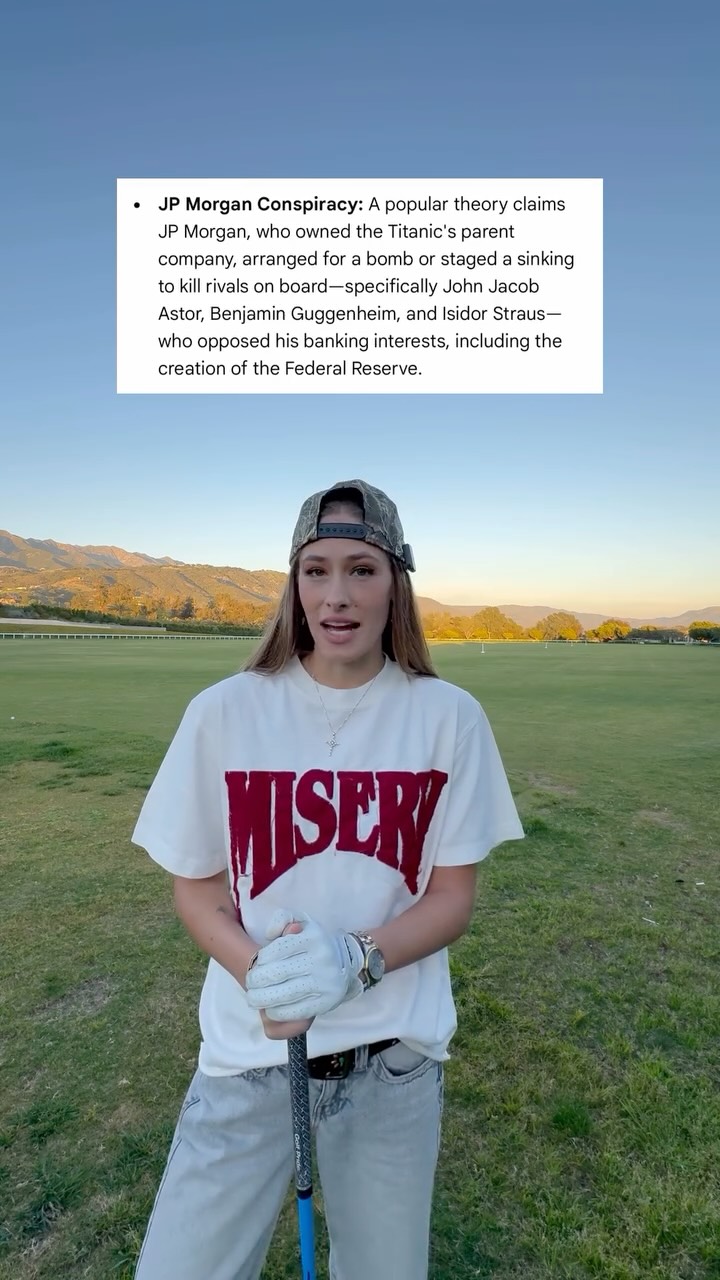 4.9M5.6×Casual yap about historical conspiracy@swaggylaggygolfdaddy · Breakdown
 2.9M5.8×Casual golf course conspiracy breakdown@swaggylaggygolfdaddy · Breakdown
 1.4M3.5×Explaining conspiracy theory while golfing@swaggylaggygolfdaddy
 1.9M4.6×Conspiracy theory with sarcastic pivot@swaggylaggygolfdaddy · Conspiracy Breakdown
 9.1M23.9×Conspiracy theory explained on golf course@swaggylaggygolfdaddy · Conspiracy Breakdown
 10.3M22.8×Conspiracy theory rant during golf@swaggylaggygolfdaddy · Breakdown
 8M20×Conspiracy theory then golf swing@swaggylaggygolfdaddy · Pope In The Pool Multitask
 2.1M2.1×Golfing while sharing random conspiracies@swaggylaggygolfdaddy · Pope In The Pool Multitask
 2.7M5.6×Golf course conspiracy theory breakdown@swaggylaggygolfdaddy · Breakdown
 7.5M11.2×Golfing while explaining conspiracy theory@swaggylaggygolfdaddy · Breakdown
 11.5M41.2×Explain conspiracy while playing golf@swaggylaggygolfdaddy · Headlines
 4.9M7×Golfing while explaining celebrity conspiracy@swaggylaggygolfdaddy · Pope In The Pool Multitask
[04]
[05]
What stops the scroll in the first 3 seconds
Verbal hook · 85%
Fourteen years before the Titanic sank, there was a man named Morgan Robertson who wrote a book called Futility...
Visual hook · 15%
A woman stands on a sunny, green golf course holding a golf club, creating a visual contrast with the serious historical topic she is discussing.
[06]
Steal this for your own video
years before , someone that nobody talks about.
[07]
The promise the opener makes, and how the video pays it back
Hook
An intriguing historical premise that creates a knowledge gap by connecting a well-known event to an unknown precursor, promising a surprising revelation.
Payoff
An abrupt and disarming pattern interrupt. The creator suddenly shifts to a mundane, unrelated topic or action, breaking the narrative tension and leaving the viewer to contemplate the grand theory without a formal conclusion.
[08]
The structural pattern this video runs on
Framework
The Conspiracy Pivot
Presenting a series of uncanny historical parallels to build credibility for a larger, unrelated conspiracy theory, then abruptly breaking the narrative tension with a non-sequitur.
The Fictional Premise
Detail a fictional work or event that serves as the basis for comparison, establishing the core elements of the 'prediction'.
The Uncanny Parallel Stack
Rapidly list multiple, highly specific points of similarity between the fictional premise and a real-world event, escalating the viewer's sense of disbelief and intrigue.
The Real-World Confirmation
Explicitly state that the real-world event mirrors the fictional one, confirming the parallels just listed and solidifying the core claim.
The Final Corroboration
Present one last, conclusive piece of evidence that solidifies the connection, making the coincidence seem undeniable.
The Interpretive Leap
Transition from presenting facts to offering a subjective interpretation, suggesting these parallels are not a coincidence but part of a larger, intentional pattern.
The Grand Theory Reveal
State the ultimate thesis or conspiracy, connecting the specific example to a much larger, systemic manipulation or hidden agenda that the initial story was designed to distract from.
what a choice in title too!
informational · beginning
The Precise Parallels in Futility In Morgan Robertson's novella, the fictional ocean liner is explicitly named the Titan. The narrative mirrors the real-world disaster with striking precision, stating that the ship struck an iceberg on its starboard side near midnight during the month of April while traversing the Atlantic Ocean.
informational · beginning
Just like its fictional counterpart, the Titanic struck an iceberg on its starboard side near midnight on April 14, 1912, while crossing the Atlantic Ocean, leading to its tragic sinking a few hours later.
informational · middle
In both the fictional account of the Titan and the real-world tragedy of the Titanic, a critical shortage of lifeboats directly led to a catastrophic loss of life that disproportionately impacted third-class passengers.
Fourteen years before the Titanic sank, there was a man named Morgan Robertson who wrote a book called Futility, which focused on an ocean liner named the Titan that hits an iceberg in the Atlantic Ocean on the starboard side at midnight and in April. And, in real life, the Titanic is struck on the starboard side by an iceberg in the Atlantic Ocean at midnight in April, and both stories have the fact that there weren't enough lifeboats to save everyone. I find that just really interesting because I feel like everything, every major event that has prompted fear in our minds. Like, I know people that they've all been predicted. Like, they've or predicted or it's just like this weird programming, but I know people who won't go on cruises cruises because of the Titanic. Like, that's just so far like, that's what they want your attention to be focused on better than the fact that this event led to the entirety of tier event led to the entirety of the American, financial system. Better, anyways, this is my driver, and I've literally have always been