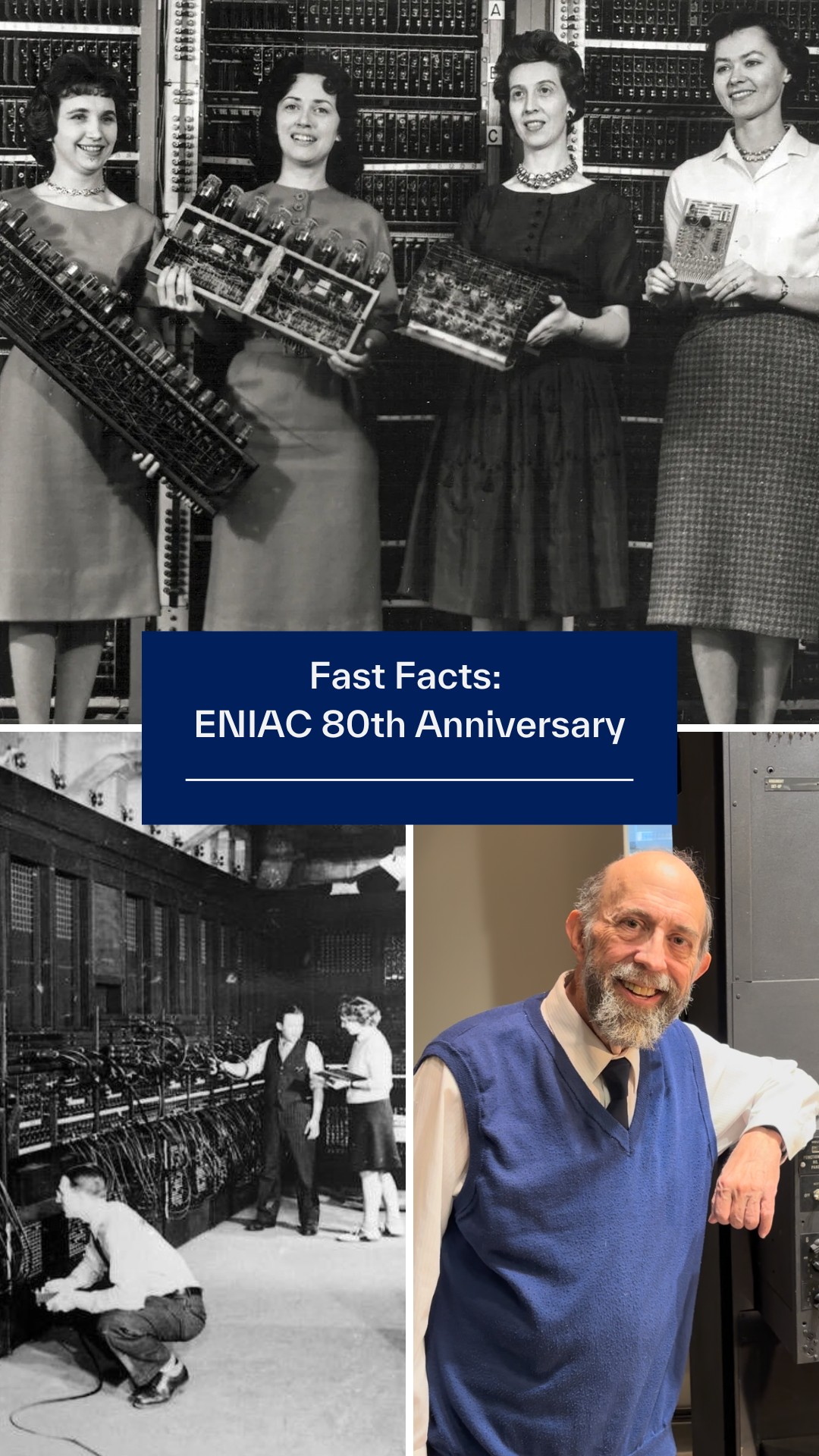
@pennengineering Today marks the 80th anniversary of ENIAC, the first programmable, electronic, general-purpose computer. This feat of engineering ushered in a new era of technology, faster and more powerful than anything before.
In this video, Penn Engineering's Paul Shaffer shares fast facts about ENIAC and reflects on eight decades of technological change.
Happy 80th anniversary, ENIAC!
Expert shares four historical factsfrom @pennengineering
[01]
Overview
An expert introduces himself and the ENIAC computer, then presents four distinct facts about its history and function. He covers its status as the first general-purpose computer, its female programming team, a unique story about its wiring, and the technological leap it represented, concluding with a celebratory message for its 80th anniversary.
A man stands in front of a large, vintage, room-sized computer with numerous dials and panels, creating immediate visual curiosity about the historical technology.
[06]
Hook template
Steal this for your own video
Stand beside a massive, historically significant [landmark object] to introduce [number] fast facts about [topic].
— Stand beside a towering Saturn V rocket to introduce 4 fast facts about the moon landing.
— Stand beside a giant blue whale skeleton to introduce 3 fast facts about ocean evolution.
— Stand beside an original printing press to introduce 5 fast facts about the history of books.
[07]
Hook and payoff
The promise the opener makes, and how the video pays it back
Hook
An expert introduces themselves, the subject, and explicitly states the video's format (e.g., 'Here are X facts about...'), establishing credibility and setting clear viewer expectations.
Payoff
The expert delivers a concluding statement that summarizes the subject's importance and provides a sense of closure, often with a call to appreciate or celebrate the subject.
[08]
Narrative framework
The structural pattern this video runs on
Framework
The Expert's Fast Facts
An authority figure presents a curated list of 3-5 surprising or impactful facts about a specific subject, moving from foundational information to a climactic 'wow' moment.
1
The Foundational Fact
Establishes the core identity and definition of the subject, providing essential context for the viewer.
2
The Human Interest Fact
Introduces a surprising or relatable human element connected to the subject, creating an emotional or historical connection.
3
The Quirky Anecdote
Presents an unexpected, memorable, and often humorous detail that makes the subject more interesting and shareable.
4
The Impact Quantifier
Delivers a powerful, easily understandable statistic or comparison that demonstrates the subject's scale, power, or significance, serving as the list's climax.
Themes
History of technology
Innovation
Pioneering women in STEM
Techniques
Expert commentary
Archival footage integration
Post caption
Today marks the 80th anniversary of ENIAC, the first programmable, electronic, general-purpose computer. This feat of engineering ushered in a new era of technology, faster and more powerful than anything before.
In this video, Penn Engineering's Paul Shaffer shares fast facts about ENIAC and reflects on eight decades of technological change.
Happy 80th anniversary, ENIAC!
Text overlays
contextual · middle
Video by Federico Mademo from Pixabay
branding · end
Penn Engineering
UNIVERSITY of PENNSYLVANIA
Transcript
Hi. I'm Paul Schaeffer. I'm here at the University of Pennsylvania at the world's first computer. We're getting ready to celebrate the eightieth anniversary of its introduction, and here's four fast facts all about it. The ENIAC, or electronic numerical integrator and computer, was the world's first electronic general purpose computer. It could be programmed to solve all kinds of different problems, not just one specific problem. It was programmed by a team of women, the world's first computer programmers. With no software, they programmed ENIAC by changing patch cords and setting switches. ENIAC's wiring was chosen in a mouse test. Engineers offered mice different insulated wires and went with the one the mice refused to chew. The reason that the ENIAC is the beginning of the age of information is because it uses electrons and not atoms to do the calculations. The electrons are moving at the speed of light and they're very very fast. With almost 18,000 vacuum tubes, it was able to do a calculation that took twelve hours in just thirty seconds. So for all the computer users out there in the audience who enjoy using computers, let's give a big cheer for the very first computer, the ENIAC, now turning 80.