@sharellegrant
Instagram · Speaker address
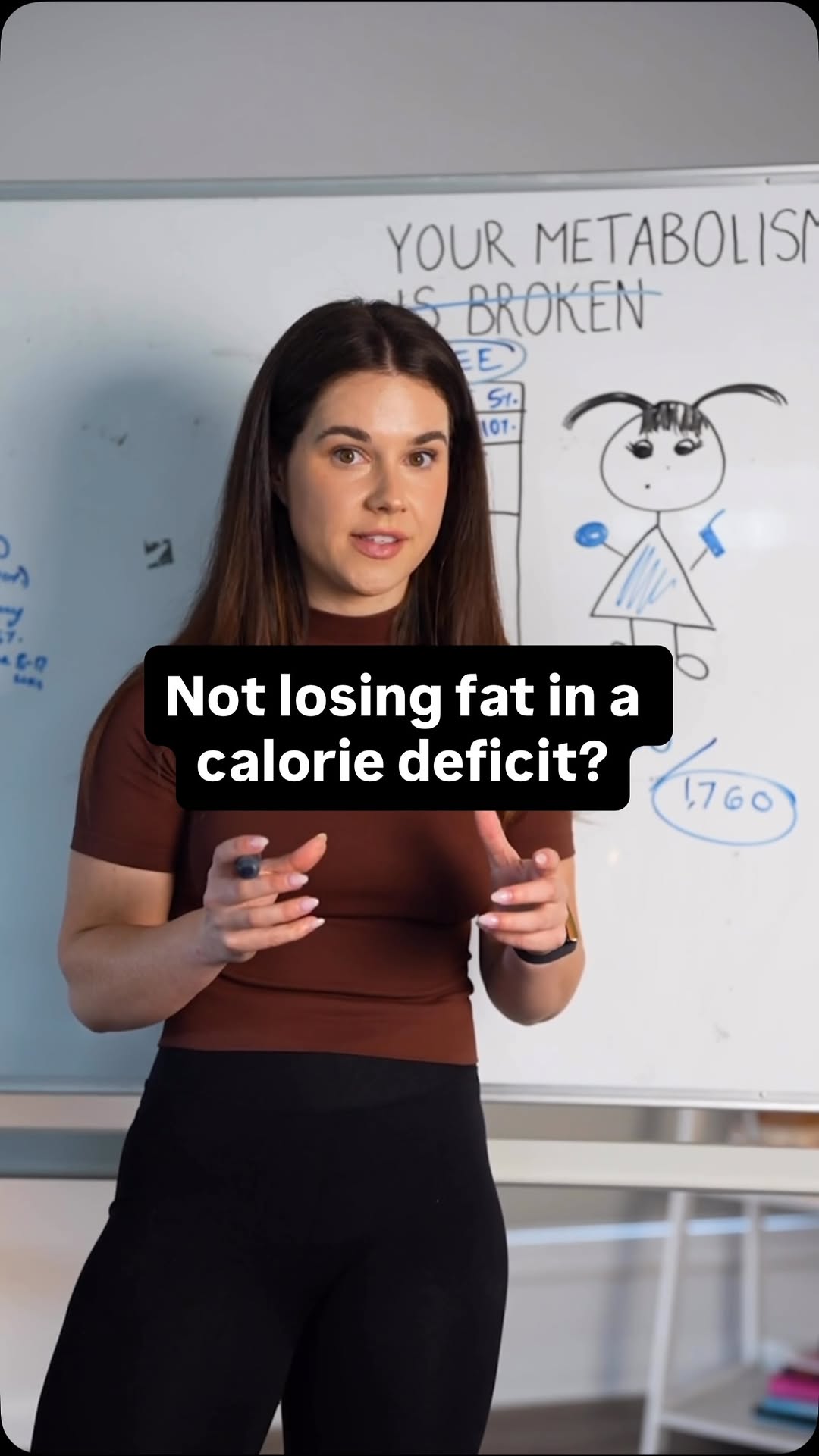
@sharellegrant Is your metabolism broken? 🤔 3 reasons why your calorie deficit isn’t working, and what to do about it.

@sharellegrant
Instagram · Speaker address
@sharellegrant Is your metabolism broken? 🤔 3 reasons why your calorie deficit isn’t working, and what to do about it.
Performance
Video #32550 · Speaker address
[01]
A fitness coach addresses the common problem of not losing fat despite being in a calorie deficit. She begins by breaking down the components of Total Daily Energy Expenditure (TDEE) on a whiteboard, explaining BMR, NEAT, TEF, and EAT. After debunking the myth of a 'broken' metabolism, she outlines three primary reasons for failure: inaccurate calorie tracking (citing research), a deficit that isn't large enough, and not allowing enough time for results. She concludes by emphasizing the need for a structured plan, support, and accountability for successful and healthy fat loss.
[02]
[03]
 2.3MExplain weight loss speed science@jeffnippard · Explainer
 1.1M1626.1×Fitness app competition for steps@jocelynwalking · Performance Proof
 306.6K11.8×Four-meal plan for fat loss@drewsxvision · Tutorial / How To
 205K9.1×Fitness coach reacts to rant@sharellegrant · Reaction
 3.2M907.9×Text overlay stairmaster workout routine@livvjordann · Before/After Transformation
 207.5KCreator shares four-meal fitness plan@drewsxvision · Playbook
 281.3KCreator shows full day's meals@jonnyrdavies · Day In The Life
 1.2M406.7×Step-by-step treadmill cardio routine@livvjordann · Before/After Transformation
 3.5M2×A day of eating for fat loss@jeffnippard · Day In The Life
 239.4KFitness creator rants about carbs@drewsxvision · Hot Take
 1.7M8.5×Fitness habits that worked vs didn't@macro_habits · Before/After Transformation
 566KCreator lists personal weight loss tips@higherupwellness · Rapid Fire Listicle
[04]
[05]
What stops the scroll in the first 3 seconds
Title hook · 45%
Not losing fat in a calorie deficit?
Verbal hook · 40%
I'm at 800 calories not working. We need to talk.
Visual hook · 15%
A before-and-after style clip showing a woman's body transformation from a less defined to a more toned physique.
[06]
Steal this for your own video
Not despite doing ?
[07]
The promise the opener makes, and how the video pays it back
Hook
Grab attention by stating a highly relatable problem and immediately presenting a provocative, counter-intuitive claim, reinforced by social proof (like a user comment).
Payoff
Solidify authority by summarizing the 'real' solution as a holistic system (e.g., plan, support) rather than a simple trick, positioning the creator's methodology as the superior path forward.
[08]
The structural pattern this video runs on
Framework
The Myth-Buster's Masterclass
Address a common audience frustration by first debunking a popular misconception, then teaching the correct foundational principle, and finally providing a list of actionable solutions to the original problem.
The Value Proposition Promise
Clearly state what the viewer will learn: both the 'why' behind their problem and the 'how' to fix it, setting a clear expectation for the video's value.
The Misconception Frame
Introduce the audience's commonly held (but incorrect) belief as the central thesis to be challenged, creating a clear 'us vs. them' dynamic with misinformation.
The Foundational Lesson
Systematically break down the complex, true principle behind the problem into simple, digestible components, often using a visual aid to establish expertise and deliver an 'aha' moment.
The Thesis Reversal
Explicitly and decisively state that the initial common misconception is false, providing a clear turning point in the narrative and a moment of revelation for the viewer.
The Pivot to the Real Culprits
Transition from debunking the myth to revealing the actual, often overlooked, reasons for the problem, framing them as a structured list.
The Actionable Triage
Deliver a numbered list of the true causes of the problem, presenting them as practical, diagnosable issues the viewer can check for themselves.
The High-Stakes Warning
Amplify the importance of the solution by outlining the negative consequences of ignoring the advice or approaching the problem incorrectly, creating urgency.
Is your metabolism broken? 🤔 3 reasons why your calorie deficit isn’t working, and what to do about it.
title · beginning
Not losing fat in a calorie deficit?
informational · beginning
It's because you're not in a calorie deficit
contextual · beginning
I'm on 800 calories and still not working
call-to-action · beginning
Hold here for 2x speed
informational · middle
Energy intake and energy expenditure: a controlled study comparing dietitians and non-dietitians
Do you think he will like me? Shot it up. Count your calories. I'm at 800 calories no working. We need to talk. Here's why you're not losing fat in a calorie deficit and exactly what to do about it. Here is you, and this is your metabolism. 70% of your metabolism is made up of something called your Bad. Oh, that's an x. 70% of the calories that you consume on a daily basis are coma calories. This involves everything from sleeping, digesting, coughing. Do you have to think about it? No. Non exercise activity thermogenesis. Daily movement. Fidgeting, walking. Me doing this right now. This makes up about 15%. No, you can't control your Best. Your NEAT is not your steps. Tier f, thermic effect of good. Literally the amount of calories that takes to digest tier. 10%. And the last one, which is depressingly low, a whopping 5% of your calories goes to exercise or eat. Worse, activity, thermogenesis? I'm gonna guess that. Is that right? This is why cardio is a pretty poor strategy when it comes to fat loss. Your metabolism is not broken. You just need to understand these and how they contribute to fat loss. Here's you, eating in a calorie deficit with your matcha latte and your protein cookie, which equals probably 800 calories. Your total daily energy expenditure, if you used a calculator, let's say it comes back at 2,200 calories, meaning that your metabolism requires 2,200 calories to stay your current body composition and weight. If you went into a calorie deficit, as a general rule of thumb, 20 to 25% is a good place to start. This would mean that 1760 calories would put you in a calorie deficit. Oh, better, Shirell, I've been eating 1,600 calories rank it's not working. Your metabolism isn't broken. Better there's a few important things that probably are. The reason why this calorie deficit is not working isn't because the math ain't mathing. There's usually three important things that are going wrong. Number one, most people simply aren't accurate enough when it comes to predicting how many calories they best, and the research shows this. Even trained professionals can underestimate their calories by, like, 30 to 50%. Number two, people actually don't cut their calories hard enough from the baseline. You wanna make sure that your calorie deficit is at least 20 to 25%. Taking off a 100 calories is not going to do anything. And the last one, your body needs time. I like to recommend a minimum of eight to twelve weeks. None of this mini cut stuff. Get in, get out, do it once a year, and then make sure that you go back to maintenance. No here's the most important part. If you don't do this the right way, you're going to lose things that you don't worst, like muscle, motivation, and metabolic health. I've coached thousands of women and they all have a few things in common. A plan, support and accountability. Simply just eating less and moving more is not a strategy.