Viral Hooks
Trending short videosText hook drives to caption
L

@lifting.jesus

TikTok · One Shot
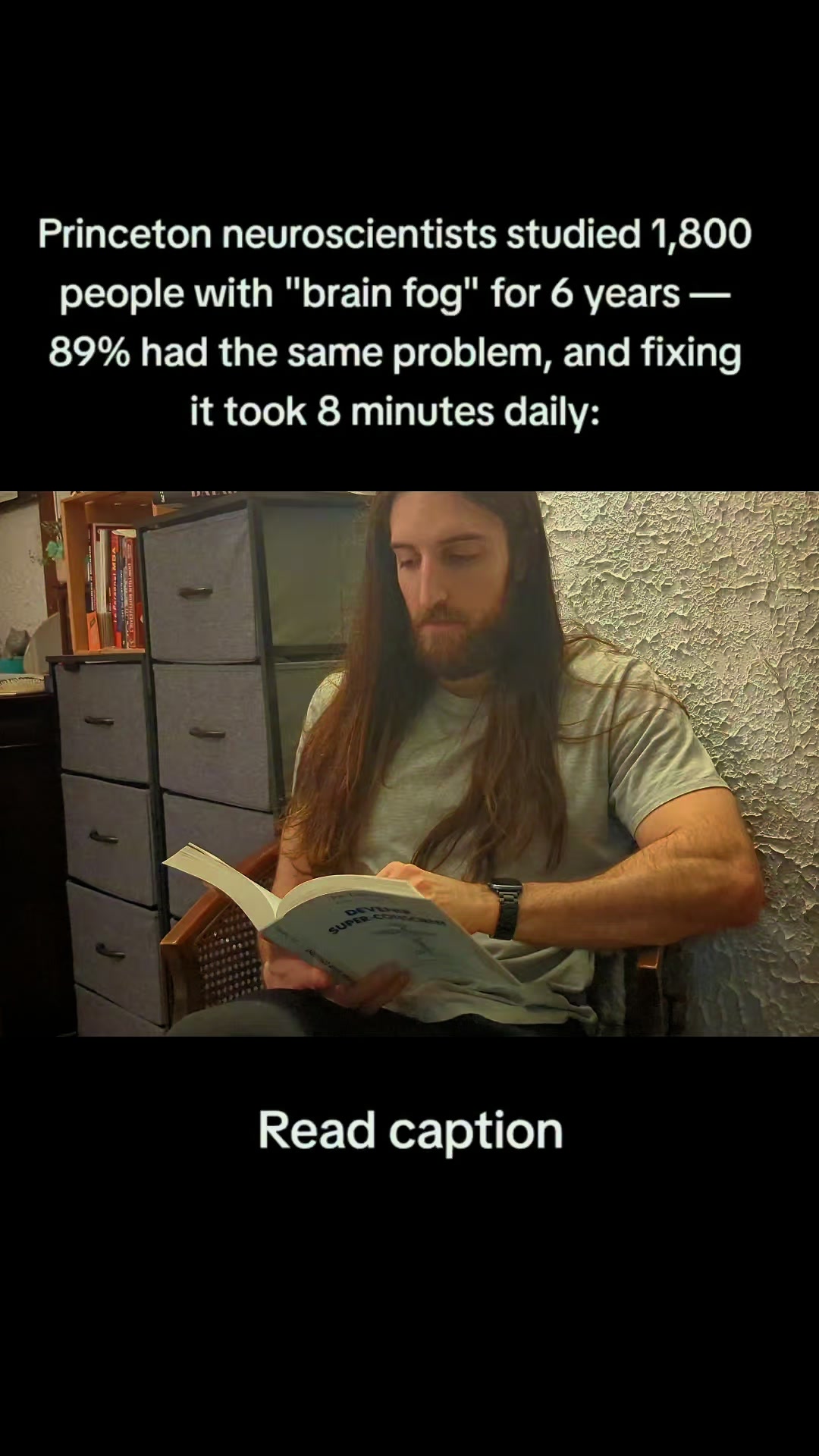
@lifting.jesus 1. Between 2015 and 2021, Princeton researchers tracked professionals complaining of chronic mental fog, poor memory, and decision fatigue. They expected sleep deprivation or burnout. Instead, 89% had one thing in common: they never externalized their thoughts. Everything stayed internal — planning, worrying, problem solving, all locked inside their heads. Their brains were overheating from running 40 background processes with no outlet. 2. The mechanism is cognitive overload: your working memory can hold 4–7 items max. But most people try to juggle 30+ — tasks, worries, ideas, reminders — all day. Brain scans showed this creates constant low grade stress — your prefrontal cortex never fully focuses because it’s also trying to not forget 20 things. You’re not thinking. You’re RAM maxed out. 3. The intervention was shockingly simple: 8 minutes of thought dumping every morning. Grab paper, write everything in your head — no structure, no editing, just rapid fire brain dump. Tasks, fears, ideas, random thoughts. Once it’s external, your brain stops using energy to hold it. Subjects reported 73% clearer thinking and 68% better focus within one week. 4. One programmer described it: “I’d spend half my day feeling busy — but doing nothing — because I couldn’t decide what to tackle first. After one week of morning dumps, my brain felt… quiet. For the first time in years, I could think one thought at a time instead of twelve half thoughts fighting for attention.” 5. Some people think mental clarity requires meditation apps, supplements, productivity systems, optimizing routines, learning focus techniques. Others know the brain just needs to stop being a storage unit — dump it on paper for 8 minutes and reclaim your RAM. One group manages mental clutter. The other deletes it daily. Which one actually thinks clearly? Drop COACHING in the comments — and I’ll message you the details for my 1:1 online fitness coaching: training, nutrition, and accountability built to get you leaner, stronger, and consistent in the gym — lose 8–10 kg in 6 months while building real strength.


View original on TikTok

The edit1 shot · 2 text
Shots Text0:05

Performance

Views
1.1M
Likes
18.8K
Comments
303
Engagement
1.7%
Outlier
1545.3×
Length · 3 Jan 2026
0:05

Video #33032 · One Shot

Text hook drives to captionfrom @lifting.jesus

[01]

Overview

The creator presents a static shot of a man reading a book, overlaid with a text hook about a Princeton study on 'brain fog.' The text promises a simple 8-minute daily solution and then explicitly directs the viewer to 'Read caption' for the full explanation and value.

[02]

Simple outline

  1. 1State authoritative premise
  2. 2Tease a simple, hidden solution
  3. 3Force engagement for the reveal
  4. 4Deliver solution and proof
  5. 5Pivot to commercial offer

[03]

Related videos

[04]

Classification

Format
Concepts
Read CaptionListicle One ShotCase Study Reminder
Elements
Text OverlayRead Below CTAMood MusicTitle Text Hook

[05]

Hook analysis

What stops the scroll in the first 3 seconds

Title hook · 85%

Princeton neuroscientists studied 1,800 people with "brain fog" for 6 years — 89% had the same problem, and fixing it took 8 minutes daily:

Visual hook · 15%

A man with long hair and a beard is shown in a calm, focused state, reading a book in a dimly lit room. The static, quiet scene acts as a pattern interrupt in a fast-paced feed, creating curiosity about the text overlay.

[06]

Hook template

Steal this for your own video

[credible experts] studied [audience problem] for [timeframe] — [percentage] had the same [root cause], and fixing it took [short daily time]:

  • — Harvard sleep researchers studied 2,000 people with afternoon crashes for 4 years — 82% had the same hydration gap, and fixing it took 5 minutes daily:
  • — Professional organizers studied 900 households with chronic clutter for 2 years — 76% had the same entryway bottleneck, and fixing it took 10 minutes daily:
  • — Sports physiotherapists studied 1,500 runners with recurring knee pain for 3 years — 84% had the same warm-up mistake, and fixing it took 7 minutes daily:

[07]

Hook and payoff

The promise the opener makes, and how the video pays it back

Hook

An on-screen text overlay presents a high-authority, data-driven claim about a relatable problem (e.g., 'Princeton neuroscientists,' '1,800 people'). It then teases an unexpectedly simple solution without revealing it, creating a strong curiosity gap that is resolved by a direct command: 'Read caption'.

Payoff

The Commercial Pivot. After delivering a complete, valuable piece of information for free, the narrative transitions into a direct call-to-action for a related paid product or service, leveraging the trust and authority built throughout the post.

[08]

Narrative framework

The structural pattern this video runs on

Framework

The Authority-Gap Funnel

Leverage an on-screen, authority-backed claim to create a powerful curiosity gap, teasing a simple solution to a common problem. The full explanation and payoff are deliberately placed in the caption, forcing the viewer to stop scrolling and engage deeply with the text, which then transitions into a commercial call-to-action.

  1. 1

    The Problem Validation

    The first section of the caption validates the viewer's problem using scientific-sounding language or a technical explanation. This builds credibility and makes the audience feel understood on a deeper level.

  2. 2

    The Solution Reveal

    The core payoff is delivered. The simple, actionable solution teased in the hook is clearly explained. Its simplicity is often emphasized to contrast with the perceived complexity of the problem.

  3. 3

    The Humanized Proof

    A short, relatable story or testimonial is provided. This translates the abstract solution into a tangible, human outcome, allowing the viewer to visualize their own success.

  4. 4

    The Superiority Frame

    A dichotomy is created that positions the revealed solution as the simple, smart choice, while framing alternative methods as overly complicated or ineffective. This elevates the value of the advice just given.

Themes

  • Mental wellness
  • Productivity hacks
  • Scientific communication
  • Self-help

Techniques

  • Information gap
  • Authority principle

Trends

  • Read Caption for value

Post caption

1. Between 2015 and 2021, Princeton researchers tracked professionals complaining of chronic mental fog, poor memory, and decision fatigue. They expected sleep deprivation or burnout. Instead, 89% had one thing in common: they never externalized their thoughts. Everything stayed internal — planning, worrying, problem solving, all locked inside their heads. Their brains were overheating from running 40 background processes with no outlet. 2. The mechanism is cognitive overload: your working memory can hold 4–7 items max. But most people try to juggle 30+ — tasks, worries, ideas, reminders — all day. Brain scans showed this creates constant low grade stress — your prefrontal cortex never fully focuses because it’s also trying to not forget 20 things. You’re not thinking. You’re RAM maxed out. 3. The intervention was shockingly simple: 8 minutes of thought dumping every morning. Grab paper, write everything in your head — no structure, no editing, just rapid fire brain dump. Tasks, fears, ideas, random thoughts. Once it’s external, your brain stops using energy to hold it. Subjects reported 73% clearer thinking and 68% better focus within one week. 4. One programmer described it: “I’d spend half my day feeling busy — but doing nothing — because I couldn’t decide what to tackle first. After one week of morning dumps, my brain felt… quiet. For the first time in years, I could think one thought at a time instead of twelve half thoughts fighting for attention.” 5. Some people think mental clarity requires meditation apps, supplements, productivity systems, optimizing routines, learning focus techniques. Others know the brain just needs to stop being a storage unit — dump it on paper for 8 minutes and reclaim your RAM. One group manages mental clutter. The other deletes it daily. Which one actually thinks clearly? Drop COACHING in the comments — and I’ll message you the details for my 1:1 online fitness coaching: training, nutrition, and accountability built to get you leaner, stronger, and consistent in the gym — lose 8–10 kg in 6 months while building real strength.

Text overlays

  • title · throughout

    Princeton neuroscientists studied 1,800 people with "brain fog" for 6 years — 89% had the same problem, and fixing it took 8 minutes daily:

  • call-to-action · throughout

    Read caption