@womp_tomp
Instagram · Split screen
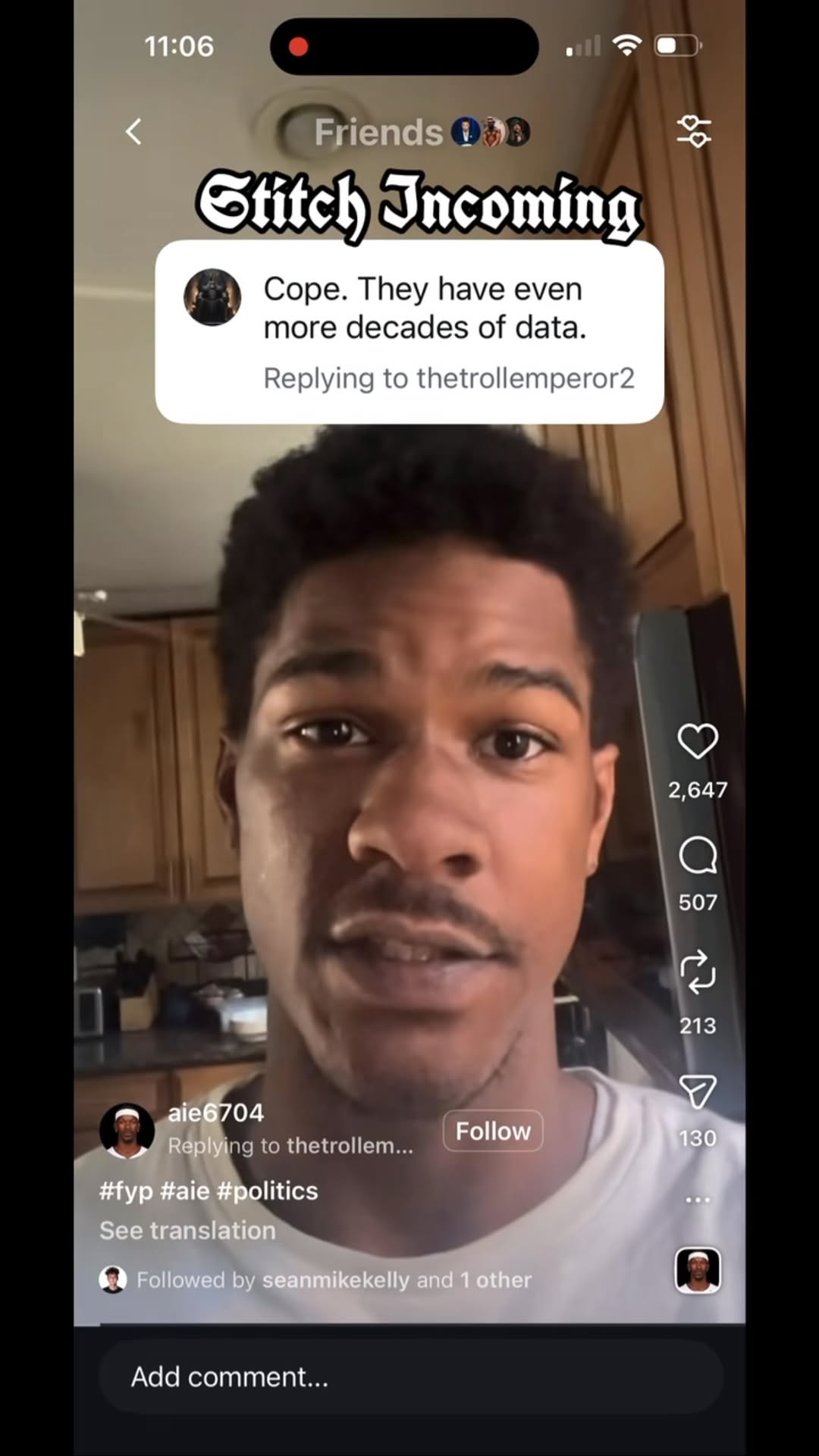
@womp_tomp are black people more peaceful? #politics

@womp_tomp
Instagram · Split screen
@womp_tomp are black people more peaceful? #politics
Performance
Video #34278 · Split screen
[01]
The video presents a debate on racial history. It starts with a clip of a creator claiming Black people have not committed the most historical atrocities, which is then rebutted by a second creator who argues this was due to a lack of technological capability, not moral superiority, using overlaid maps and images to support his points on slavery and colonization.
[02]
[03]
 354.4K17.5×Creator refutes stats with data@womp_tomp · Reaction
 746.1K22.8×Comparing racial supremacist talking points@womp_tomp · Cultural Rant
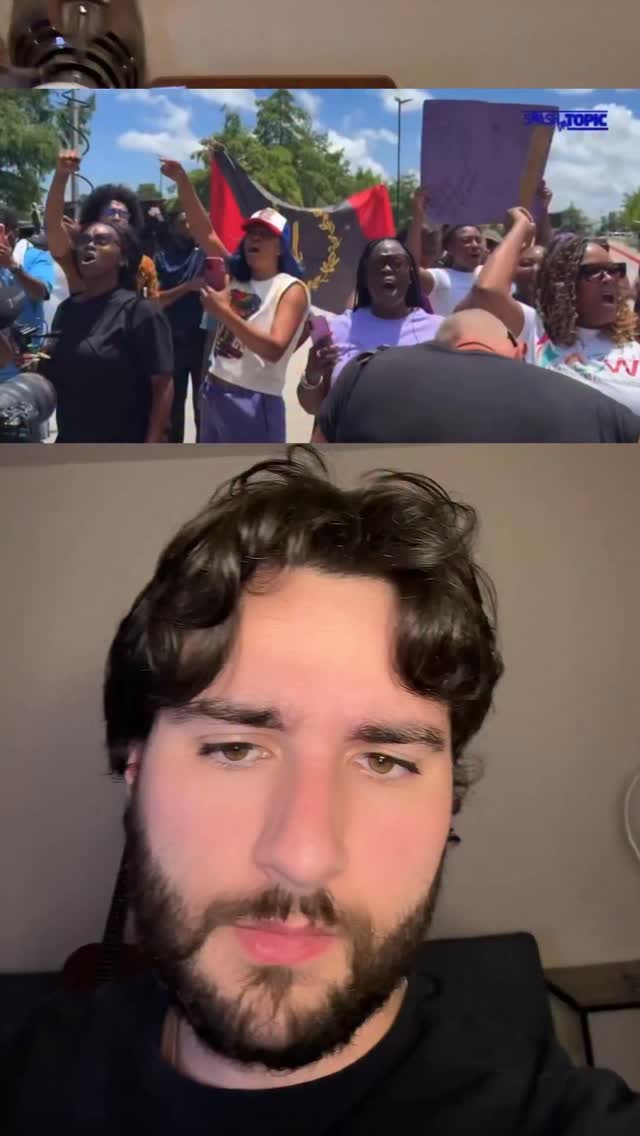 446.2K14.6×Split-screen political hot take@womp_tomp · Hot Take
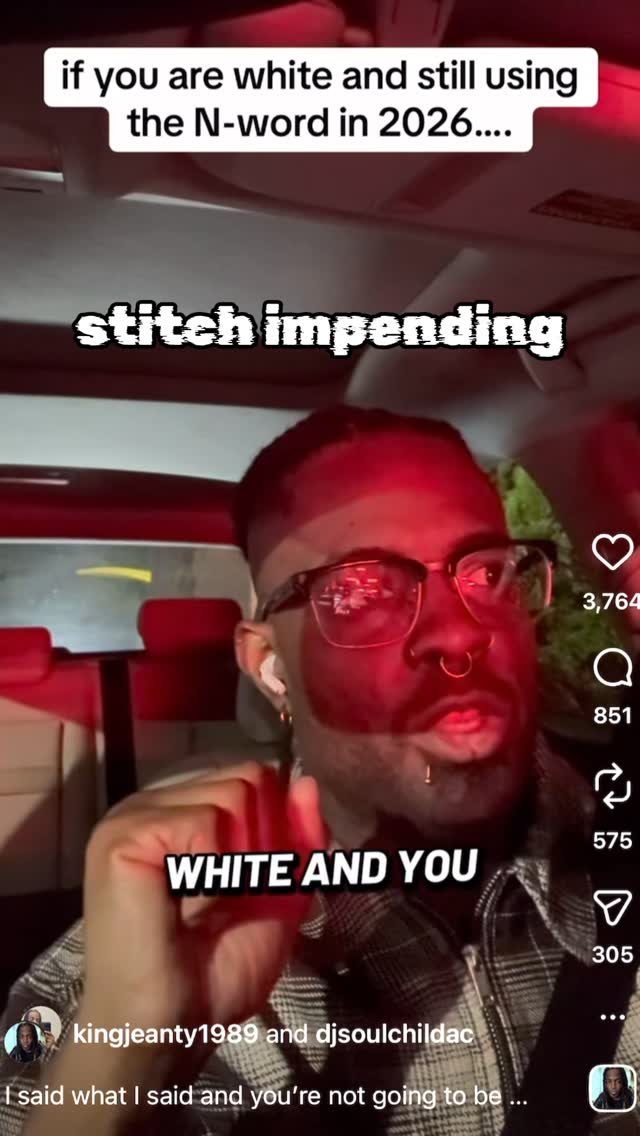 1.2M66.7×Video response with personal attack@womp_tomp · Hot Take
 354K5.5×Provocative hypothetical with data overlays@womp_tomp · Hot Take
 175.9K2.1×Debunking a political narrative@womp_tomp · Cultural Rant
 241.3K384.9×Explaining racism through contamination fears@glass__museum · Breakdown
 1.1M13.7×Split-screen political commentary rant@womp_tomp · Hot Take
 546.4K120.6×News commentary on political hypocrisy.@thecanaryuk · Headlines
 1.6M53×Commentary on online doxxing incident@womp_tomp · Hot Take
 275.7K4.2×Provocative political monologue to camera@womp_tomp · Hot Take
 188.9K5.4×Commentator breaks down controversial news story@womp_tomp · Breakdown
[04]
[05]
What stops the scroll in the first 3 seconds
Title hook · 15%
Stitch Incoming
Verbal hook · 75%
Because empirically speaking, if you look at data from the last seven hundred years, black people aren't even the top three races who have caused the most atrocities or murders around the world.
Visual hook · 10%
A close-up shot of a man speaking directly to the camera, with a prominent on-screen comment from another user displayed above his head, providing immediate context for a debate.
[06]
Steal this for your own video
If you look at , doesn’t hold up the way people think it does.
[07]
The promise the opener makes, and how the video pays it back
Hook
The video opens with a clip of another creator making a clear, data-based, and controversial claim about history and race, establishing a thesis to be challenged.
Payoff
The creator concludes by restating the core thesis as a clear, memorable principle, urging the audience not to confuse capacity for action with innate moral character. This provides a final, thought-provoking summary of the entire argument.
[08]
The structural pattern this video runs on
Framework
The Abrasive Rebuttal
To deconstruct an opponent's argument by aggressively reframing their premise from one of morality or choice to one of capability or technological limitation. The structure uses a provocative counter-claim as a hook and then builds a case to support it, driving engagement through controversy and a debate-style format.
The Dismissive Counter-Hook
The main creator immediately and aggressively refutes the initial claim with a blunt, insulting counter-premise that shifts the entire basis of the argument from morality to capability.
The 'Would Have If You Could Have' Argument
The creator posits a counter-factual scenario, arguing that the group in question would have committed the acts if they possessed the means, using smaller-scale internal conflicts as evidence of intent.
The Technology Deficit Evidence
Specific technological or infrastructural gaps are cited as the primary reason for the lack of large-scale action, directly supporting the initial counter-hook about capability.
The Core Thesis: Ability, Not Morality
The argument is explicitly clarified: the observed outcome was not a result of a moral choice, but a direct consequence of a lack of ability.
The Juxtaposition of Progress
A contrasting group is introduced and credited with major advancements, creating a clear dichotomy that reinforces the 'capability gap' argument.
The Concession and Re-contextualization
Potential counter-examples are acknowledged but framed as exceptions that prove the rule, often by attributing their success to proximity to the more 'advanced' contrasting group.
The Power-Atrocity Link
The creator connects the advancements of the contrasting group directly to their capacity for large-scale negative actions, framing it as an inevitable consequence of power and capability.
are black people more peaceful? #politics
title · beginning
Stitch Incoming
contextual · beginning
Cope. They have even more decades of data. Replying to thetrollemperor2
Because empirically speaking, if you look at data from the last seven hundred years, black people aren't even the top three races who have caused the most atrocities or murders around the world. Because you were too dumb, like you couldn't figure out how to do it. If Africans could have, they would have enslaved Europeans and Asians. You guys were doing it to each other for literally hundreds of years, and there's still more slavery in Africa today than there was during the Transatlantic slave trade. You just couldn't figure out, like, boats and stuff and, like, big wheels and the plow. It's not that you chose not to colonize and enact your will on other people. It's that you didn't have the ability to do so. Europeans and Asians also pushed humanity forward better leaps and bounds. And sure, the countries and communities abutting the Mediterranean in Africa, like Egypt and Carthage participated in that development. But with that power came a greater capacity to do evil, and I do think it was evil, like the the rape of the Congo, for example. But let's not confuse capacity with, like, internal