@glass__museum
TikTok · Speaker address

@glass__museum On dating, “gold diggers”, and financial freedom #capitalism #politics #feminism #dating #sociology

@glass__museum
TikTok · Speaker address
@glass__museum On dating, “gold diggers”, and financial freedom #capitalism #politics #feminism #dating #sociology
Performance
Video #37191 · Speaker address
[01]
The creator argues that capitalism negatively impacts modern heterosexual dating by making it transactional. She supports this thesis by citing Kristen Ghodsee's book "Why Women Have Better Sex Under Socialism," explaining how capitalism structurally disadvantages women in the labor market and privatizes unpaid domestic labor. The creator uses historical context, such as Richard Nixon's veto of a national childcare act, to show how these systems reinforce women's financial dependence on men, ultimately commodifying love and relationships.
[02]
[03]
 270.9K11.1×Critiquing monogamy with historical evidence@glass__museum · Breakdown
 430.6K12.9×Communism explained via dating analogy@womp_tomp · Hot Take
 247.5K7.4×Split-screen satirical political commentary@womp_tomp · Satirical Advice
 247.7K387.7×Explaining patriarchal relationship norms@glass__museum · Hot Take
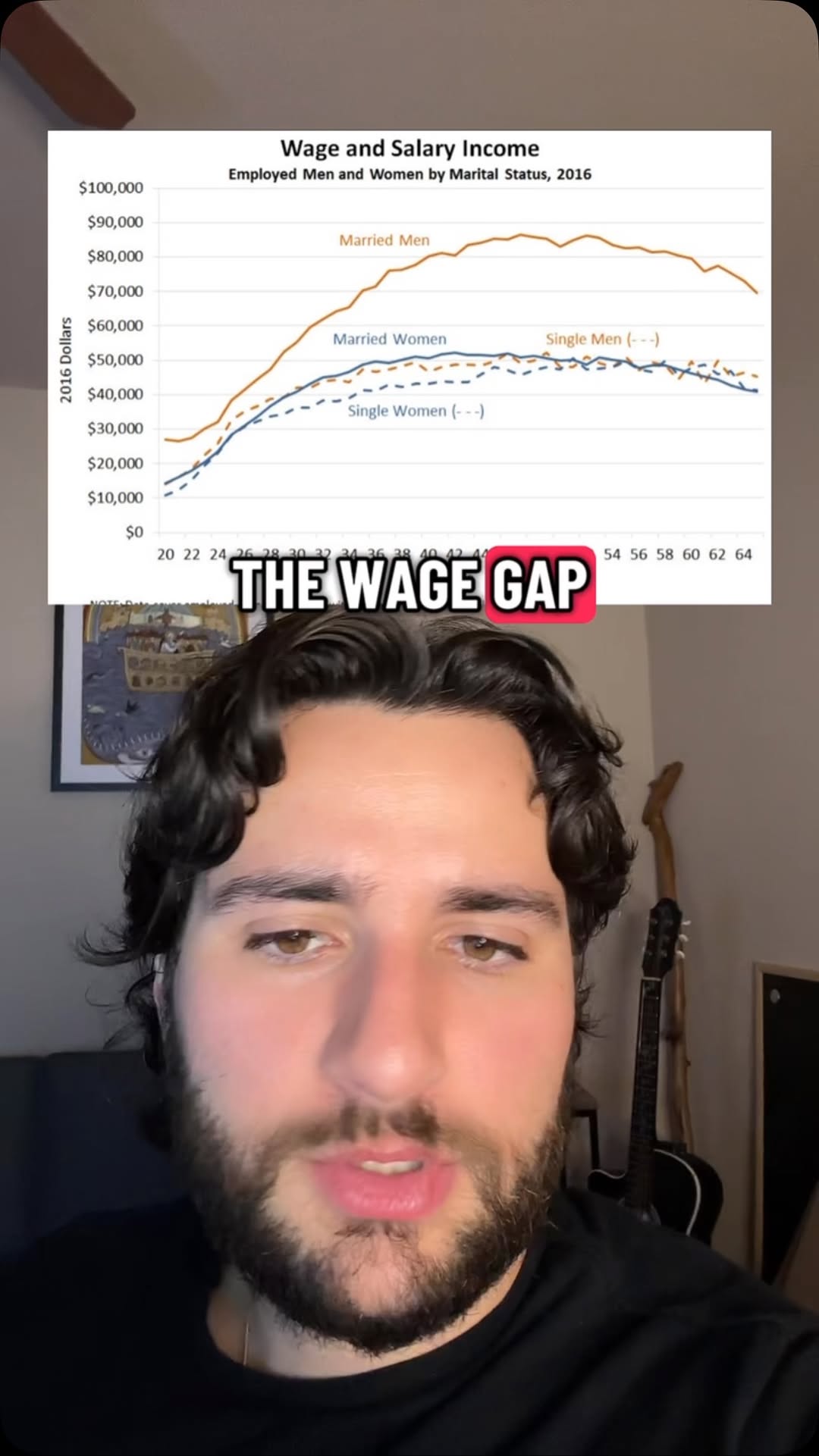 488.9K12.4×Contrarian take on gender wage gap@womp_tomp · Hot Take
 58.5KWalking monologue on dating problems@cbwritescopy · Hot Take
 217.8K3.3×Creator critiques leftist ideological arguments@womp_tomp · Cultural Rant
 190.3K5.6×Rant on sexual value economics@womp_tomp · Hot Take
 269.2K193.1×Controversial relationship advice talking head@skyfisherforsky · Anecdotal Philosophy
 456.5K1.8×Creator explains dating theory with slides@thatzonaguy · Hot Take
 278.3K8.3×Man in car explains society.@womp_tomp · Hot Take
 573.6K30.8×Man reacts to and critiques video.@womp_tomp · Reaction
[04]
[05]
What stops the scroll in the first 3 seconds
Title hook · 55%
CAPITALISM IS RUINING YOUR SEX LIFE
Verbal hook · 40%
Capitalism is ruining your sex life.
Visual hook · 5%
A medium shot of the creator speaking directly to the camera with expressive hand gestures, creating an immediate and personal connection with the viewer.
[07]
The promise the opener makes, and how the video pays it back
Hook
A bold, counter-intuitive statement that connects a large, abstract concept to a deeply personal and universal experience, generating immediate curiosity and emotional investment.
Payoff
An empowering reframe that concludes the argument by shifting the viewer's perspective on the solution—from an individual action to the need for systemic change—providing a sense of clarity and intellectual satisfaction.
[08]
The structural pattern this video runs on
Framework
The Systemic Reframe
To take a widely felt personal frustration, absolve the individual of blame, and reframe it as the logical outcome of a larger, external system, thereby providing intellectual validation and a new lens for understanding.
The Common Ground
Grounds the abstract thesis in a widely observed, relatable social phenomenon or online discourse, making the viewer feel seen and confirming their own experiences.
The Diagnostic Shift
Pivots the argument by explicitly stating that the problem is not the fault of the individuals involved, but rather the result of an external system or structure.
The Expert Anchor
Introduces an authoritative source (a book, study, expert) to lend credibility and provide the core theoretical framework for the argument that follows.
The Causal Mechanism
Breaks down the step-by-step process of how the external system creates the conditions for the relatable problem, often by explaining structural disadvantages and their consequences.
The Concrete Proof Point
Uses a specific, tangible piece of evidence (a historical event, a policy decision, a statistic) to anchor the abstract theory in reality, making the argument feel more concrete and undeniable.
The Inevitable Consequence
Connects the systemic explanation directly back to the initial relatable problem, demonstrating how the system logically produces the behaviors and frustrations first identified.
The Contrasting World
Briefly presents an alternative model or system to demonstrate that the current situation is a result of specific choices, not an inevitability, thereby strengthening the critique.
On dating, “gold diggers”, and financial freedom #capitalism #politics #feminism #dating #sociology
title · beginning
CAPITALISM IS RUINING YOUR SEX LIFE
contextual · end
#ROMANCE
Capitalism is ruining your sex life. You might have deleted Hinge, but you can't escape the abysmal state of the modern heterosexual dating landscape. Spend five minutes online looking at straight relationship advice, and you'll no doubt run into a plethora of guys complaining about girls being gold diggers and girls complaining about broke guys. Let's become clear, though, is that economics are a substantial factor shaping heterosexual relationship dynamics. But the problem isn't necessarily the people looking for love under these conditions, it's the system that commodifies love in the first place. In her book, Why Women Have Better Sex Under Socialism, author Kristen Ghodzie argues that capitalism transactionalizes love by tying women's economic security to romantic partnership. Under capitalism, women are structurally disadvantaged in the labor market, with their labor generally perceived as less valuable since employers know that there's always a possibility that they may eventually become mothers. As the free market limits tier involvement through policies like paid parental leave, universal childcare, and other family supports, many women are forced to choose between having a career or a family. And obviously, this isn't to say that there aren't women who do both. It's just that capitalism makes it much harder. Rather than supporting caregiving collectively, capitalism privatizes it within the family. Childcare, domestic labor, elder care all become unpaid responsibilities performed overwhelmingly by women. And this labor is, as Good writes, invisible as far as the market is concerned. Capitalism thrives on women's unpaid domestic labor because it subsidizes the market economy by reproducing workers at no cost to the employer or state. The US actually came surprisingly close to creating a national childcare system until Nixon vetoed it in 1971, arguing that it would undermine a family centered approach, which better going through the bullshit translator best means why should the government pay for something that a woman do for free? The traditional family model was embraced as a tenant of the good good American family. As Gazi notes, woman's wage work was conflated with the evils of communism. The American way of life meant male breadwinners and female homemakers. And so if women are systematically encouraged to be financially dependent on their husbands, it's no wonder that women are gold diggers. If leaving a relationship means the threat threat of losing housing or health care, then of course tier are gonna be other considerations when you choose your partner beyond just love. And on the flip side, men will internalize this idea that wealth increases their desirability under the system. And so both parties are essentially participating in an exchange structured by the market. Hashtag romance. Am I right? In contrast, state socialist countries, despite their many political shortcomings, did attempt to reduce this dependence by socializing many of the economic burdens traditionally carried within families. By making men and women equal recipients of services from the socialist state, these policies help to decouple love and intimacy from economic considerations. Everyone wants good sex, but we need to start looking at the material conditions that are shaping our sex lives. As George Bernard Shaw wrote nearly a century ago, capitalism acts on women as a continual bribe to enter into sex relations for money. Directly or indirectly, sex and money are always linked in women's lives. If your husband wants to have sex and you need your husband to survive, then there's always gonna be a power dynamic implicit in your sex life better you admit it or no. And so better sex isn't just about finding the right worse, it's about creating the material conditions where people can choose each other freely instead of out of economic necessity.