Viral Hooks
Trending short videosInvestigative breakdown of fire truck costs
M

@maxxrosenblum

Instagram · Greenscreen Talking Head

@maxxrosenblum In the 1990s America had roughly thirty firms that built fire trucks. Today three companies control about 80% of the market, the wait for a new engine has stretched from twelve months to five years, and the price of a standard pumper has doubled past the million-dollar mark. A 2004 truck bought used for $105,000 in 2023 is now worth $155,000. Fire apparatus, in other words, is the only class of motor vehicle in America that currently appreciates with age. That is not how markets are supposed to work. The mechanism is neither mysterious nor particularly novel. A series of private-equity roll-ups consolidated a once-fragmented industry; the resulting giants shut capacity, lengthened backlogs, and pitched the delays to Wall Street as “strong visibility into future net sales.” Municipalities, bound to bespoke specifications and per-truck competitive bids, have no leverage. Homeowners pay the bill through ISO-driven insurance premiums. The cure is dull and obvious: published reference specifications, a leasing tier for small departments, and a refurbishment base in the towns where the plants were shuttered. America built a thousand ships a year in 1943. It can probably manage a few more fire trucks. #Economics #firstresponders #privateequity #Manufacturing

View original on Instagram

The edit1 shot · 12 text
Shots Text2:31

Performance

Views
171.7K
Likes
8.3K
Comments
226
Engagement
5%
Outlier
35.7×
Length · 6 Aug 2026
2:31

Video #38450 · Greenscreen Talking Head

Investigative breakdown of fire truck costsfrom @maxxrosenblum

[01]

Overview

The creator explains the 'fire truck conspiracy,' detailing how private equity firms consolidated the fire truck manufacturing industry, leading to doubled prices, five-year wait times, and appreciating used vehicles. He presents data charts and news articles to show how three companies now control 80% of the market, shut down plants to reduce capacity, and frame backlogs as a positive for Wall Street. The creator then outlines the negative consequences for fire departments, homeowners (via insurance premiums), and proposes a three-part solution involving standardization, leasing models, and rebuilding the industrial base.

[02]

Simple outline

  1. 1State a shocking, relatable problem
  2. 2Reveal the hidden systemic cause
  3. 3Detail widespread personal consequences
  4. 4Propose a clear, actionable solution
  5. 5Reiterate the personal stakes

[03]

Related videos

[04]

Classification

Concepts
BreakdownConspiracy BreakdownCase Study Breakdown
Elements
Title Text HookImage OverlayData Visualization GraphicGreen Screen Composite

[05]

Hook analysis

What stops the scroll in the first 3 seconds

Title hook · 35%

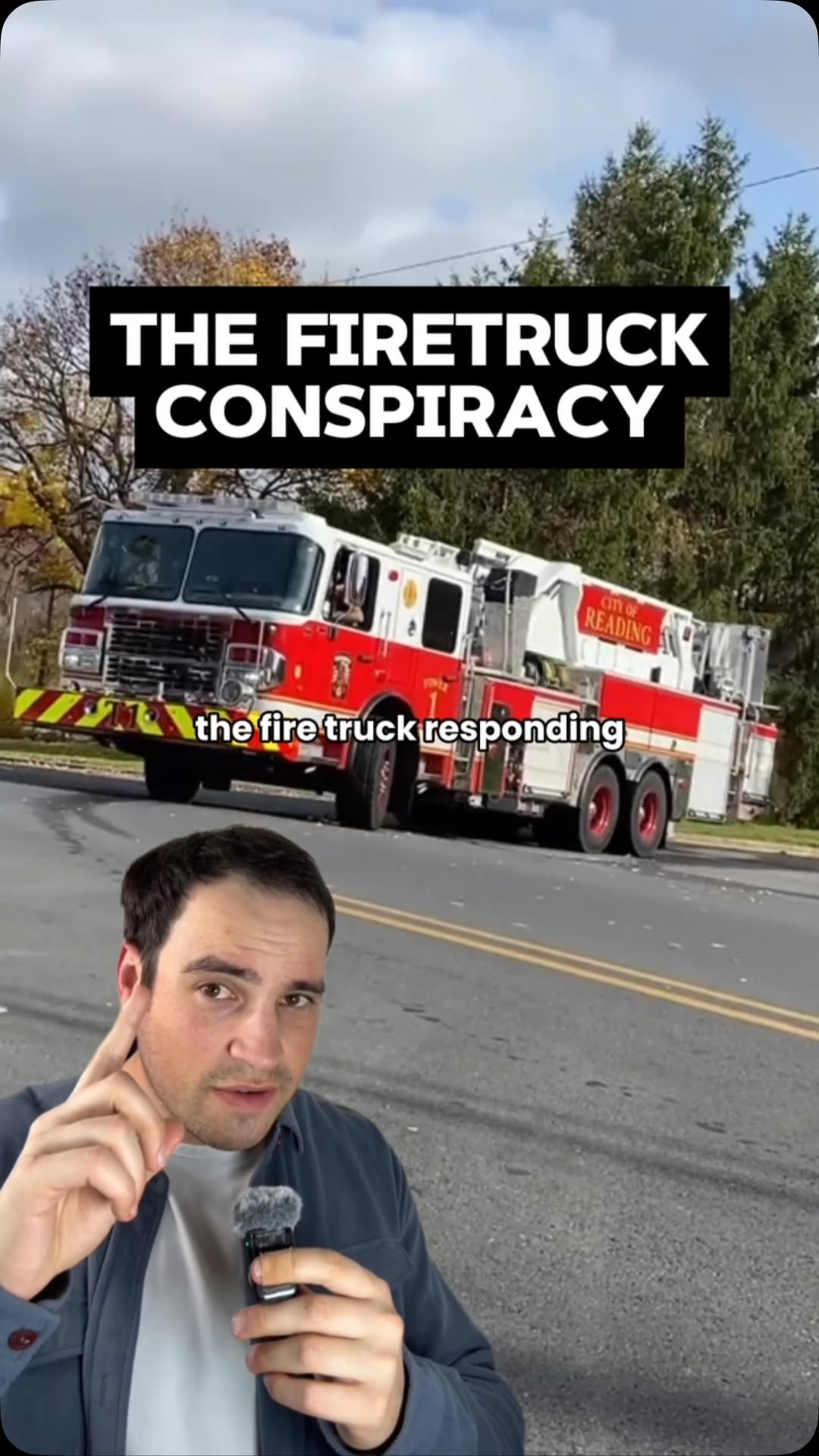
THE FIRETRUCK CONSPIRACY

Verbal hook · 60%

The fire truck responding to your emergency is probably older than the firefighter driving it.

Visual hook · 5%

A large red and white fire truck is shown turning a corner on a street, filling the upper portion of the frame with dynamic movement.

[06]

Hook template

Steal this for your own video

The [everyday public asset] responding to your [emergency or need] is probably older than the [worker] operating it.

  • — The ambulance responding to your 911 call is probably older than the paramedic driving it.
  • — The school bus picking up your kids is probably older than the driver behind the wheel.
  • — The Coast Guard vessel responding to your mayday is probably older than the rescue swimmer on board.

[07]

Hook and payoff

The promise the opener makes, and how the video pays it back

Hook

A surprising, counter-intuitive, and personal observation about a familiar system that immediately establishes that something is wrong (e.g., 'The thing designed to save you is older than the person operating it').

Payoff

A final call to action that reframes the problem as a clear opportunity for disruption, summarizing the ideal conditions for a new entrant and ending by re-stating the personal stakes to the viewer, making the problem immediate and tangible again.

[08]

Narrative framework

The structural pattern this video runs on

Framework

The Systemic Failure Blueprint

To expose a hidden, systemic failure in a seemingly mundane industry by revealing the powerful actors responsible, detailing the cascading negative consequences, and outlining a clear, actionable path to a solution.

  1. 1

    The Market Failure Proof

    Presenting hard data points (price, wait times, illogical value changes) that quantify the problem and prove the initial observation is not an anomaly but a symptom of a broken system.

  2. 2

    The Origin Story

    Asking 'How did we get here?' and rewinding time to contrast a past, healthier state of the industry with the current dysfunctional one, setting the stage for the villain's entrance.

  3. 3

    The Villain Reveal

    Identifying the specific actors (e.g., private equity, a handful of corporations) and the precise strategy (e.g., roll-ups, consolidation) they used to break the system for their own gain.

  4. 4

    The Sinister Motive

    Revealing that the system's negative outcomes are not an accidental bug but an intentional feature, often by quoting internal documents or investor pitches that frame the public's pain as a business advantage.

  5. 5

    The Collateral Damage

    Expanding the scope of the problem to show how it personally affects the viewer through secondary costs they weren't aware of (e.g., insurance premiums, decline in local services).

  6. 6

    The Barrier Analysis

    Posing the logical question of 'Why hasn't this been fixed?' and then dismantling common assumptions by revealing the true, non-obvious regulatory or structural barriers that protect the status quo.

  7. 7

    The Three-Pillar Blueprint

    Transitioning from problem to solution by presenting a clear, multi-part, and logical plan that directly addresses the previously identified barriers and systemic failures.

Themes

  • Market consolidation
  • Corporate greed
  • Impact of private equity
  • Industrial policy
  • Public infrastructure

Techniques

  • Data visualization
  • Investigative storytelling
  • Problem-solution framework

Post caption

In the 1990s America had roughly thirty firms that built fire trucks. Today three companies control about 80% of the market, the wait for a new engine has stretched from twelve months to five years, and the price of a standard pumper has doubled past the million-dollar mark. A 2004 truck bought used for $105,000 in 2023 is now worth $155,000. Fire apparatus, in other words, is the only class of motor vehicle in America that currently appreciates with age. That is not how markets are supposed to work. The mechanism is neither mysterious nor particularly novel. A series of private-equity roll-ups consolidated a once-fragmented industry; the resulting giants shut capacity, lengthened backlogs, and pitched the delays to Wall Street as “strong visibility into future net sales.” Municipalities, bound to bespoke specifications and per-truck competitive bids, have no leverage. Homeowners pay the bill through ISO-driven insurance premiums. The cure is dull and obvious: published reference specifications, a leasing tier for small departments, and a refurbishment base in the towns where the plants were shuttered. America built a thousand ships a year in 1943. It can probably manage a few more fire trucks. #Economics #firstresponders #privateequity #Manufacturing

Text overlays

  • title · beginning

    THE FIRETRUCK CONSPIRACY

  • informational · beginning

    Price of a new fire-engine $500k -> $1M Roughly doubled since 2020

  • informational · beginning

    Delivery wait time 12 mo -> 60 mo 5x longer than pre-2020

  • informational · beginning

    Used fire truck value Bought in 2023 for $105k Worth today $155k+ Net change +48%

  • informational · middle

    1990s manufacturers ~30 Today, top 3 control ~80% US annual sales ~$3B

  • informational · middle

    REV Group buys KEM fire truck division

  • informational · middle

    A closing factory, a booming economy and a town's search for identity

  • informational · end

    Senators Investigate Private Equity Role in Soaring Fire-Truck Costs

  • contextual · end

    BRACE YOURSELF DISRUPTION IS COMING

  • informational · end

    NFPA 1901 - the rulebook every fire truck must pass

  • informational · end

    A three-pillar fix

  • informational · end

    The clearest setup in industrial tech

Transcript

The fire truck responding to your emergency is probably older than the firefighter driving it. We need to talk about why that matters. You see the price of a new fire engine has doubled since 2020 and wait times went from twelve months to five years. A department that bought a used 2004 truck for a $105 two years ago, and the same truck now goes for $50 more. In fact, used fire trucks are appreciating in a way no other vehicle does. But how did we get here? Because in the nineteen nineties, there were around 30 fire truck manufacturers in America, then private equity showed up. American Industrial Partners built Rev Group by rolling up brand after brand. Oshkosh, Rosenbauer followed the same playbook. And today, three companies control roughly 80% of The entire US market of fire trucks. The country's largest private manufacturer, KME, got absorbed into Rev Group and then the plant shut down in 2022, which meant capacity went way down and demand prices went vertical. But the part no one's talking about is that Rev Group pitches Wall Street that its 24 backlog is a feature, quote, strong visibility into future net sales. The wait fire departments have to endure is the business model. Fire departments are running 30 year old ladder trucks and waiting on dashboards that haven't been manufactured in a decade. But the worst don't stop at the fire truck. Your home insurance premium is partly set by your community's ISO fire rating, which depends on the apparatus age and reserves. And old trucks means worser ratings and higher premiums for every homeowner in the ZIP code. Volunteer departments get wiped out because they can't write a million dollar check. It's the same playbook you've seen in health care roll ups. Private equity buys up a fragmented essential industry, runs it for cash flow, and customers have nowhere else to go. And that has led the Senate to start holding hearings. Antitrust class action lawsuits are stacked up. The firefighters union wants the DOJ and FTC involved, but breakups alone don't build factories. The real question is why hasn't anyone disrupted this? Fire trucks aren't necessarily harder to build than garbage trucks or mining equipment. The barrier is NFPA 19 no one certification. Plus better department is ordering bespoke specs plus municipal buyers who can't pre commit to volume. All three are policy problems, not engineering ones. A defense truck maker like AM General could stand up a line tomorrow. An EV native startup could do to fire trucks best Rivian did to delivery bad. But the real play is standardization. Publish five reference specs under NFPA, Pumper, Better, Rank, and let departments opt into commodity trucks with fixed prices and guaranteed delivery. Keep custom bespoke. Bundle that with a leasing model so small departments don't need the capital hit and a refurbishment industrial base in the same towns where KME closed. Because right no, America literally cannot replace its own fire trucks fast enough to put out its own fires. So if you wanna get weird in an industrial market, this is one of the cleanest setups out there. Three companies, one regulatory mode, captive buyers, and political momentum. Grab a truck engineer, grab a retired fire chief, and get to work. Until then, your local department is praying the '19 96 better truck makes it through another summer, and you're paying the difference.

Investigative breakdown of fire truck costs | Viral Hooks