@thejaunt_
Instagram · Single Take
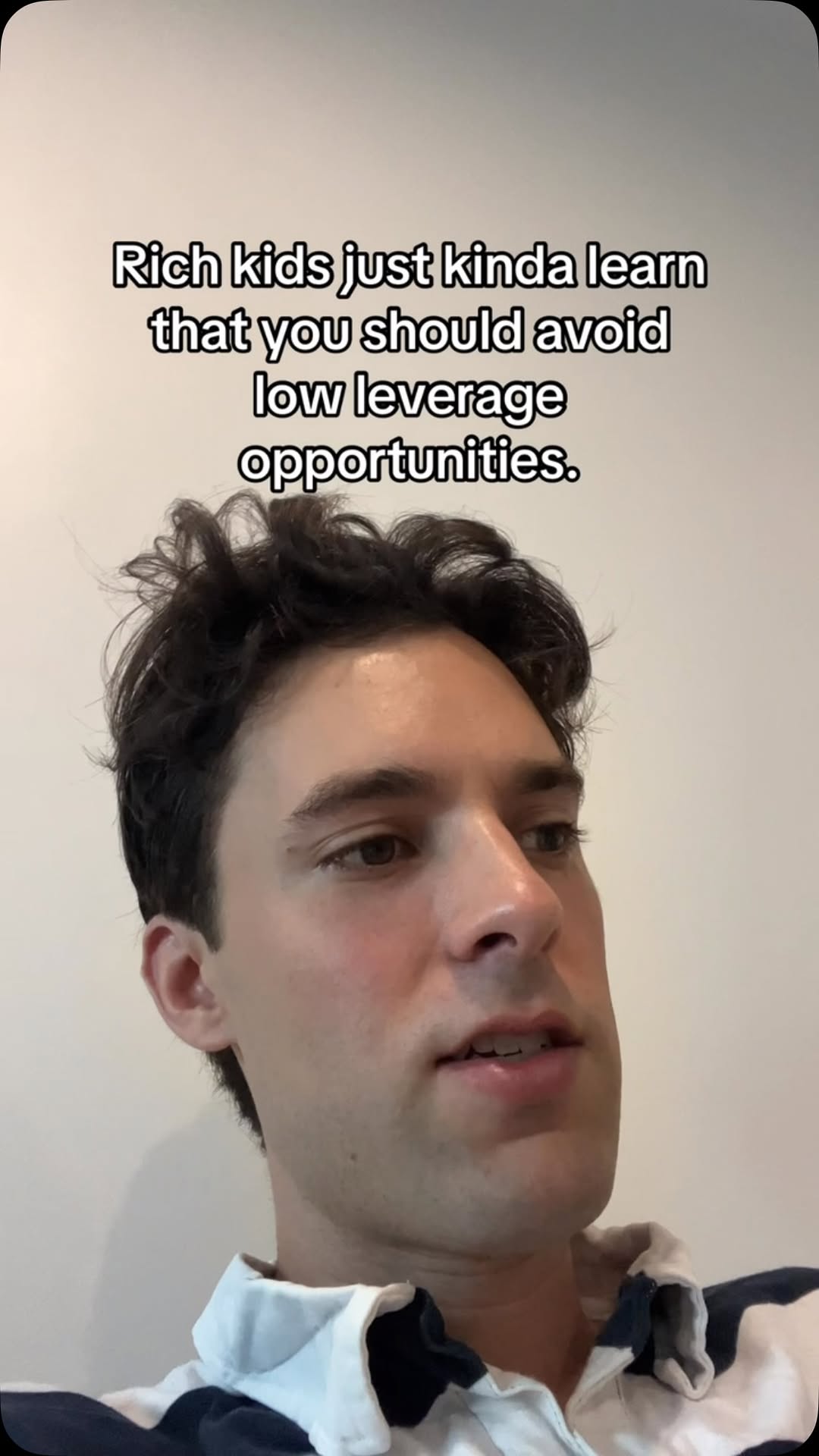
@thejaunt_ Rich kids avoid low leverage opportunities

@thejaunt_
Instagram · Single Take
@thejaunt_ Rich kids avoid low leverage opportunities
Performance
Video #38458 · Single Take
[01]
The creator delivers a monologue explaining the 'rich kid' mindset of avoiding 'low leverage' or 'middle market' career opportunities. He contrasts their preference for either high-paying prestigious jobs or high-agency passion projects against the perceived waste of time in traditional corporate career paths, while acknowledging the privilege that enables this perspective.
[02]
[03]
 715.1K52.5×Personal story illustrates wealth concept@thejaunt_ · Anecdotal Philosophy
 334.5K547.5×Controversial monologue on breaking rules@samstoffel · Cultural Rant
 149.1K1.7×Anecdote explains a success mindset@benhbader · Anecdotal Philosophy
 2.9M4.9×Comedic rant comparing life experiences@maxmanticof_ · Cultural Rant
 1.4M24.8×Three wealth archetypes compare careers@avnibarman_ · Stereotype Satire
 160.1K4.4×Creator rants about tech culture@morganhoong · Cultural Rant
 89.4KAssertive advice for first-gen students@morganhoong · Hot Take
 103.1KRant about financial mindset priorities@oikirkybruz · Cultural Rant
 356.7KMonologue advice on dream jobs@bradley.thor · Hot Take
 135.6K6.9×Walking monologue on class experience@ethanareynolds · Cultural Rant
 263.8K3.7×Creator breaks down the work-to-reward mindset shift needed to scale income dramatically@briarcochran · Anecdotal Philosophy
 1.4M88.7×Lifestyle montage with voiceover philosophy@bensantos508 · Motivational Mantra
[04]
[05]
What stops the scroll in the first 3 seconds
Title hook · 55%
Rich kids just kinda learn that you should avoid low leverage opportunities.
Verbal hook · 40%
Rich kids just kinda learn that you should avoid low leverage opportunities.
Visual hook · 5%
A direct-to-camera close-up shot of the speaker, creating a personal and conversational feel from the start.
[06]
Steal this for your own video
Rich kids just kinda learn to avoid . You should too.
[07]
The promise the opener makes, and how the video pays it back
Hook
A provocative generalization about a specific group's 'secret' mindset, creating immediate curiosity and a desire to understand the underlying logic.
Payoff
A concise, memorable, and often profane mantra that crystallizes the entire argument into a powerful, quotable takeaway, solidifying the binary choice as the only logical conclusion.
[08]
The structural pattern this video runs on
Framework
The Binary Manifesto
Presenting a complex topic as a simple, binary choice between two extremes, while devaluing the common 'middle' path as an inefficient and undesirable compromise.
The Origin Story
Provides an anecdotal or observational basis for the initial thesis, explaining how this special mindset is acquired through environmental learning, making the abstract concept tangible.
The Two Extremes
Establishes the core binary framework. It presents two opposing, 'high-leverage' paths as the only valid options, framing them as 'all or nothing' choices (e.g., maximum reward vs. maximum autonomy).
The Devalued Middle
Explicitly defines and critiques the moderate, common, or 'safe' path. This path is framed as a low-return trap that offers neither of the benefits of the two extremes, using a specific, relatable example to illustrate its inefficiency.
The Credibility Shield
Proactively acknowledges and dismisses the most obvious counter-argument or privilege associated with the thesis. This builds trust with the audience by demonstrating self-awareness.
The Universal Bridge
Expands the initial, niche observation into a universally applicable principle or lesson, allowing a broader audience to identify with the 'elite' mindset.
Rich kids avoid low leverage opportunities
title · beginning
Rich kids just kinda learn that you should avoid low leverage opportunities.
contextual · beginning
You know, like their parents growing up, they would either say this to them, or they would just observe it in their parents.
contextual · beginning
Their parents would pay someone else to do something that they could do themselves and seemed kind of expensive, but the parents are like, no, it's worth it for me because I can make more money elsewhere.
contextual · beginning
And then the kids internalize that attitude.
contextual · middle
And then when they graduate college, even though they don't really have any experience and they're probably not worth that much in the job marketplace, they're not interested in going for middle market opportunities.
contextual · middle
They either wanna go into finance, medicine, law, consulting, somewhere where they're gonna get paid really good money for their time,
contextual · middle
or they wanna go into something where they're gonna make basically no money or shit money, but they're gonna have high leverage, high agency. They can do it completely their own way or do something that they love.
contextual · middle
But they really avoid the middle.
contextual · middle
The middle is where you don't really get enough money for your time.
contextual · middle
You go into a job where you, you start at 55,000, and over the course of seven years of grinding your ass and playing corporate politics, you end up making like 115 K.
contextual · end
I'm not saying it's bad money, but they look at that and they just go, it's not worth it. If I'm gonna do that, I'll just go start my own business and be poor for the next five years.
contextual · end
Now I understand. I'm kind of overlooking the fact that they can have this all or nothing, swing for the fences mentality because they have the safety net of their parents.
contextual · end
I also know that sometimes connections play a role in them getting these good jobs.
contextual · end
But I actually think a lot of people have this experience. If they move from middle class to upper class, they look back on all the jobs or all the things that they did for money, and they're like, yeah, that was a good learning experience, yada, yada, but what a waste of time. They're paying me $30 an hour for a year of my life.
contextual · end
That's what I'm saying when they avoid low leverage opportunities.
contextual · end
Give me money or give me freedom. Don't give me a little bit of money with very little freedom. That's bullshit.
Rich kids just kinda learn that you should avoid low leverage opportunities. You know, like tier parents growing up, they would either say this to them or they would just observe it in their parents. Their parents would pay someone else to do something that they could do themselves and seemed kind of expensive. But the parents are like, no, it's worth it for me because I can make more money elsewhere. And then the kids internalize that attitude. And then when they graduate college, even though they don't really have any experience and they're probably not worth that much in the job marketplace, they're not interested in going for middle market opportunities. They either want to go into finance, medicine, law, consulting, somewhere where they're going to get paid really good money for their time, or they want to go into something where they're going to make basically no money or shit money, but they're going to have high leverage, high agency. They can do it completely their own way or do something that they love, but they really avoid the middle. The middle is where you don't really get enough money for your time. You go into a job where you start at 55,000. No over the course of seven years of grinding your ass and playing corporate politics, you end up making like 115 ks. I'm not saying that's bad money, but they look at that and they just go, it's not worth it. If I'm gonna do that, I'll just go start my own business and be poor for the next five years. Now I understand I'm kind of overlooking the fact that they can have this all or nothing swing for the fences mentality because they have the safety net of their parents. I also know that sometimes connections play a role in them getting these good jobs. But I actually think a lot of people have this experience if they move from middle class to upper class. They look back on all the jobs or all the things that they did for money, and they're like, yeah, that was a good learning experience, yada yada, but what a waste of time. They're paying me $30 an hour for a year of my life. That's what I'm saying when they avoid low leverage opportunities. Give me money or give me freedom. Don't give me a little bit of money with very little freedom. That's bullshit.