@thejaunt_
Instagram · Yap
@thejaunt_ Poor people struggle to smell risk-taking on rich people

@thejaunt_
Instagram · Yap
@thejaunt_ Poor people struggle to smell risk-taking on rich people
Performance
Video #40822 · Yap
[01]
The creator delivers a monologue arguing that the key difference between the rich and poor is the willingness to take risks. He explains that due to an 'information gap,' those without wealth often attribute success to luck or privilege, failing to see the history of risk and failure behind it. To illustrate his point, he tells a detailed story about his now-wealthy uncle, who once risked his health for a business meeting for a company that ultimately failed, highlighting the unseen struggles and high-risk tolerance required for eventual success.
[02]
[03]
 4.9M413.6×Explaining the high-leverage career mindset@thejaunt_ · Opportunity Explainer
 334.5K547.5×Controversial monologue on breaking rules@samstoffel · Cultural Rant
 149.1K1.7×Anecdote explains a success mindset@benhbader · Anecdotal Philosophy
 2.9M4.9×Comedic rant comparing life experiences@maxmanticof_ · Cultural Rant
 103.1KRant about financial mindset priorities@oikirkybruz · Cultural Rant
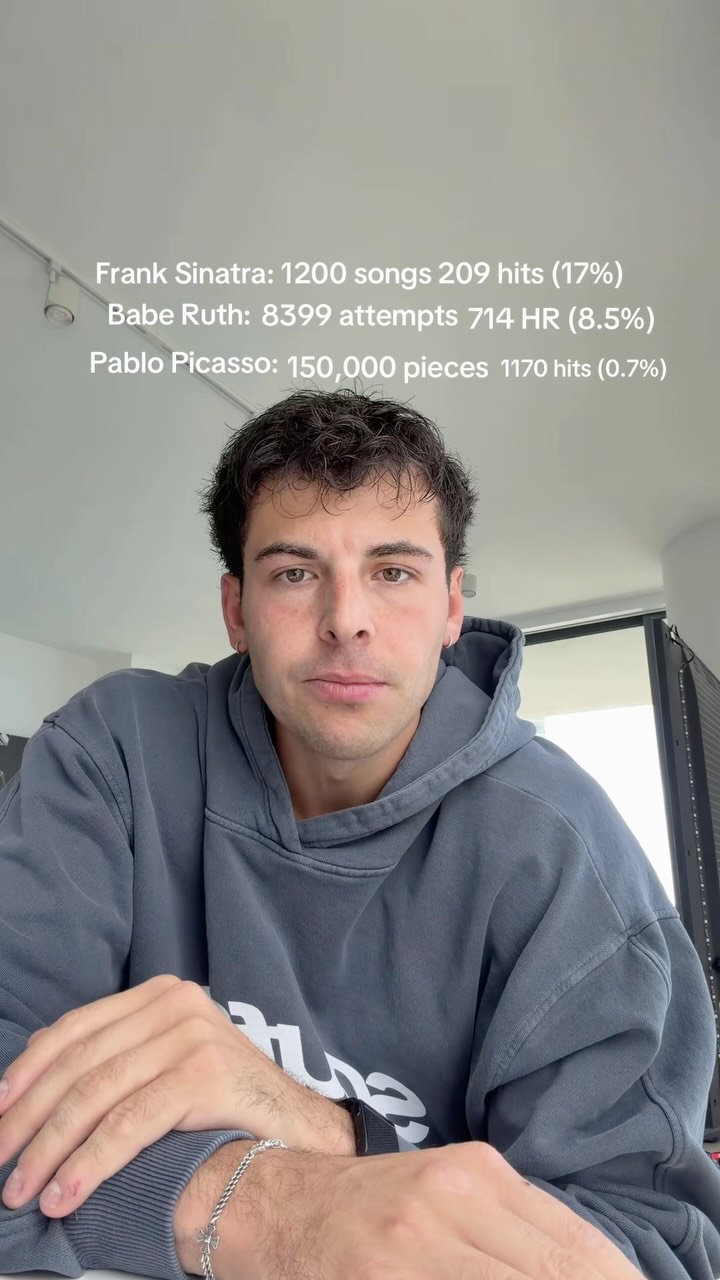 1.3M31.3×Statistical proof for embracing failure@austingeorgas
 135.6K6.9×Walking monologue on class experience@ethanareynolds · Cultural Rant
 138.2K1.4×Direct advice on risk vs stability@morganhoong · Hot Take
 263.8K3.7×Creator breaks down the work-to-reward mindset shift needed to scale income dramatically@briarcochran · Anecdotal Philosophy
 713.1K3.4×Walking monologue on class and race@ethanareynolds · Cultural Rant
 1.7M4.1×Comedic monologue on financial irresponsibility@davi87dp · Storytime
 4.3M15.7×Explaining why taxing rich fails@squidpakter · Hot Take
[04]
[05]
What stops the scroll in the first 3 seconds
Title hook · 55%
Poor people struggle to smell risk-taking on rich people.
Verbal hook · 40%
Poor people struggle to smell risk taking on rich people.
Visual hook · 5%
A close-up, direct-to-camera shot of the speaker making steady eye contact. The casual attire (baseball cap, t-shirt) and simple background create an immediate sense of authenticity and personal connection.
[06]
Steal this for your own video
Poor people can't see the on .
[07]
The promise the opener makes, and how the video pays it back
Hook
A provocative, contrarian statement that establishes a knowledge gap between two distinct groups, creating immediate curiosity.
Payoff
A full-circle restatement of the initial hook's core metaphor, now imbued with the new understanding gained from the narrative, providing a satisfying intellectual resolution.
[08]
The structural pattern this video runs on
Framework
The Parable of Perception
To challenge a common misconception by revealing a hidden, counter-intuitive variable, proving it with a detailed personal anecdote, and concluding with a universal principle that re-frames the viewer's perception.
The Common Misconception
Deconstructs the audience's likely default explanation for the phenomenon (e.g., luck, privilege), showing why it's an incomplete or incorrect model.
The Hidden Variable
Introduces the true, underlying factor that explains the phenomenon. Defines this variable with concrete, relatable examples to make it tangible.
The Empathy Bridge
Acknowledges and validates the perspective of the group that doesn't possess the 'hidden variable,' explaining the rational reasons for their position to build trust and prevent alienation.
The Proving Ground Anecdote
Tells a detailed, personal, and visceral story that serves as a case study for the hidden variable in action. The story demonstrates extreme commitment and includes a surprising twist or failure to enhance authenticity.
The Perception Gap
Uses the anecdote to explicitly contrast the surface-level appearance (what outsiders see) with the unseen reality of struggle, failure, and effort.
The Universal Principle
Distills the lesson from the anecdote into a concise, memorable rule that reframes the viewer's understanding and gives them a new mental model.
Poor people struggle to smell risk-taking on rich people
title · beginning
Poor people struggle to smell risk-taking on rich people.
informational · beginning
There's an information gap.
informational · beginning
They don't have enough personal examples of how someone goes from poor to rich.
informational · beginning
So people going from poor to rich just seems like some great mystery.
informational · beginning
And to fill that gap, their minds tend to default to luck or privilege.
informational · middle
All self-made rich people are risk takers.
informational · middle
That risk taking can come in many forms.
informational · middle
Many poor people, though, are afraid to take risk, and for good reason.
informational · middle
They feel that they don't have a wide margin for error.
contextual · middle
I think about my uncle. My uncle is proper rich now, but he didn't come from money.
contextual · end
And that business later failed anyway.
informational · end
In order to smell risk, you must first take on a sufficient amount of it yourself.
informational · end
Once you have, you'll smell it on people.
Poor people struggle to smell risk taking on rich people. There's an information gap. They don't have enough personal examples of how someone goes from poor to rich. So people going from poor to rich just seems like some great mystery. And to fill that gap, their minds tend to default to luck or privilege. Of course, there are rich people that got lucky, but they're probably more like the minority of rich people. Most rich people, if you heard their stories from start to finish, you'd realize they're actually unique in one regard in particular. All self made rich people are risk takers. That risk taking can come in many forms. It can be risking your own money to start a business, risking your free time to work more hours, or risking your self image to post content online. It doesn't matter what it is that they risk so much as the fact that they were willing to take on an abnormal amount of risk. Many poor people, though, are afraid to take risk and for good reason. They feel that they don't have a wide margin for error. If they blow their savings on a business idea and it fails, now they're back to step one and they've erased years of savings. Ironically, though, if you hear rich people's stories, many of them had exactly that happen to them when they first tried. I think about my uncle. My uncle is proper rich now, but he didn't come from money. My dad told me this story about when my uncle had just started out his first business. My uncle ended up getting really sick with a super high better, the sort of fever you'd probably go to a hospital for today, and he had a big meeting with a potential client that he felt like he couldn't miss. So what he did is he rubbed alcohol on his armpits to bring down his temperature just enough so that he could attend the meeting without crashing in a pit of sweat. This is very dangerous, by the way, self regulating a high fever. But he did it, and he hobbled into the meeting and closed the client. And that business later failed anyway. It would be very easy for one of my uncle's employees now to look at him. And if they didn't know his full tier, to just rank, this guy's a rich asshole. Why does he get to earn 30 times what we do? They don't know that he failed at three businesses to get to this one and that he's basically been a raging workaholic for four straight decades and has an insane tolerance for overall risk and uncertainty. The thing is, though, you can only sense this risk taking in another person if you hear their story or if you yourself have taken rank. Most of his employees don't know his full story and probably have never taken a risk quite as comparable to some of his, so they struggle to see why he is where he is. In order to smell risk, you must first take on a sufficient amount of it yourself. Once you have, you'll smell it on people. You'll smell it especially on rich people. The smell of risk taking.