@olivia.unplugged
TikTok · Speaker address
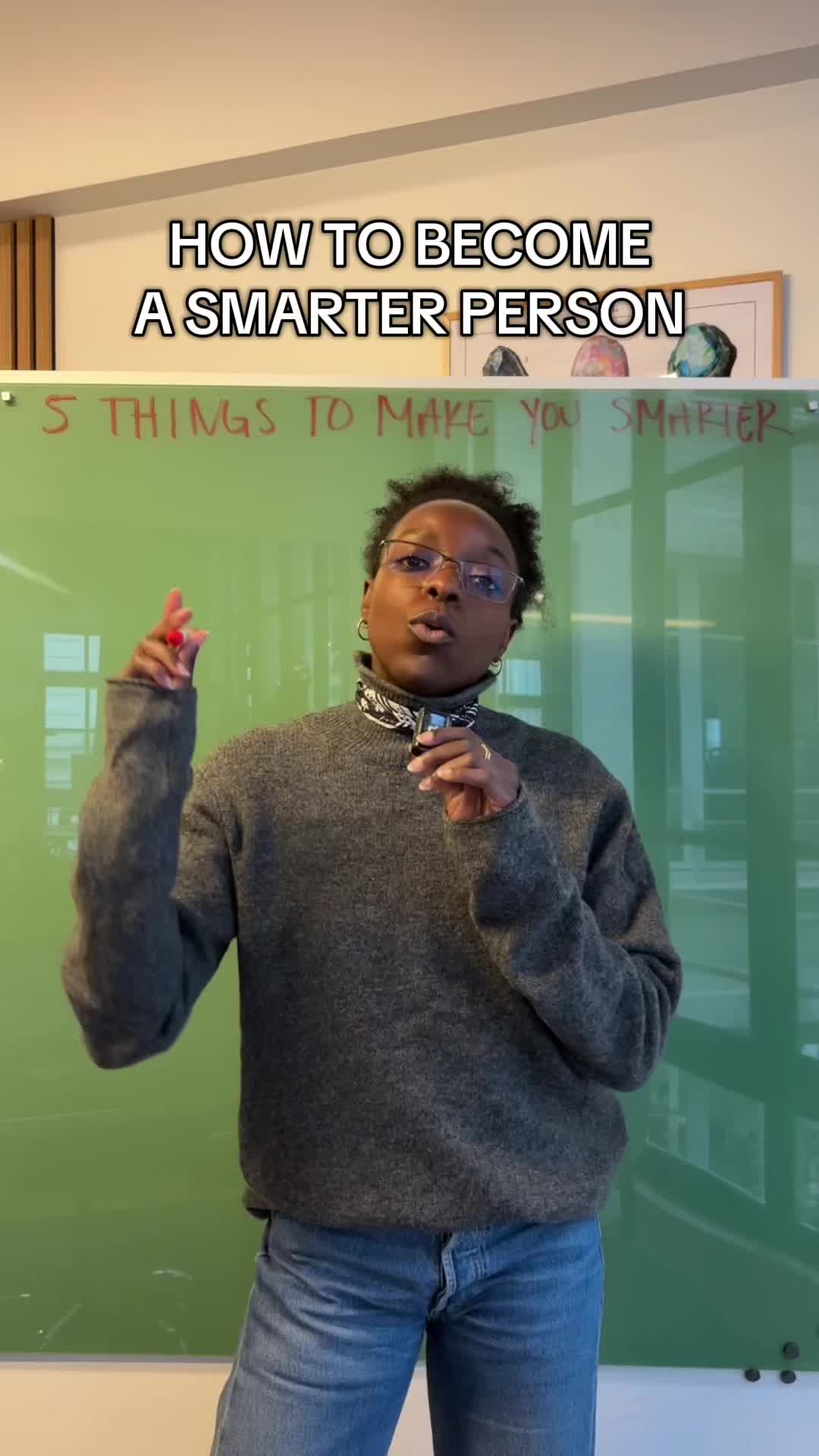
@olivia.unplugged It’s not about gathering more information, it’s about using what you’ve got already. #besmart #smarthabits #smartpeople #selfhelp

@olivia.unplugged
TikTok · Speaker address
@olivia.unplugged It’s not about gathering more information, it’s about using what you’ve got already. #besmart #smarthabits #smartpeople #selfhelp
Performance
Video #42864 · Speaker address
[01]
The creator stands in front of a whiteboard and presents five actionable habits to become a smarter person. For each point—having hobbies, researching everything, learning a language, slowing down life, and maintaining physical health—she writes it on the board, explains the concept with personal examples, and cites scientific research to support the cognitive benefits.
[02]
[03]
 1.1M39×Creator shares five mindset shifts@cariwilliamson · Tutorial / How To
 4.2M108×Creator lists niche self-improvement habits@jun_yuh · Rapid Fire Listicle
 87.9KExplains how environment shapes habits@coachkyle · Breakdown
 191.9K6.4×Mindset advice with illustrative overlays@coachkyle · Breakdown
 218.3K34.8×Three affordable hobbies that build wealth@avni · Breakdown
 226.5K24×Simple framework for changing life@viralclubhouse_ · Motivational Mantra
 174.9K14.1×Reciting four principles for luck@thejaunt_ · Breakdown
 871.4K3.8×Split screen neuroscience mindset breakdown@rony · Breakdown
 1.2M4.3×Self-help advice as product ad@chloe.shih · Value Vlog
 863.1KSelf-improvement guide for men@wendylikestostudy · Tutorial / How To
 317.1KNumbered list of health fundamentals@joeysorts · Rapid Fire Listicle
 392.7K16.8×Turn life goals into tangible projects@angel.agree · Motivational Mantra
[04]
[05]
What stops the scroll in the first 3 seconds
Title hook · 50%
HOW TO BECOME A SMARTER PERSON
Verbal hook · 50%
We are the most informed generation in history, yet somehow the dumbest.
Visual hook
A speaker stands in front of a large green whiteboard holding a marker, establishing an immediate educational or classroom-like setting.
[06]
Steal this for your own video
HOW TO BECOME A
[07]
The promise the opener makes, and how the video pays it back
Hook
A Contrarian Premise: State a provocative, counter-intuitive, or relatable problem that challenges the viewer's assumptions and promises a solution.
Payoff
The Concluding Reframe: Summarize the overarching philosophy, directly contrasting the proposed solutions with the initial problem from the hook. This redefines the viewer's understanding of the core concept and provides a powerful, memorable takeaway.
[08]
The structural pattern this video runs on
Framework
The Actionable Thesis Blueprint
A prescriptive list-based framework that presents a series of actionable steps to solve a provocative problem stated in the hook. Each step is personalized with an anecdote and validated with a scientific or logical benefit, culminating in a redefinition of the initial problem.
The Foundational Habit (Hobbies)
Introduce the first, often broadest, actionable step. Personalize it with specific examples and provide the core justification for why it works, ending with a memorable rule.
The Mindset Principle (Curiosity)
Introduce a cognitive or mindset-based step. Use a relatable, everyday example to demonstrate its application and explain its psychological benefit.
The Skill-Building Challenge (Language)
Introduce a more difficult or specific skill-based step. Demonstrate personal effort or vulnerability to build connection, then link it to tangible improvements.
The Behavioral System (Slowing Down)
Introduce a step focused on changing daily routines or systems. Showcase a specific tool or method used to enforce this change and explain how it counters a negative societal trend.
The Physical Grounding (Health)
Introduce a final step that connects the mental/behavioral advice to physical well-being. Provide simple, non-negotiable rules and their physiological impact.
It’s not about gathering more information, it’s about using what you’ve got already. #besmart #smarthabits #smartpeople #selfhelp
title · beginning
HOW TO BECOME A SMARTER PERSON
title · beginning
5 THINGS TO MAKE YOU SMARTER
informational · middle
Park DC, Bischof GN. The sane mind: neuroplasticity in response to cognitive training https://pubmed.ncbi.nlm.nih.gov/22576894/
informational · middle
Gruber MJ, Gelman BD, Ranganath C. States of curiosity modulate hippocampus-dependent learning via the dopaminergic circuit. https://pubmed.ncbi.nlm.nih.gov/25389380/
informational · middle
Li, P., Legault, J., & Litcofsky, K. A. (2014). Neuroplasticity as a function of second language learning: Anatomical changes in the human brain. Cortex. https://pubmed.ncbi.nlm.nih.gov/24999494/
informational · middle
Bialystok, E., Craik, F. I., & Freedman, M. (2007). Bilingualism as a protection against the onset of symptoms of dementia. Neuropsychologia. https://pubmed.ncbi.nlm.nih.gov/17126388/
informational · end
Ratey, J. J., & Loehr, J. E. (2011). The positive impact of physical activity on cognition during adulthood: a review of underlying mechanisms, evidence and recommendations. https://pubmed.ncbi.nlm.nih.gov/21306316/
informational · end
Benton, D., & Parker, P. Y. (1998). Breakfast, blood glucose, and cognition. https://pubmed.ncbi.nlm.nih.gov/9521033/
We are the most informed generation in history, yet somehow the dumbest. Here are five things I've been doing to fix that. Number one is I actually have real hobbies, and I split them into three different types. A lot of people commented on that hobby video talking about how they don't have time and they don't have money. Any more excuses? No? Okay. Moving on. I have a free hobby, what I call a coffee money hobby, and an investment hobby. My free hobby is reading. My friend and I lead a book club where we typically read nonfiction books. I'm also always reading a fiction book. That book typically comes with me on the better, and it's the one that I read before I go to bed. What I call my coffee money hobby is really just be making a small sacrifice within my monthly budget, and that funds my coffee money hobby, which is crocheting. And thirdly, an investment hobby. That is actually something where I have to invest in it. I am going to buy a DJ set. I'm gonna buy it secondhand, and that is my fall hobby. When you practice a skill, you are strengthening your brain's wiring. Having hobbies increases neuroplasticity, the brain's ability to form new connections, and improves long term memory and problem solving. And say it with me, scrolling is not a hobby. Number two, I research everything. For example, I went and saw Tron last night. Tonight, I am doing a deep dive on the sound engineers. The soundtrack was incredible. I wanna understand how many people did it actually take to be able to create this experience. Curiosity is a skill. Use it to your benefit. It strengthens your neuroplasticity, which keeps your brain young. And I know you're not thinking about that right now because you're young, but we all are gonna age. Number three is a fun one. Learn a new language. But you don't have to live in a different country to learn a new language. Learning a new language activates multiple different regions within your brain. It improves your memory, and it protects against cognitive decline. Yes, it is so humbling. Number four, I have hacked my life to slow down a little bit. We live in a world that rewards urgency. So I've built boundaries in my life that actually forced me to slow down. One of those boundaries means no phone in the first and last hours of my day. You have seen my tier to thrive time block on Opal, and this is what allows me to do things in the morning before work and after work. I do things that bring me joy in little doses, and what that does is it completely resets my baseline, and I actually start feeling pleasure in the simple things instead of always urgently searching for dopamine. And number five, not a brain thing, but a physical thing. I go for 10 k steps a day, and I do not skip breakfast. Exercise increases blood flow to the brain and best something called the BDNF, brain derived neurotrophic factor, which is like miracle good for your neurons. I also start every single day with a high protein breakfast. It stabilizes your cortisol and your blood sugar levels, and it gives your brain exactly what it needs to really, truly think clearly. Your morning coffee does not count as breakfast. Your brain deserves better than that. These are the things that actually make me better. Not the endless podcasts and self help loops, but the things that help make me feel alive. Being smart is not about cramming your brain with more information. We already have too much of that. It's about doing the things that you already know that make you better.