@itsemilyhiggins
Instagram · Talking Head Edit
@itsemilyhiggins Why more attractive people are less likely to find a lasting partner and why more options is not always better

@itsemilyhiggins
Instagram · Talking Head Edit
@itsemilyhiggins Why more attractive people are less likely to find a lasting partner and why more options is not always better
Performance
Video #44042 · Talking Head Edit
[01]
The creator explains the psychological concept of the 'paradox of choice' by first presenting a counterintuitive claim about attractiveness and relationships. She illustrates the concept using the 1995 Stanford jam study, then supports it with findings from a Harvard study on divorce rates among attractive people and data on dating app behavior. Finally, she broadens the application of the concept to other life areas like budgeting, career choices, and hobbies, concluding that having more options can lead to decision paralysis and a fear of loss.
[02]
[03]
 645.7K92.5×Monologue breaking down a quote@sensei.nick · Breakdown
 27.8M856.1×Explaining the paradoxical dating loop@thejaunt_ · Vulnerable Monologue
 456.5K1.8×Creator explains dating theory with slides@thatzonaguy · Hot Take
 400.6K6.5×Mock TED talk on relationships@thatzonaguy · Cultural Rant
 237.5K4.4×Satirical TED Talk on dating@thatzonaguy · Breakdown
 308.5K5×Mock TED Talk on dating@thatzonaguy · Hot Take
 165.9K2.2×Creator shares theory on gay dating@joshforeman2 · Vulnerable Monologue
 289.1K11.6×Philosophical monologue on pretty women@thejaunt_ · Hot Take
 451.2KCreator gives controversial dating advice.@maxmanticof_ · Hot Take
 3.3M3.2×Direct to camera dating hot take@maxmanticof_ · Hot Take
 745.4K25.4×Explains dating and competition dynamics@nycdivorcelawyer · Breakdown
 218.5K5.6×Man answers question with whiteboard@bensantos508 · Hot Take
[04]
[05]
What stops the scroll in the first 3 seconds
Verbal hook · 100%
What if I told you that the more attractive you are, the less likely you are to find a lasting relationship?
Visual hook
A woman speaking directly to the camera in a medium close-up shot, establishing a personal and direct connection with the viewer.
[06]
Steal this for your own video
What if I told you that the more you have, the less likely you are to ?
[07]
The promise the opener makes, and how the video pays it back
Hook
Pose a provocative, counter-intuitive statement that challenges a commonly held belief, creating an immediate knowledge gap the viewer wants to fill.
Payoff
Deliver a concise, philosophical summary that reframes the viewer's perspective and provides a memorable, shareable takeaway about the core concept.
[08]
The structural pattern this video runs on
Framework
The Parable Proof Framework
To explain a complex psychological or social phenomenon by first presenting a counter-intuitive claim, then proving it with a simple, unrelated analogy, and finally validating it with direct evidence and broader applications.
The Parable of Proof
Introduce a simple, seemingly unrelated story or experiment that serves as an easy-to-understand analogy for the complex core concept.
The Academic Anchor
Formally name the scientific principle or concept behind the analogy and define it, lending credibility and authority to the argument.
The Thesis Validation
Present direct, data-backed evidence (e.g., a study, statistic) that explicitly supports the initial provocative premise, closing the loop.
The Relatable Reinforcement
Connect the concept to a modern, highly relatable example from the audience's everyday life (e.g., technology, social media).
The Universal Application
Demonstrate the broad applicability of the core principle by showing how it manifests in multiple, diverse areas of life, transforming it from a niche idea into a universal truth.
Why more attractive people are less likely to find a lasting partner and why more options is not always better
contextual · beginning
find a lasting relationship
contextual · beginning
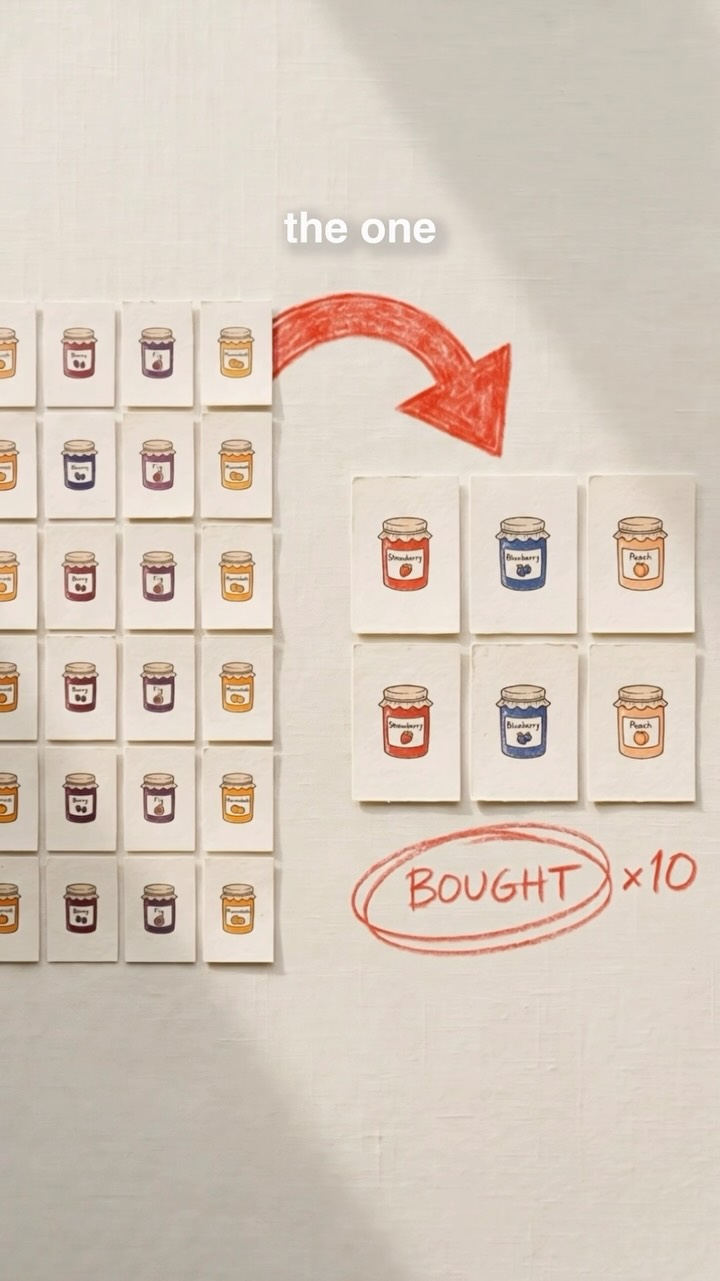
STANFORD, 1995
informational · beginning
24
informational · beginning
24 flavors
informational · beginning
6
contextual · middle
the table
informational · middle
BOUGHT x10
title · middle
PARADOX OF CHOICE
contextual · middle
HAPPINESS
contextual · middle
OPTIONS
informational · middle
WORSE
contextual · middle
HARVARD STUDY
informational · middle
DIVORCE
contextual · middle
AVERAGE ATTRACTIVE VERY ATTRACTIVE
informational · middle
SHORTER
informational · end
$20
informational · end
$2,000
What if I told you that the more attractive you are, the less likely you are to find a lasting relationship? In 1995, a Stanford graduate student set up a jam table at the grocery store. Sometimes the table would have 24 flavors of jam, and other times it would only have six. But people were 10 times more likely to buy something from the table with less options than the one with more. Psychologist Barry Schwartz called this the paradox of choice, and he found that past a certain point, more options actually makes you worse off. Harvard researchers found that more attractive people were more likely to get divorced, and the more attractive the person, the shorter the marriage tended to be. Researchers have also found that the more profiles you swipe through on a dating app, the more people you are likely to reject. But this doesn't just apply to dating. The bigger the budget, the harder it is to spend. The more talented you are, the harder it is to choose a career. The more interests you have, the less likely you are to master any of them. So maybe more isn't better because the more options you have, the more you have to lose by choosing.