@wired
Instagram · Split screen
@wired When an entry-level Volvo can get to 60 mph quicker than a Porsche 911, and in the same time as a Ferrari, electric car makers need a reset.

@wired
Instagram · Split screen
@wired When an entry-level Volvo can get to 60 mph quicker than a Porsche 911, and in the same time as a Ferrari, electric car makers need a reset.
Performance
Video #4501 · Split screen
[01]
The speaker argues that electric vehicles have become too powerful, citing the BYD U9 Extreme as the new fastest production car. He uses a 'Jurassic Park' analogy to question the necessity of such power, then provides evidence by detailing the extreme acceleration and horsepower of models from Tesla, BMW, and Mercedes. The speaker broadens the argument to include powerful family SUVs and even an 'urban' Volvo that outperforms a Porsche, before pivoting to suggest that rapid charging technology is a more meaningful innovation than raw speed.
[02]
[03]
 197.1K1.4×Counterintuitive car efficiency breakdown@drakemoschkau · Breakdown
 307.8K6.2×Two car experts debate transmissions.@carsandbids · Debate
 2.8MOld car beats new cars test@autowashco · Case Study Breakdown
 281.1K39.5×Interview question with car reveal@jcanonbloom · Hot Take
 97.3K12.8×Problem, old solutions, new solution@autowashco · Breakdown
 464.5K21.4×Split-screen car regulation breakdown@carswithpearce · Breakdown
 204K7.5×Ranking car gear shifter designs@uncouver_ · Hot Take
 90.5KExpert breaks down race strategy@visacashapprb · Breakdown
 115.3K1.6×Expert interview on F1 careers@essesmag · Ask an Expert
 111.4K3.5×Explains pros and cons of car modification@flock_mfg · Breakdown
 1.7M1192.4×Man demonstrates lightweight racing wheel@thattireguy · Product Demo
 876.4KPsychological breakdown of motorsports hobby@blake.helps · What Your X Says About You
[04]
[05]
What stops the scroll in the first 3 seconds
Title hook · 35%
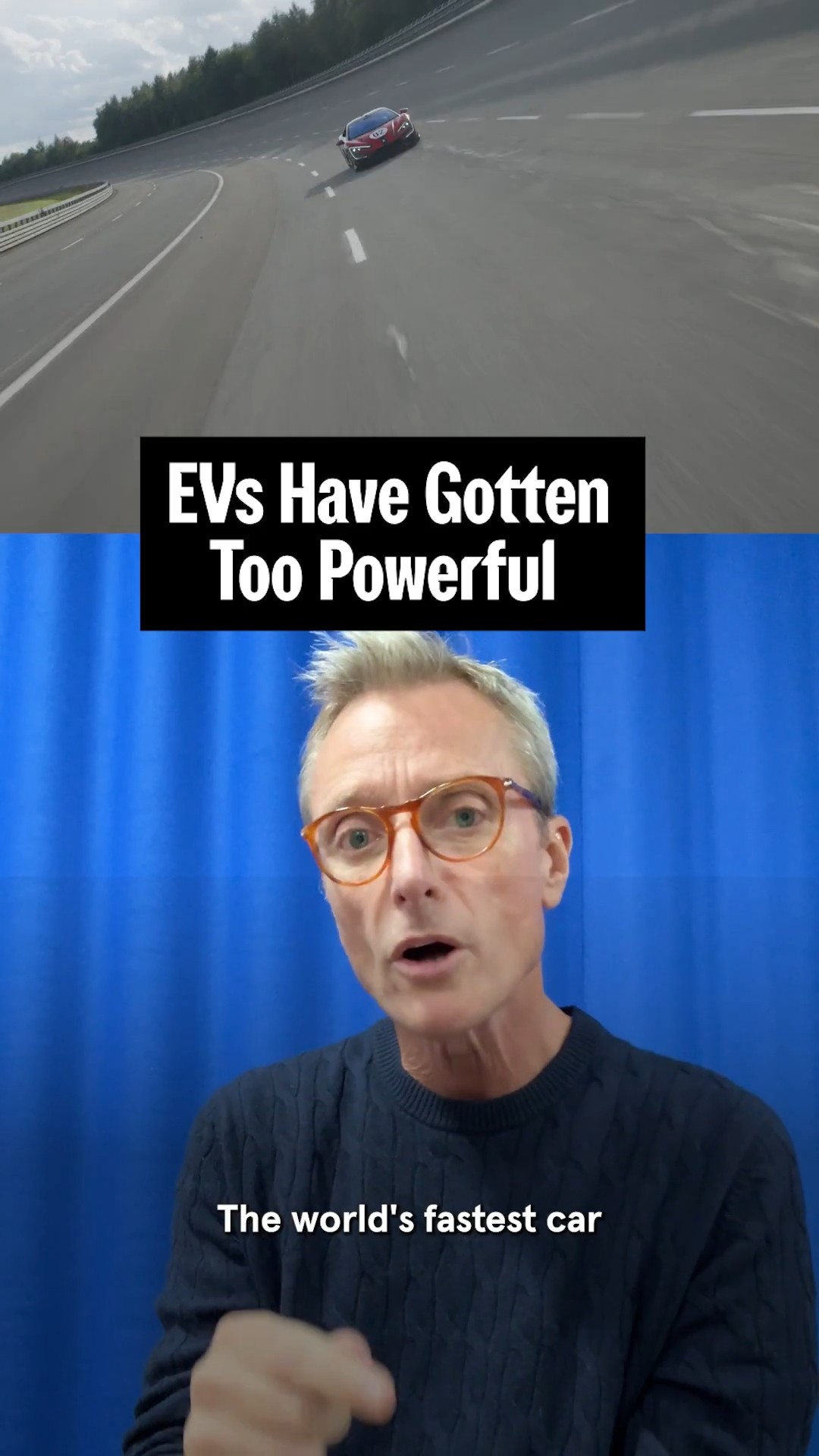
EVs Have Gotten Too Powerful
Verbal hook · 45%
The world's fastest car is now an EV.
Visual hook · 20%
A high-speed shot of a red supercar drifting around a banked corner on a racetrack, creating immediate visual energy and action.
[07]
The promise the opener makes, and how the video pays it back
Hook
The Record-Breaking Revelation: Start with a startling, superlative fact that establishes the topic at its most extreme, immediately capturing attention by breaking a known record or convention.
Payoff
The Reframing Question: Conclude with a rhetorical question or a final statement that forces the audience to re-evaluate their priorities, positioning the alternative metric as the more logical and important one for real-world application.
[08]
The structural pattern this video runs on
Framework
The 'Wrong Metric' Argument
To challenge a commonly accepted measure of success in a given field by presenting extreme examples of its achievement, and then pivoting to argue that a different, more practical metric is what truly matters.
The Thematic Frame
Introduce a counter-intuitive thesis or question that challenges the value of the superlative just presented. Use a relatable analogy or pop-culture reference to frame the core argument (e.g., 'Just because we can, does it mean we should?').
The Escalation Gauntlet
Provide a rapid succession of increasingly extreme examples that support the initial superlative, pushing the concept to its logical, almost absurd, conclusion and demonstrating the scale of the issue.
The Normalization Pivot
Transition the argument from niche, high-end examples to more mainstream, relatable ones, demonstrating that the extreme trend is impacting the everyday user, not just experts or enthusiasts.
The Trojan Horse Proof
Use the most unexpected, mundane, or 'safe' example to deliver the most powerful and shocking piece of evidence, creating a strong cognitive dissonance for the viewer.
The Alternative Metric Introduction
Pivot the entire discussion away from the established (and now problematized) metric of success towards a new, more practical and meaningful one that offers a solution or a better way forward.
When an entry-level Volvo can get to 60 mph quicker than a Porsche 911, and in the same time as a Ferrari, electric car makers need a reset.
title · beginning
EVs Have Gotten Too Powerful
branding · middle
Jeremy White FOR WIRED
branding · middle
COURTESY: Tesla
The world's fastest car is now an EV. BYD's electric u nine extreme is officially the fastest production car in the worse, reaching 308.4 miles per hour at a test track in Germany on September 20. But much like the scientists in Jurassic Park, engineers were so preoccupied with whether they could do something, they didn't stop to think if they should. Let me explain. Tesla's model s Plaid dips just below the two seconds to 62 miles per hour mark. BMW's tech that underpins its latest newer classer cars could see the next generation of fully electric m cars deliver as much as 1,340 brake horsepower. That's a megawatt, by the way. Mercedes recently unveiled the AMG Tier concept, tier production version of which arrives in showrooms a year from no. And that also produces up to one megawatt of power and says Mercedes can accelerate to 124 miles per hour in five seconds. Obviously, not every EV is capable of warping to 60 miles per hour in two seconds or yes, but when cars such as the BMW I x and the Polestar three can be had with dual motors and well north of 600 brake horsepower, you've got to wonder. These aren't supercars no are they meant to be. They're quasi SUV all rounders, state of the automotive art circa 2025 with world class interiors and connectivity. But even urban EVs are nudging into this territory. Volvo, a brand built on driving safety, has the e x 30 twin motor plus all wheel drive. Now the e x 30 is marketed as an urban EV aimed at younger demographics no they can make it their first Volvo. But the twin motor plus AWD can rocket from standstill to 60 miles per hour best shy of three point five seconds. That's a full second faster than the Porsche nine eleven t and almost on par with the new Ferrari Amalfi. Mercedes has new battery cell chemistry that allows the AMG tier to charge at up to 850 kilowatts. That's a game changer right tier, promising recharging times in mere minutes. Isn't the speed at which you can recharge more meaningful in the real world than the speed at which you can hit 60 miles per hour. Maybe a recalibration needs to occur. There is such a thing as too much power and that's why it makes us pause.