@golfdigest
Instagram · Talking Head Edit
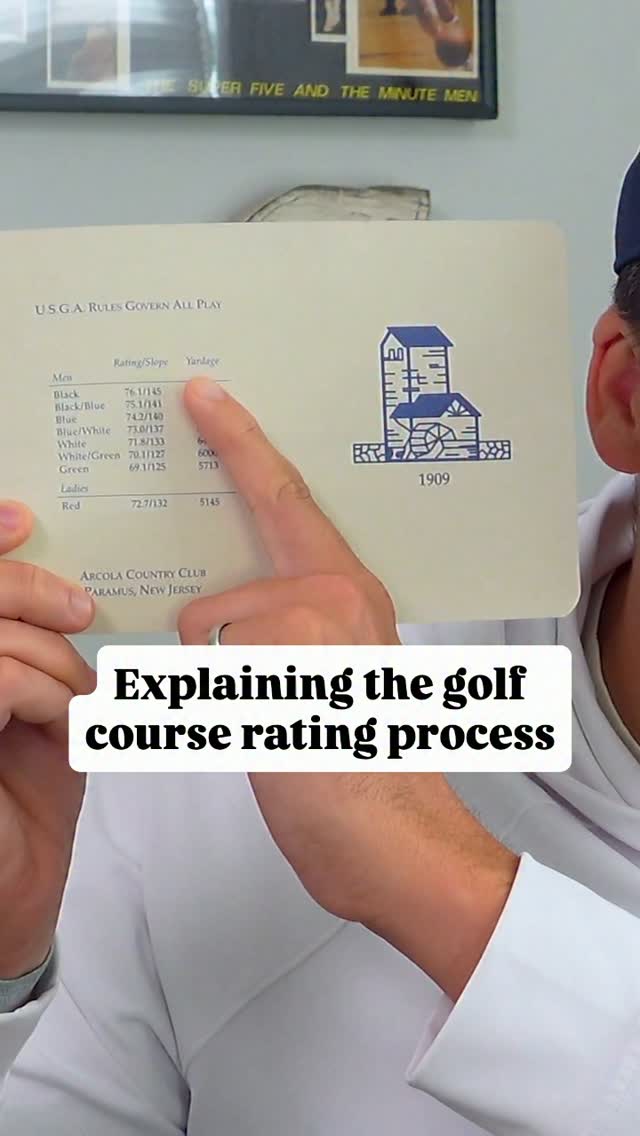
@golfdigest You’ve seen the slope rating on every scorecard. But do you know what it actually means?

@golfdigest
Instagram · Talking Head Edit
@golfdigest You’ve seen the slope rating on every scorecard. But do you know what it actually means?
Performance
Video #46274 · Talking Head Edit
[01]
The creator explains the complex process behind golf course slope and rating numbers found on scorecards. He details that the ratings are conducted by licensed regional golf associations like the MGA, shows how volunteer raters work in groups on the course, and begins to break down the specific on-course factors they evaluate, such as forced carries, elevation changes, and landing zones.
[02]
[03]
 70.9KExplaining golf handicap system simply@shaneohgolfs · Explainer
 227.3K1.6×Rapid fire golf accessory ratings@shaneohgolfs · Rapid Fire Listicle
 97.4K29.4×Reviewing a classic muni golf course@golf_culture1 · Showcase
 142.5K1×Creator defines good golfer skill levels@shaneohgolfs · Explainer
 310.8K2.6×Explains golf handicap system using chart@shaneohgolfs · Breakdown
 890.6K41.6×Explaining a golf game's rules@manorsgolf · Tutorial / How To
 400.5K12.3×Rating a mystery golfer's bag@shaneohgolfs · Expert Rate/Rank
 269.6K1.9×Creator comedically rates followers' golf bags@shaneohgolfs · Expert Rate/Rank
 113.2K5.7×Golf aiming strategy explainer graphic@golfdigest · Guide Carousel
 235.2K1.7×Golf problem and proposed solution@shaneohgolfs · Breakdown
 193.3K2.7×Creator gives opinion on golf rules@shaneohgolfs · Rapid Fire Listicle
 1.4M9×Golf bunker rules explained visually@usga · Tutorial / How To
[04]
[05]
What stops the scroll in the first 3 seconds
Title hook
Explaining the golf course rating process
Verbal hook
Have you ever looked at the rating and slope numbers on the back of your scorecard and wondered, what do they mean?
Visual hook
The speaker holds up a golf scorecard and points directly to the rating numbers, immediately establishing the video's specific topic with a relevant prop.
[07]
The promise the opener makes, and how the video pays it back
Hook
The Common Curiosity Hook: Poses a direct, relatable question about a familiar but mysterious element (the numbers on a scorecard) to create an immediate knowledge gap the viewer wants filled.
Payoff
The Procedural Cliffhanger: Ends mid-process after revealing several key steps (moving to the landing zone), creating anticipation for the next part of the explanation and satisfying the initial curiosity while leaving the viewer wanting more.
[08]
The structural pattern this video runs on
Framework
The Process Demystifier
To take a common but poorly understood concept or object and reveal the surprisingly complex 'how' behind it through a step-by-step, behind-the-scenes explanation.
The Complexity Reveal
Immediately follows the hook by stating that the answer is far more intricate than the audience assumes, justifying the need for the detailed explanation to follow.
Establishing the Hierarchy
Identifies the official governing bodies or authorities responsible for the process (USGA, MGA), lending credibility and a sense of 'insider access'.
The Logistical Breakdown
Explains the human organization and deployment strategy, showing how teams are structured and assigned to tackle the task efficiently (groups of six, front/back nine).
The Procedural Toolkit
Zooms in on the specific tools and assignments (paper forms for each gender/tee set), transitioning from high-level strategy to on-the-ground execution.
The First Checkpoint Analysis
Begins the step-by-step walkthrough of the process from its logical starting point (the tee box), evaluating the first set of variables (forced carries, elevation).
You’ve seen the slope rating on every scorecard. But do you know what it actually means?
title · beginning
Explaining the golf course rating process
contextual · beginning
Christopher Powers Senior Writer
branding · middle
USGA
branding · middle
MGA 1897
contextual · end
Forced Carry
contextual · end
Elevation Changes
Have you ever looked at the rating and slope numbers on the back of your scorecard and wondered, what do they mean? Who comes up with them? What's the difference between the two? I got a worst look at the course rating process, and there is so much more that goes into it than you realize. First off, these ratings are conducted by state or regional golf associations, which are licensed by the USGA. Today, it was the Metropolitan Golf Association, the MGA. They broke up in groups of six. Three men and three women in each group. One group on the front nine, one group on the back nine. Two volunteers started on the most played tee set and the other four split up on the other sets of tees. Each raider has a paper form they take with them, each one with a particular gender and tee set on it. They'll each start from the tee box where they'll look at any forced carries, rough carry, elevation change, then they'll go to the landing zone. From there