Viral Hooks
Trending short videosDoctor ranks best and worst sleeping positions.
N

@nealkshah

Instagram · Graphic Yap
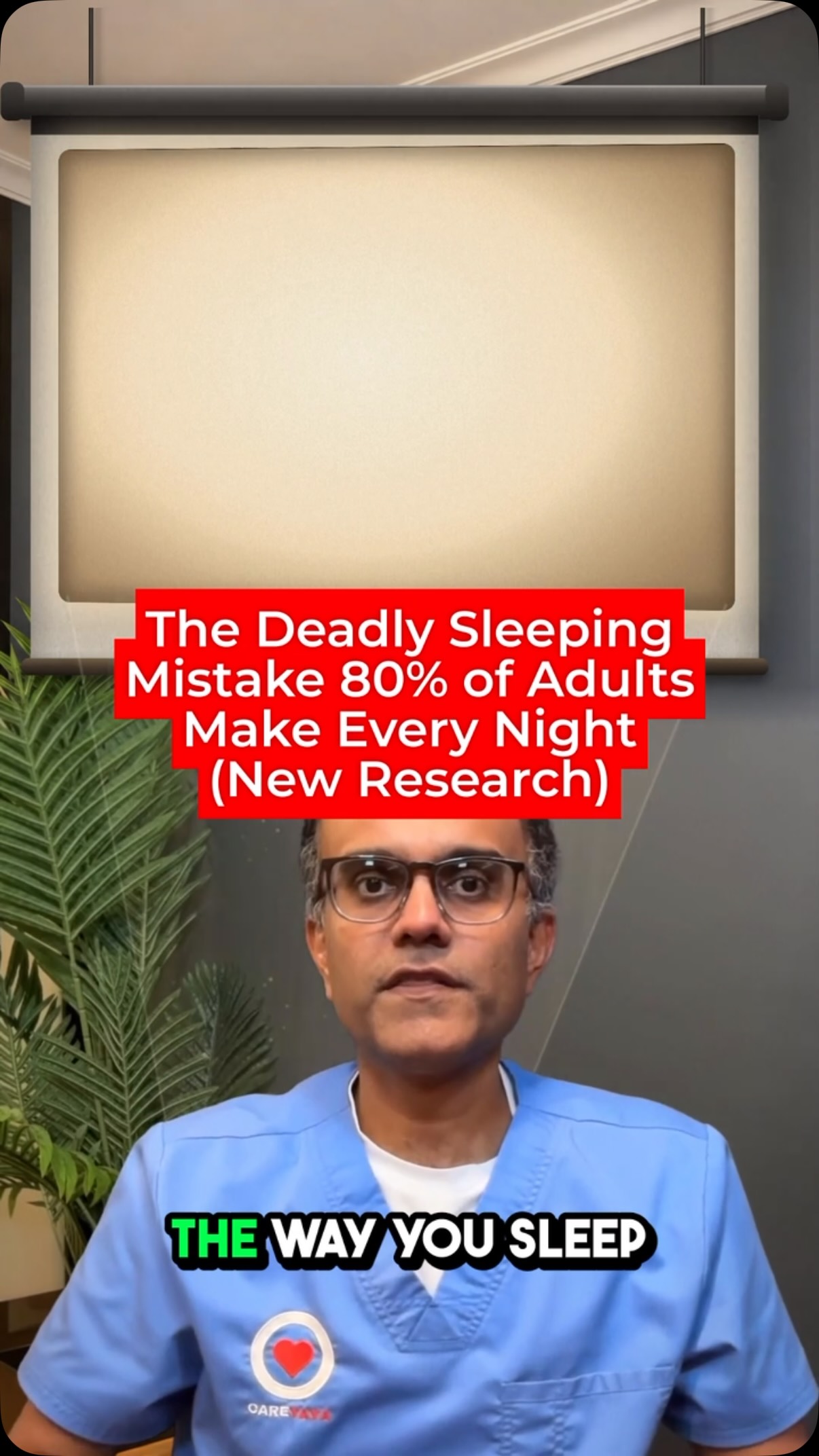
@nealkshah What’s the best sleeping position? It’s not what you think. Most of us treat sleep posture as just personal comfort, but after 50, as spinal discs thin and throat muscles soften, gravity can quietly turn your bed into a hazard for your back, your breathing, and even your brain. Here’s the ranking from worst to best. Stomach sleeping is the worst, because it forces your neck into a 90-degree twist for hours, straining the spine and compressing nerves. Flat on your back is next, since for many people it worsens snoring, sleep apnea, and acid reflux. The winner is side sleeping, and here’s the fascinating part: research suggests sleeping on your side clears the brain’s waste, including the amyloid and tau proteins tied to Alzheimer’s, roughly 25% more effectively than back or stomach sleeping, because your brain does most of its overnight “cleaning” in that position. The left side is also best for easing acid reflux. One tip that changes everything: use a three-pillow setup, one supporting your head in line with your spine, one hugged in your arms to protect your shoulder, and one between your knees to keep your hips aligned. If you have heart failure or a shoulder injury, ask your doctor first. Follow for more sleep science, and share this with a stomach sleeper. #SleepBetter #BrainHealth #HealthyAging
View original on Instagram

The edit1 shot · 4 text
Shots Text13:21

Performance

Views
1.6M
Likes
68.7K
Comments
2K
Engagement
4.4%
Outlier
47.7×
Length · 1 Nov 2026
13:21

Video #48089 · Graphic Yap

Doctor ranks best and worst sleeping positions.from @nealkshah

[01]

Overview

A medical professional explains the serious health risks associated with common sleeping positions, especially as people age. He uses animated MRI scans and other graphics on a screen behind him to illustrate how poor posture can lead to memory loss, acid reflux, and nerve damage. He concludes by promising to rank sleeping positions from worst to best based on new research to help viewers improve their brain, heart, and joint health.

[02]

Simple outline

  1. 1Reveal hidden daily danger
  2. 2Dispel common misconception
  3. 3Promise a definitive ranking

[03]

Related videos

[04]

Classification

Concepts
BreakdownExpert Rate/RankOpportunity Explainer
Elements
Side-by-Side Visual AidMotion GraphicsTitle Text HookImage OverlayGraphic OverlayText Overlay

[05]

Hook analysis

What stops the scroll in the first 3 seconds

Title hook · 50%

The Deadly Sleeping Mistake 80% of Adults Make Every Night (New Research)

Verbal hook · 40%

The way you sleep might be quietly accelerating memory loss, triggering silent acid reflux, or crushing the nerves in your neck and lower back.

Visual hook · 10%

A speaker in medical scrubs stands in front of a projector screen that transitions from a blank, textured background to a detailed MRI scan of a human brain and neck.

[06]

Hook template

Steal this for your own video

The [alarming adjective] [daily habit] Mistake [percentage] of [audience type] Make [timeframe] ([credibility cue])

  • — The Deadly Sleeping Mistake 80% of Adults Make Every Night (New Research)
  • — The Costly Budgeting Mistake 90% of Freelancers Make Every Month (Per a CPA)
  • — The Silent Warm-Up Mistake 70% of Runners Make Every Morning (Physical Therapist Explains)

[07]

Hook and payoff

The promise the opener makes, and how the video pays it back

Hook

Asserts that a mundane, universal habit has severe, hidden negative consequences, using fear-based language (e.g., 'deadly,' 'crushing') to create immediate urgency.

Payoff

Reveals the single 'healthiest' or 'best' option and provides actionable tips on how to implement it correctly, delivering the ultimate solution the viewer has been waiting for.

[08]

Narrative framework

The structural pattern this video runs on

Framework

The Definitive Ranking Framework

To establish a high-stakes problem with a common activity, invalidate a popular belief about it, and then provide a definitive, evidence-based ranking from worst to best, culminating in a single optimal solution.

  1. 1

    The High-Stakes Threat

    Links a common activity to specific, severe health problems (e.g., memory loss, nerve damage), framing it as a silent, accelerating danger.

  2. 2

    The Common Misconception Invalidation

    States a widely held, comforting belief about the topic and immediately refutes it, creating a knowledge gap and positioning the viewer's current understanding as incorrect.

  3. 3

    The Escalating Risk Factor

    Introduces a new variable (e.g., age, environment) that makes the previously 'safe' activity newly hazardous, explaining why the old belief is no longer valid.

  4. 4

    The Consequence Specification

    Translates the general threat into concrete, terrifying outcomes (e.g., 'choking off oxygen,' 'leading to Alzheimer's'), making the danger feel personal and tangible.

  5. 5

    The Value Proposition & Format Reveal

    Explicitly states the video's purpose: to provide a definitive ranking of options from worst to best, based on new research. This sets clear expectations and promises a structured, satisfying resolution.

Themes

  • Preventative health
  • Healthy aging
  • Scientific education
  • Debunking common assumptions

Techniques

  • Expert authority
  • Data visualization
  • Problem-solution framing

Post caption

What’s the best sleeping position? It’s not what you think. Most of us treat sleep posture as just personal comfort, but after 50, as spinal discs thin and throat muscles soften, gravity can quietly turn your bed into a hazard for your back, your breathing, and even your brain. Here’s the ranking from worst to best. Stomach sleeping is the worst, because it forces your neck into a 90-degree twist for hours, straining the spine and compressing nerves. Flat on your back is next, since for many people it worsens snoring, sleep apnea, and acid reflux. The winner is side sleeping, and here’s the fascinating part: research suggests sleeping on your side clears the brain’s waste, including the amyloid and tau proteins tied to Alzheimer’s, roughly 25% more effectively than back or stomach sleeping, because your brain does most of its overnight “cleaning” in that position. The left side is also best for easing acid reflux. One tip that changes everything: use a three-pillow setup, one supporting your head in line with your spine, one hugged in your arms to protect your shoulder, and one between your knees to keep your hips aligned. If you have heart failure or a shoulder injury, ask your doctor first. Follow for more sleep science, and share this with a stomach sleeper. #SleepBetter #BrainHealth #HealthyAging
Text overlays

  • title · beginning

    The Deadly Sleeping Mistake 80% of Adults Make Every Night (New Research)

  • informational · middle

    1 2 3 4

  • title · end

    Best & Worst SLEEPING POSITIONS

  • contextual · end

    I'M NEAL K.

Transcript

The way you sleep might be quietly accelerating memory loss, triggering silent acid reflux, or crushing the nerves in your neck and lower back. Most of us assume that sleeping position is just a matter of your personal comfort. But especially as you get older, physical changes in your spine, airway, and circulation can turn your bed into either therapy or a medical and orthopedic hazard. The position that you loved sleeping in in your twenties could now be choking off your oxygen flow, straining your heart, or blocking your brain from clearing toxic proteins that lead to Alzheimer's. In this video, I'm gonna break down the latest research on the best and worst sleeping positions, especially as you age, ranking each posture from the most dangerous to the single healthiest position for your brain, heart, and joints. I'm Neil Kesha.