@fmsmith319
Instagram · Graphic Yap
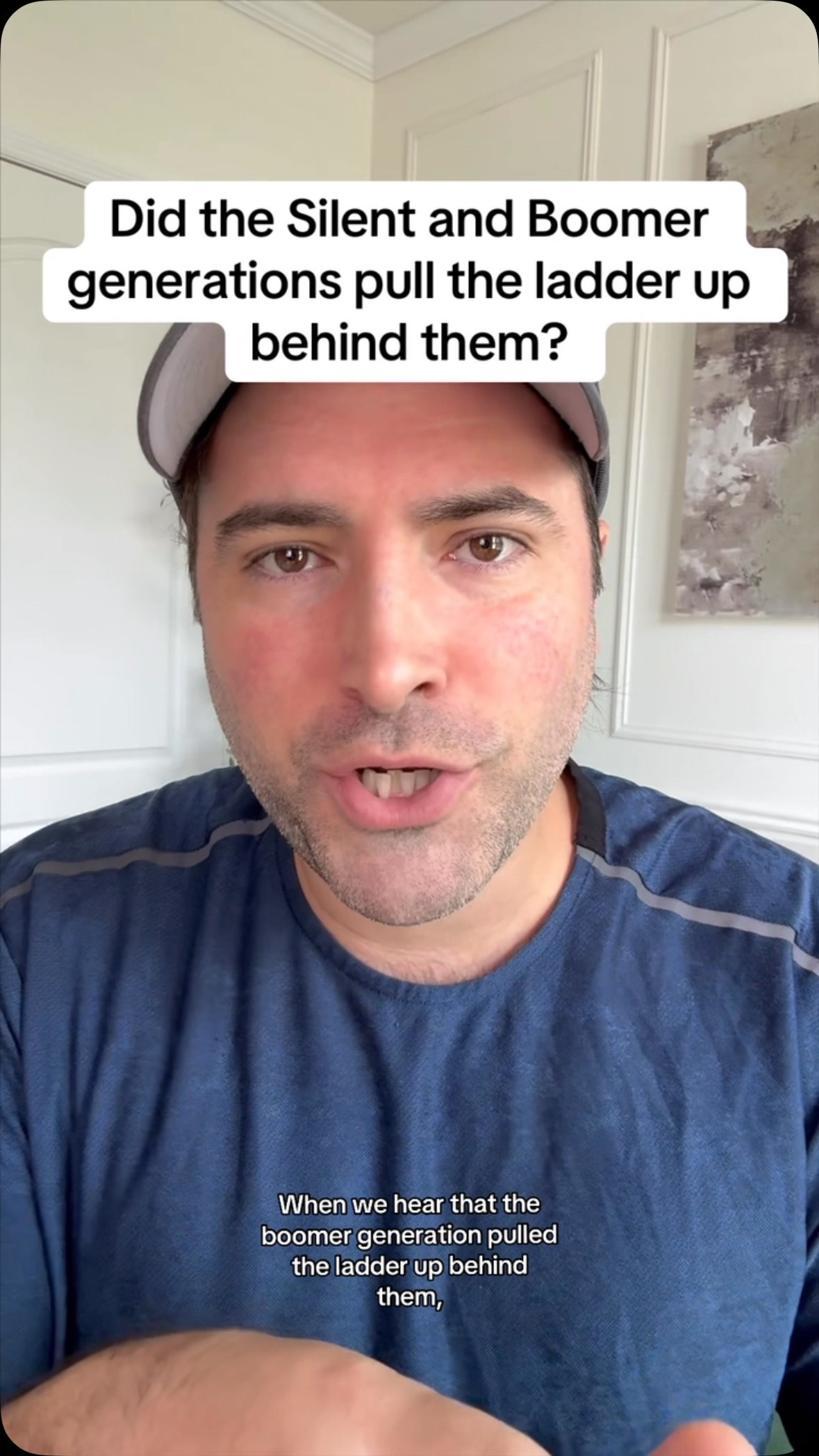
@fmsmith319 Did the Silent and Boomer generations pull the ladder up behind them?

@fmsmith319
Instagram · Graphic Yap
@fmsmith319 Did the Silent and Boomer generations pull the ladder up behind them?
Performance
Video #48609 · Graphic Yap
[01]
The creator presents a detailed argument that the Silent and Boomer generations benefited from numerous government programs and favorable economic conditions (Social Security, highways, Medicare, affordable housing/college) but then enacted policies that disadvantaged subsequent generations. He uses a series of on-screen sources to evidence how college became unaffordable, student and national debt soared, and economic policies shifted to favor corporations over individuals. He concludes by asking for accountability and for the older generations to help create similar opportunities for younger people.
[02]
[03]
 264.6K1.5×Split-screen generational political debate@fmsmith319 · Cultural Rant
 176.3K9.9×Generational real estate hot take@alfonsofrfr · Hot Take
 351K7.2×Monologue on Gen X characteristics@fmsmith319 · Hot Take
 10.4M67.7×Explaining generational IQ drop causes@rony · Breakdown
 2.1M2.6×Car rant debunking who actually drives the national debt@bradley.thor · Hot Take
 630.7K4.9×Man on bridge philosophizes hope@aview.fromabridge · Cultural Rant
 519.8KCreator refutes three common arguments in favor of economic tariffs@bradley.thor · Breakdown
 583.3KComedic rant gatekeeping a trend@maxmanticof_ · Hot Take
 189.9KExplaining the modern work crisis@yourbrain_onmoney · Breakdown
 186.6K3.1×Conspiracy rant with supporting charts@womp_tomp · Hot Take
 699.3KCar rant on how recessions benefit the wealthy at everyone else's expense@bradley.thor · Hot Take
 562.2K1.9×Millennial explains 2008 recession survival@fmsmith319 · Nostalgia Highlight
[04]
[05]
What stops the scroll in the first 3 seconds
Title hook
Did the Silent and Boomer generations pull the ladder up behind them?
Verbal hook
When we hear that the boomer generation pulled the ladder up behind them, here's what we mean.
Visual hook
An intense, direct-to-camera close-up shot of the speaker, creating an immediate and serious tone.
[07]
The promise the opener makes, and how the video pays it back
Hook
Decode a common, emotionally charged phrase ('pull the ladder up'), promising to provide the definitive evidence and meaning behind it, creating an immediate knowledge gap for the viewer.
Payoff
The Reciprocity Plea. Concludes with a direct, emotional appeal to the target group, asking them to help the current group in the same way their own predecessors helped them. This frames the call to action not as a demand for reparations, but as a request to continue a legacy of support.
[08]
The structural pattern this video runs on
Framework
The Generational Receipt
To build a persuasive argument by chronologically presenting evidence of a past generation's advantages, demonstrating how those advantages were subsequently removed for future generations, and concluding with an emotional plea for intergenerational solidarity and action.
The Inheritance Inventory
Rapidly lists a series of major systemic benefits, government programs, and favorable economic conditions that a previous generation received. Each point is presented with a specific date or era to establish a factual, historical foundation of advantage.
The Great Reversal
Pivots the narrative to demonstrate how, after benefiting from these conditions, the same generation enacted or supported changes (policy, social, economic) that dismantled or restricted access to those same benefits for those who came after.
The Consequence Catalog
Details the direct negative outcomes for the current generation, often framed as a rhetorical list of things they lack in stark contrast to what the previous generation had, quantifying the damage (e.g., student debt figures).
The Systemic Indictment
Broadens the argument from specific examples to the overarching ideological and policy shifts that enabled the 'Great Reversal,' attributing these large-scale changes to the leadership and dominant philosophy of the previous generation.
The Disarming Absolution
Explicitly states that individual members of the target group are not personally or maliciously to blame. This strategically de-escalates potential defensiveness and reframes the issue as a collective problem, turning a potential adversary into a potential ally.
Did the Silent and Boomer generations pull the ladder up behind them?
title · beginning
Did the Silent and Boomer generations pull the ladder up behind them?
informational · beginning
The Social Security Act was signed into law on August 14, 1935. It went into effect in stages: payroll taxes and first lump-sum payouts began in January 1937, and regular monthly recurring benefits officially started in January 1940.
informational · beginning
*and coverage expanded significantly in the 1950s
informational · beginning
The U.S. Interstate Highway System officially started on June 29, 1956, when President Dwight D. Eisenhower signed the Federal-Aid Highway Act of 1956. The original plan authorized 41,000 miles of roads with an initial 13-year funding window spanning from 1957 through 1969.
informational · middle
Medicare passed into law when President Lyndon B. Johnson signed the Social Security Amendments of 1965 on July 30, 1965. The historic bill-signing ceremony took place in Independence, Missouri, where former President Harry S. Truman was enrolled as the very first Medicare beneficiary.
informational · middle
Medicaid was established on July 30, 1965, when President Lyndon B. Johnson signed the Social Security Amendments of 1965 into law. The legislation created both Medicare and Medicaid as a joint federal and state program to help provide medical care for people with low incomes.
informational · middle
Housing in the 1960s, 1970s, and 1980s was viewed primarily as a place to live rather than a quick way to get rich. Over time, financial rules changed, and houses started to be seen as major wealth-building assets and investments.
informational · middle
NIMBY stands for "Not In My Back Yard". In housing, it describes local residents who oppose new real estate projects—such as apartment buildings, denser housing, or affordable housing—built near their homes, often trying to protect their neighborhood look, parking, and property values.
informational · middle
In the 1960s, 1970s, and 1980s, the yearly in-state tuition and required fees at public 4-year colleges in the U.S. averaged roughly $240 to $400 in the 1960s, $400 to $800 in the 1970s, and climbed from $800 to over $1,500 by the late 1980s.
informational · end
During the 1980s, higher education shifted from a public good to a private good or private investment. Funding models changed as governments cut public spending. Colleges raised tuition prices. Students and families began to view a degree as a tool for personal financial gain instead of a shared community benefit.
informational · end
Total U.S. student loan debt stands at approximately $1.86 trillion, spread across more than 42 million American borrowers. This massive total represents the second-largest category of household debt in the nation, impacting consumer spending, homeownership rates, and retirement planning.
informational · end
The U.S. national debt stands at roughly $39.9 trillion in mid-August 2026 and is on track to cross the $40 trillion threshold. Over the past four decades, federal borrowing has surged from roughly $1.6 trillion in the mid-1980s to nearly $40 trillion today, driven by continuous budget deficits, economic rescue packages, and rising interest costs.
informational · end
In the 1980s, President Ronald Reagan introduced major tax cuts rooted in supply-side economics (often called "trickle-down economics"), aiming to spur business investment and economic growth by significantly lowering top individual income and corporate tax burdens.
informational · end
Stock buybacks were effectively greenlit in the United States in 1982 when the Securities and Exchange Commission (SEC) introduced Rule 10b-18. This safe-harbor provision provided a clear legal framework for companies to repurchase their own shares without running immediate risks of charges of market manipulation.
informational · end
In the 1980s, American companies shifted from traditional pensions to 401(k) plans to cut costs and shift investment risk onto workers. Following a 1978 tax law and key 1981 IRS rules, employers rapidly replaced guaranteed lifetime benefit pensions with self-directed savings plans.
informational · end
Modern private equity dominance began in the 1980s. This era marked the first major boom of leveraged buyouts (LBOs), fueled by relaxed government rules on pension funds, the rise of high-yield "junk" bonds, and high-profile mega-deals like the $31.1 billion takeover of RJR Nabisco in 1988.
informational · end
Super PACs started in early 2010. They were created because of two major legal decisions. These rulings allowed groups to raise and spend unlimited amounts on political ads.
When we hear that the better generation pulled the ladder up behind them, here's what we mean. The better parents and grandparents in the late nineteen thirties decided to pass social security. So the boomer generation was the first generation that was given, inherited this social program where they knew going to worse, they were gonna have some form of retirement through the government and the collective. Then in 1956, they decided to build the interstate highways. 41,000 miles of interstate highways was given to the boomer generation, and most of it was covered by the federal government. Then in 1965, they were given Medicare. So they knew when they retired that they were gonna have health insurance. Medicaid was also passed around that time. In the sixties, seventies, and eighties, housing was affordable. It wasn't looked at as an asset like it is today. It was just a thing that people were able to buy. And then you created the NIMBY mindset, not in my backyard. You got houses and then created zoning regulations and didn't want affordable housing coming in your your neighborhoods to prop up your value. Rank college in the sixties, seventies, and eighties, when the better were in college, it was $300 a year, maybe up to $2,000 a year for state public schools. And as soon as the boomers graduated college, the administration at the time says, you know what? This college thing is not a public good. It's a private luxury. Let's put the burden on the family and on the students. And that led to $1,800,000,000,000 of debt. And now we've had this much growth in fifty years, and we look around. Did our generation get any any programs? Did we get free college, free health care, respectable paid maternity and paternity leave? Did we get a four day work week? We don't have high speed rails. Yet the silent generation and boomer generation leadership got us $40,000,000,000,000 in debt. The only thing that has changed is we have given all the power to the corporations, not the people. We green best stock buybacks. We switched from pensions to four zero one k's. We allowed the dominance of private equity and leveraged buyouts. We allowed super packs to happen and rank up $40,000,000,000,000. It is not the individual better fault who's watching this. We do not think that you maliciously voted to screw over your children's generation. We're asking for the accountability now. These are not predictions. We're looking in the past. There's proof. Please help us. How worse your parents and grandparents able to provide things for you to make your life easier, and you guys aren't reciprocating and doing the same thing for us? That's our complaint. Work with us, please.