Viral Hooks
Trending short videosExplains physics of upside-down F1 car
I

@inside_decoded

Instagram · Faceless

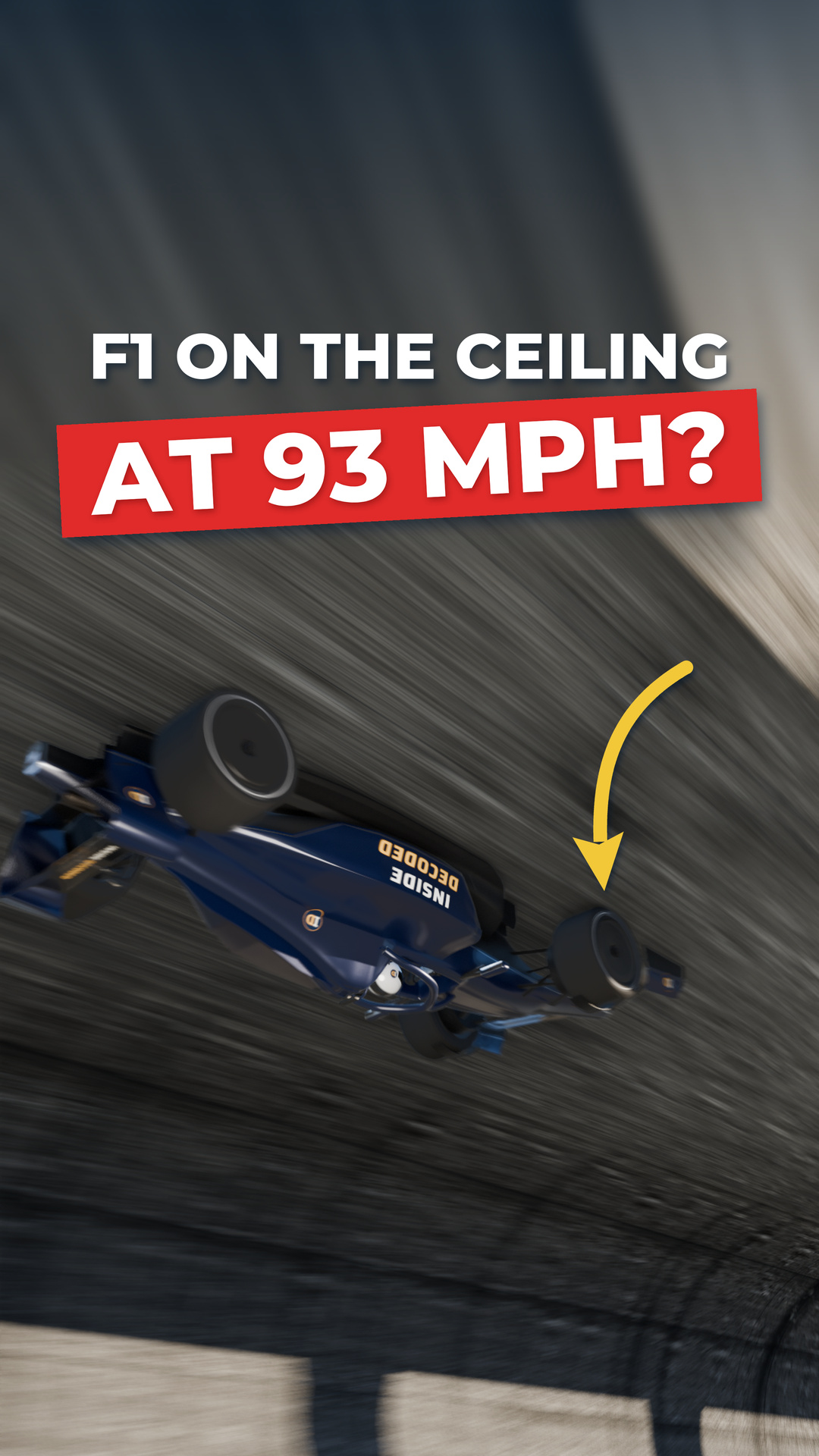
@inside_decoded Why an F1 Car Could Drive Upside Down Could aerodynamic downforce hold a Formula 1 car against a ceiling? Its wings and floor press it toward the surface as speed rises. In its 2022 explanation, Mercedes estimated that downforce matched its car's weight at about 93 mph. But matching the weight is only the beginning. Upside down, the tyres still need enough grip to overcome air resistance, and the fuel and oil systems would need to work inverted. This video explores the physics behind the theory: 93 mph is a model-specific estimate, not a guaranteed ceiling-driving speed. Sources: Mercedes-AMG F1 — Downforce explained: https://www.mercedesamgf1.com/news/feature-downforce-in-formula-one-explained NASA Glenn — The lift equation: https://www1.grc.nasa.gov/beginners-guide-to-aeronautics/lift-equation/ Driver61 — Project Inversion: https://driver61.com/formula-one/project-inversion-driving-f1-car-upside-down/ #InsideDecoded #Formula1 #F1 #Aerodynamics #Engineering

View original on Instagram

The edit1 shot · 8 text
Shots Text1:13

Performance

Views
165.6K
Likes
4.8K
Comments
20
Engagement
2.9%
Outlier
7.3×
Length · 30 Oct 2026
1:13

Video #49446 · Faceless

Explains physics of upside-down F1 carfrom @inside_decoded

[01]

Overview

The video uses 3D animation and a voiceover to explain the physics behind the theory that a Formula 1 car can drive upside down. It details how downforce is generated by the car's wings and underfloor, then explains the practical challenges that prevent this from happening, including lack of tire grip, engine fluid starvation, and the inability to slow down.

[02]

Simple outline

  1. 1State counter-intuitive claim
  2. 2Explain the core principle
  3. 3Reveal escalating complications
  4. 4Deliver paradoxical payoff

[03]

Related videos

[04]

Classification

Format
Concepts
BreakdownStrange but TrueWhat Is X?
Elements
3D AnimationMotion GraphicsVoiceoverText Overlay
Account

[05]

Hook analysis

What stops the scroll in the first 3 seconds

Verbal hook · 90%

At about 93 miles an hour, this Formula one car could drive on the ceiling.

Visual hook · 10%

A high-quality 3D animation of a Formula 1 car moving at high speed through a tunnel, creating a dynamic and visually engaging opening.

[06]

Hook template

Steal this for your own video

At about [specific threshold number and unit], this [everyday thing or machine] could [impossible-sounding feat].

  • — At about 40 miles an hour, this city bus could jump a drawbridge gap.
  • — At about 3 degrees below freezing, this sourdough starter could rise on its own in your fridge.
  • — At about 200 words per minute, this auctioneer could outtalk a speed-reading champion.

[07]

Hook and payoff

The promise the opener makes, and how the video pays it back

Hook

Present a shocking or counter-intuitive 'what if' scenario as a factual possibility, immediately creating a knowledge gap and a question of 'how?'.

Payoff

Re-confirm the initial hook's claim but immediately undercut it with the inescapable trap, creating a memorable, shareable, and intellectually satisfying paradoxical statement.

[08]

Narrative framework

The structural pattern this video runs on

Framework

The Paradoxical Deep Dive

To deconstruct a fascinating but seemingly impossible claim by first proving its theoretical validity, then systematically revealing the practical flaws that prevent it, culminating in a memorable paradox.

  1. 1

    The Foundational Analogy

    Explain the core scientific principle behind the claim using a simple, universally understood analogy (e.g., a plane's wing) to make a complex topic accessible.

  2. 2

    The 'Secret' Mechanism

    Reveal a hidden or more complex mechanism that is the true source of the phenomenon (e.g., the underfloor), making the viewer feel they are receiving insider information.

  3. 3

    The Equilibrium Proof

    Quantify the principle by identifying the exact conditions or 'tipping point' where the initial claim becomes theoretically true, providing a satisfying 'Aha!' moment.

  4. 4

    The Reality Test

    Visually transition from the theoretical world to a simulated practical application, setting the stage for the deconstruction of the initial claim.

  5. 5

    The First Fatal Flaw

    Introduce the first and most fundamental problem that arises when the theory meets reality, creating the initial 'but...'

  6. 6

    The Cascade of Complications

    Systematically introduce a series of secondary and tertiary problems (e.g., drag, mechanical failure), each one building on the last to make the scenario progressively less feasible.

  7. 7

    The Inescapable Trap

    Reveal the final, unsolvable condition that renders the entire scenario a practical impossibility, serving as the checkmate in the argument.

Themes

  • Physics
  • Engineering Limits
  • Aerodynamics

Techniques

  • 3D Animation
  • Motion Graphics
  • Voiceover

Post caption

Why an F1 Car Could Drive Upside Down Could aerodynamic downforce hold a Formula 1 car against a ceiling? Its wings and floor press it toward the surface as speed rises. In its 2022 explanation, Mercedes estimated that downforce matched its car's weight at about 93 mph. But matching the weight is only the beginning. Upside down, the tyres still need enough grip to overcome air resistance, and the fuel and oil systems would need to work inverted. This video explores the physics behind the theory: 93 mph is a model-specific estimate, not a guaranteed ceiling-driving speed. Sources: Mercedes-AMG F1 — Downforce explained: https://www.mercedesamgf1.com/news/feature-downforce-in-formula-one-explained NASA Glenn — The lift equation: https://www1.grc.nasa.gov/beginners-guide-to-aeronautics/lift-equation/ Driver61 — Project Inversion: https://driver61.com/formula-one/project-inversion-driving-f1-car-upside-down/ #InsideDecoded #Formula1 #F1 #Aerodynamics #Engineering

Text overlays

  • informational · beginning

    93 MPH 150 KM/H about

  • contextual · beginning

    ILLUSTRATIVE

  • informational · middle

    LIFT

  • informational · middle

    DOWNFORCE

  • informational · middle

    MERCEDES F1 ESTIMATE (2020)

  • informational · middle

    WEIGHT

  • informational · end

    DRAG

  • branding · throughout

    INSIDE DECODED

Transcript

At about 93 miles rank hour, this Formula one car could drive on the ceiling. So why have you never seen one do it? Air rushing over a plane's wing pushes it up. Flip that wing over, and the air pushes down instead. F-one wings are basically that. Plane wings mounted upside down. But the biggest push comes from underneath. The floor hides two tunnels that squeeze the air no it rushes faster. Fast air presses less, so the air above wins and pins the car down. That's downforce. And it grows best. Twice the speed, four times the push. Around 93 miles an hour, it's as strong as the car's own weight. No, send it up the wall, onto the ceiling. Gravity pulls it down. The air presses it back up just as hard. Here's the catch. The tires only grip with what's left over. And at 93, that's almost nothing. And the air drags it back. To fight that, the tires need real grip, so it has to go even faster. Even then, the engine could starve. Fuel and oil slosh away from the pumps. And it could never slow down. Ease off, the push fades, and it falls. So yes, an F1 car could drive on the ceiling. It just could never stop.