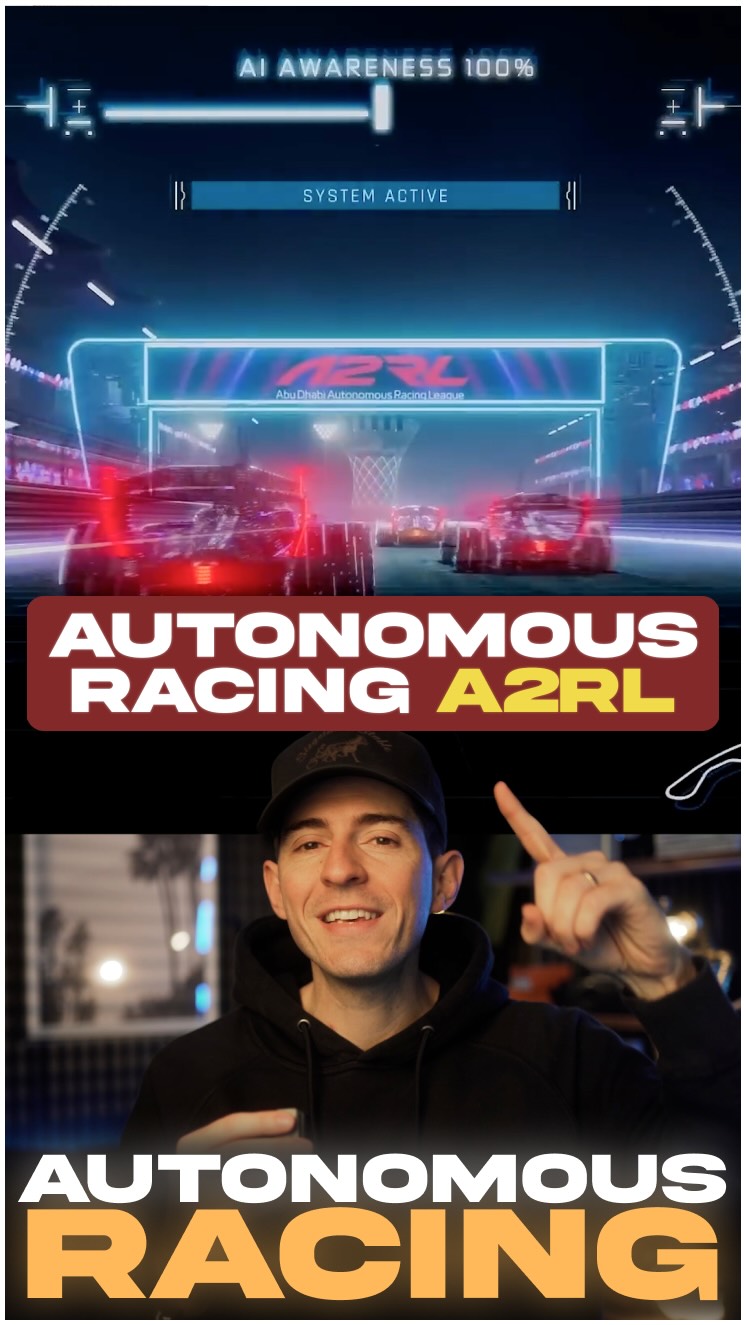
@kallaway This new racing league is like F1…except these cars drive themselves 👀
It’s called the Abu Dhabi Autonomous Racing League (A2RL).
And they’re pioneering a brand new category of racing.
In the A2RL, each team is given the exact same car and basic software package.
But here’s the difference…
Instead of having teams modify their physical car, like in F1, each team’s focus is to write custom software to build an AI driver and race plan.
They’re not actually allowed to modify the car…only the AI brain that drives it.
To build these AI drivers, each car is equipped with dozens of high-powered sensors.
Radar, lidar, GPS and visual cameras.
Those sensors combine together to generate hundreds of gigabytes of raw data every single lap, which the teams use to adjust their AI driving strategy.
Now this league is only in its second year, but it’s already showing massive growth and interest among tech enthusiasts.
Specifically because of how well it’s stress testing autonomous technology.
Just like F1 car brands use learnings from their racecars to inform their commercial vehicles, the A2RL is doing the same thing for autonomous cars.
Because the truth is, this league is really a testing ground for cutting edge driverless technology.
The learnings, strategies, and techniques that work in the racecars, will be trickled down to autonomous vehicles all over the world.
If you want to watch on November 15th, the A2RL has a huge event with the top 11 teams competing for a $2.25M prize pool.
Follow @kallaway for more videos like this
#ai #artificialintelligence #racing #racecar #f1 #tech #technology #a2rl #robot #robotics #autonomouscars #autonomousdriving
The creator explains the concept of the Abu Dhabi Autonomous Racing League (A2RL), a new form of motorsport where cars are driven by AI. He contrasts it with F1, details the technology involved (sensors, data collection), and discusses its broader implications as a testing ground for commercial autonomous vehicle technology.
A dynamic, close-up shot of a sleek, red F1-style race car in motion, creating immediate visual interest and energy.
[06]
Hook template
Steal this for your own video
This is [reaction word]: [unexpected thing] now exists
— This is wild: AI-driven race cars now exist
— This is insane: robots now referee professional soccer matches
— This is crazy: fully autonomous surgery clinics now exist
[07]
Hook and payoff
The promise the opener makes, and how the video pays it back
Hook
Grabs attention by presenting a familiar subject and immediately contradicting a core expectation about it, creating an instant mystery.
Payoff
Delivers the ultimate 'so what?' by revealing the concept's long-term, global impact, reframing it from a niche interest into a foundational element for future technology.
[08]
Narrative framework
The structural pattern this video runs on
Framework
The Analogy Subversion Framework
Introduce a new or complex topic by first presenting a familiar analog, then immediately subverting a key assumption about it to create a curiosity gap. The narrative then resolves this gap by explaining the new concept's unique mechanics and its broader, real-world significance.
1
The Subversion Hook
Establishes a familiar frame of reference (e.g., F1 racing) and then immediately breaks it by revealing a key element is missing or different (e.g., no driver), forcing the viewer to seek an explanation.
2
The Concept Reveal
Names the new subject and states its high-level premise in a single, concise sentence, directly answering the initial mystery.
3
The Core Differentiator
Explains the fundamental rule or mechanism that makes this new concept unique, often by directly contrasting it with the initial, familiar analog.
4
The Technical Deep Dive
Provides specific, tangible details about the technology or components involved, adding a layer of credibility and satisfying technical curiosity.
5
The Process Explanation
Illustrates how the previously mentioned technical components work together in a functional process to achieve the concept's goal.
6
The Significance Statement
Elevates the topic's importance by explaining why it's relevant and gaining traction now, often citing growth or current interest.
7
The Real-World Analogy
Connects the niche subject to a well-understood, large-scale process or industry, clarifying its purpose and impact for a broad audience.
Themes
Innovation
Future of Technology
Artificial Intelligence
Techniques
B-Roll
Motion Graphics
Text Overlays
Visual Analogy
Trends
AI Explainers
Post caption
This new racing league is like F1…except these cars drive themselves 👀
It’s called the Abu Dhabi Autonomous Racing League (A2RL).
And they’re pioneering a brand new category of racing.
In the A2RL, each team is given the exact same car and basic software package.
But here’s the difference…
Instead of having teams modify their physical car, like in F1, each team’s focus is to write custom software to build an AI driver and race plan.
They’re not actually allowed to modify the car…only the AI brain that drives it.
To build these AI drivers, each car is equipped with dozens of high-powered sensors.
Radar, lidar, GPS and visual cameras.
Those sensors combine together to generate hundreds of gigabytes of raw data every single lap, which the teams use to adjust their AI driving strategy.
Now this league is only in its second year, but it’s already showing massive growth and interest among tech enthusiasts.
Specifically because of how well it’s stress testing autonomous technology.
Just like F1 car brands use learnings from their racecars to inform their commercial vehicles, the A2RL is doing the same thing for autonomous cars.
Because the truth is, this league is really a testing ground for cutting edge driverless technology.
The learnings, strategies, and techniques that work in the racecars, will be trickled down to autonomous vehicles all over the world.
If you want to watch on November 15th, the A2RL has a huge event with the top 11 teams competing for a $2.25M prize pool.
Follow @kallaway for more videos like this
#ai #artificialintelligence #racing #racecar #f1 #tech #technology #a2rl #robot #robotics #autonomouscars #autonomousdriving
Text overlays
title · beginning
This is wild
contextual · beginning
is not F1.
informational · beginning
don't have a human driver
title · beginning
ABU DHABI AUTONOMOUS RACING LEAGUE
informational · middle
Only the A.I. Brain
informational · end
stress testing autonomous
contextual · end
for autonomous cars
Transcript
This is wild. What you're seeing is not F1. Because if you look closely, those cars don't have a human driver. This is the Abu Dhabi Autonomous Racing League. And they're pioneering a brand new category of racing, one where the cars drive themselves. It's pretty wild. In the H2RL, each team is given the exact same car and basic software package. But here's the difference. Instead of having the teams modify the physical car, like rank F1, each team's focus is tier right custom software to build an AI driver and race plan. They're not actually allowed to modify the car, only the AI brain that drives it. Now here's where things get interesting. To build these AI drivers, each car is equipped with dozens of high powered sensors, radar, lidar, GPS, and visual cameras. Those sensors combine together to generate hundreds of gigabytes of raw data every single lap that the teams use to adjust their AI driving strategy. Now this league is only in its second year, but it's already showing massive growth and interest among tech enthusiasts, specifically because of how well it's stress testing autonomous technology. Just like F1 car brands use learning from their race cars to inform commercial vehicles, the A2RL is doing the same thing for autonomous cars because the truth is this league is really a testing ground for cutting edge driverless technology. And the learning strategies and techniques that work in the race cars will be trickled down to autonomous vehicles all over the world.