Viral Hooks
Trending short videosVintage camera film changing process
_

@_dallasmarley_

Instagram · Vlog
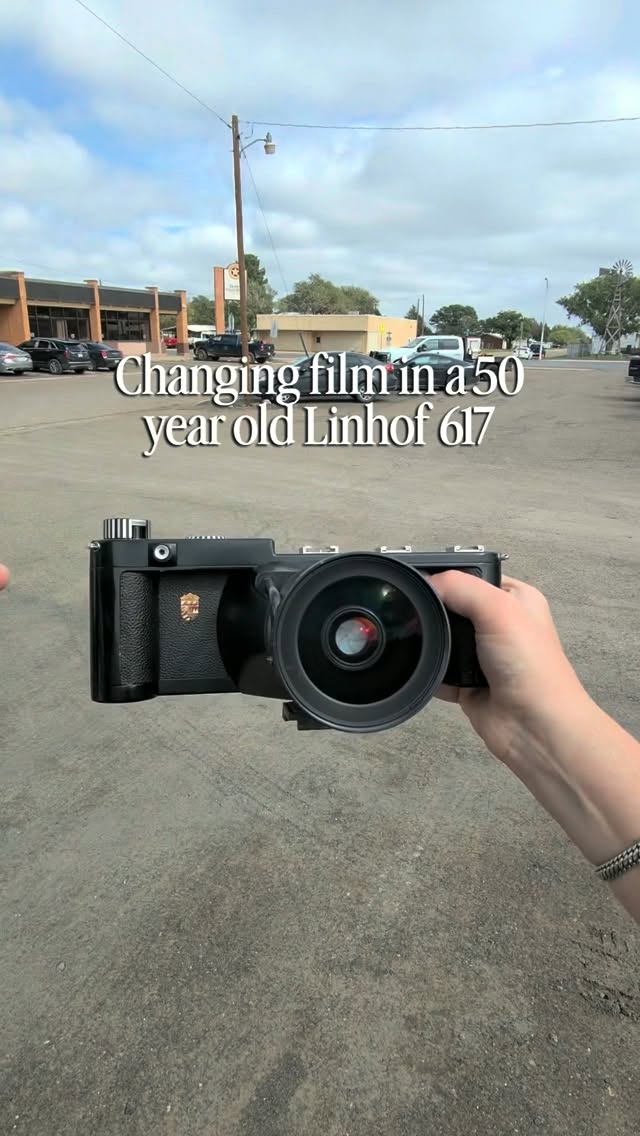
@_dallasmarley_ This camera could technically be considered a large format camera because the negatives are so huge. It’s a Linhof Technorama 617. Made in Germany. It shoots 6x17 centimeters on regular 120 roll film. That’s about three times as wide as it is tall, so every frame comes out as a giant panoramic strip. A 4x5 sheet of large format film is smaller than one of these negatives. And you only get four shots per roll. Four. A normal medium format camera gives you 10 to 16 on the same roll. Here, each frame eats up a huge chunk of the film, so every click costs you. You can’t spray and pray with this thing. The lens is a 90mm Schneider Super Angulon, and it’s built right into the camera. It’s a wide angle, and on a frame this big it gives you roughly the view of a 22mm lens on a 35mm camera. Super wide, but sharp from edge to edge. It opens up to f/5.6, so it’s not a fast lens, but it doesn’t need to be. It’s made to be shot outside in good light. One thing about it is that wide lenses like this tend to get darker toward the edges of the frame. A lot of people use a center filter to even that out. When you hold one of these negatives up to the light, it looks like a movie screen. Is it practical? No. Is it slow? Yes. But it makes you slow down and think about every frame, and I love that about it. Four shots. Make them count.

View original on Instagram

The edit1 shot · 3 text
Shots Text0:56

Performance

Views
72K
Likes
3.2K
Comments
78
Engagement
4.6%
Outlier
22.3×
Length · 29 Oct 2026
0:56

Video #49573 · Vlog

Vintage camera film changing processfrom @_dallasmarley_

[01]

Overview

The creator demonstrates the process of changing a roll of 120 film in a vintage Linhof Technorama 617 panoramic camera. From a first-person perspective, they show the camera's features, open the back, remove the used roll, insert a new roll of film, thread it, close the camera, and advance the film to the first frame, all while text overlays provide context about the camera.

[02]

Simple outline

  1. 1Showcase unique object
  2. 2Reveal critical limitation
  3. 3Demonstrate complex process
  4. 4Complete activating action

[03]

Related videos

[04]

Classification

Format
Concepts
ProcessShowcaseTutorial / How To
Elements
Text OverlayFirst-Person POVMood MusicTitle Text Hook

[05]

Hook analysis

What stops the scroll in the first 3 seconds

Title hook

Changing film in a 50 year old Linhof 617

Visual hook

First-person POV shot holding a large, unique, vintage Linhof 617 camera, creating immediate curiosity about the unusual object.

[07]

Hook and payoff

The promise the opener makes, and how the video pays it back

Hook

A first-person POV shot introduces a unique object, with a text overlay stating the specific, intriguing process about to be performed, immediately establishing subject and context.

Payoff

The Activation: The final mechanical action is performed to make the object ready for use, providing a satisfying audio-visual conclusion to the ritual and confirming its success.

[08]

Narrative framework

The structural pattern this video runs on

Framework

The Ritual Process

Transforming a technical process into a high-stakes, satisfying ritual by highlighting its unique constraints and showcasing the deliberate, methodical steps required for completion from a first-person perspective.

  1. 1

    The Object Showcase

    Visually explore the object from multiple angles in a POV shot, highlighting its unique form factor and establishing it as the hero of the narrative.

  2. 2

    The Scarcity Reveal

    Introduce a critical limitation or constraint via a text overlay, raising the stakes of the process and framing it as something special or difficult.

  3. 3

    The Value Implication

    Use a follow-up text overlay to translate the limitation into a tangible cost or consequence (e.g., financial, time), adding a layer of drama and exclusivity.

  4. 4

    The Unveiling

    Begin the core process by opening or disassembling the object, revealing its complex inner workings to the viewer.

  5. 5

    The Procedural Breakdown

    Methodically demonstrate the core process step-by-step, showing the removal of old components and the careful preparation and installation of new ones.

  6. 6

    The Final Seal

    Reassemble the object, showing it being closed and secured, signaling the near-completion of the delicate operation.

Themes

  • Analog technology
  • Nostalgia
  • Craftsmanship
  • Patience in art

Techniques

  • First-person perspective
  • Process demonstration
  • Aesthetic showcase

Post caption

This camera could technically be considered a large format camera because the negatives are so huge. It’s a Linhof Technorama 617. Made in Germany. It shoots 6x17 centimeters on regular 120 roll film. That’s about three times as wide as it is tall, so every frame comes out as a giant panoramic strip. A 4x5 sheet of large format film is smaller than one of these negatives. And you only get four shots per roll. Four. A normal medium format camera gives you 10 to 16 on the same roll. Here, each frame eats up a huge chunk of the film, so every click costs you. You can’t spray and pray with this thing. The lens is a 90mm Schneider Super Angulon, and it’s built right into the camera. It’s a wide angle, and on a frame this big it gives you roughly the view of a 22mm lens on a 35mm camera. Super wide, but sharp from edge to edge. It opens up to f/5.6, so it’s not a fast lens, but it doesn’t need to be. It’s made to be shot outside in good light. One thing about it is that wide lenses like this tend to get darker toward the edges of the frame. A lot of people use a center filter to even that out. When you hold one of these negatives up to the light, it looks like a movie screen. Is it practical? No. Is it slow? Yes. But it makes you slow down and think about every frame, and I love that about it. Four shots. Make them count.

Text overlays

  • title · beginning

    Changing film in a 50 year old Linhof 617

  • informational · beginning

    1 roll of film produces 4 negatives.

  • contextual · middle

    (Don't do the math on the cost per shot 🥸)

Transcript

What are you taking?