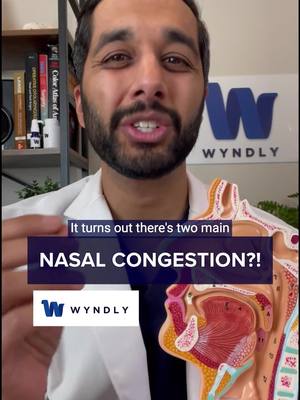
@wyndlyteam Do you have nasal congestion, but you're not sure why? It turns out there's two main types of nasal congestion. The first type of nasal congestion is when you're always blocked, no matter what. It doesn't matter what time of year, your nose is always blocked up. That could be an anatomical reason, meaning the cartilage inside your nose could be bent, we call that a deviated nasal septum, or you could have trouble breathing, and these turbinates inside your nose could be swollen up and they can be blocking air. Rarely, it can be something like nasal polyps or could even be a mass. But most people have nasal congestion that comes and goes, meaning you have it, and then like a couple days later, your nose is open again and then it gets blocked off, or sometime in the spring it's always blocked. Most of the time that's what we call a functional problem, meaning that something is getting in your nose and causing swelling of the tissues. Often times, it's allergies, meaning an allergies to pollen, dust, dander, cats, dogs, something like that. It gets into your nose, it causes the tissue to swell and it makes it so you have trouble for the air going through here and into your windpipe. By treating your allergies or by treating your sinusitis or whatever your cause is, you can actually make it so that you can breathe better. This is gonna help you breathe better, sleep better, and exercise better. So, fixing your nasal congestion is totally important because ultimately you don't really wanna be breathing through your mouth, you wanna be breathing through your nose, that's why we have it. If you wanna learn more, please subscribe. #allergies #allergyrelief #allergy #allergic #allergicreactions #allergymedicine #allergymedication #allergens #petallergens #pollenallergy #petallergy #dustallergy #allergytreatments #sinushealth #healthyliving #livingwell #livinghealthy #allergycare #allergysymptoms #immunotherapy #petallergies #seasonalallergies #allergytest #wyndly
Doctor explains nasal congestion typesfrom @wyndlyteam
[01]
Overview
The creator, a doctor, begins by asking viewers if they have unexplained nasal congestion. He then explains that there are two main types: anatomical (constant blockage from physical issues like a deviated septum) and functional (intermittent blockage from causes like allergies), using a physical anatomical model to illustrate his points. He concludes by explaining the benefits of treating the root cause, such as better breathing and sleep, and includes several calls-to-action to follow, comment, and check his profile.
You have nasal congestion, but you're not sure why?
Visual hook · 15%
A doctor in a white coat holds a large, colorful, and detailed anatomical model of a human head cross-section, immediately signaling an expert-led educational topic.
[07]
Hook and payoff
The promise the opener makes, and how the video pays it back
Hook
A direct, relatable question that identifies a common viewer pain point and promises an explanation.
Payoff
A final justification for why addressing the problem is important, followed by a direct call to action for channel growth.
[08]
Narrative framework
The structural pattern this video runs on
Framework
The Diagnostic Funnel
To diagnose a common, relatable problem by simplifying it into two distinct categories, then focusing on the more common category to offer a solution and its life-improving benefits.
1
The Thesis Statement
Establishes the video's structure by stating the problem will be broken down into a simple binary classification (e.g., two types, two reasons).
2
Category 1: The Niche Case
Briefly explains the first, often less common, category to establish expertise and address a segment of the audience, often using a visual aid for clarification.
3
Category 2: The Common Case
Pivots to the second, more relatable category, describing its symptoms in a way that resonates with the majority of viewers, creating a 'that's me' moment.
4
The Root Cause Reveal
Explains the underlying mechanism of the common category, identifying a primary culprit that viewers can recognize and understand.
5
The Solution Pathway
Transitions from problem to solution by outlining a general, actionable approach to fixing the identified root cause.
6
The Benefit Trinity
Articulates the solution's value by listing three distinct, aspirational improvements to the viewer's quality of life (e.g., 'breathe better, sleep better, exercise better').
Themes
Health education
Problem-solving
Self-improvement
Medical advice
Techniques
Direct address
Visual demonstration
Call-to-action overlays
Post caption
Do you have nasal congestion, but you're not sure why? It turns out there's two main types of nasal congestion. The first type of nasal congestion is when you're always blocked, no matter what. It doesn't matter what time of year, your nose is always blocked up. That could be an anatomical reason, meaning the cartilage inside your nose could be bent, we call that a deviated nasal septum, or you could have trouble breathing, and these turbinates inside your nose could be swollen up and they can be blocking air. Rarely, it can be something like nasal polyps or could even be a mass. But most people have nasal congestion that comes and goes, meaning you have it, and then like a couple days later, your nose is open again and then it gets blocked off, or sometime in the spring it's always blocked. Most of the time that's what we call a functional problem, meaning that something is getting in your nose and causing swelling of the tissues. Often times, it's allergies, meaning an allergies to pollen, dust, dander, cats, dogs, something like that. It gets into your nose, it causes the tissue to swell and it makes it so you have trouble for the air going through here and into your windpipe. By treating your allergies or by treating your sinusitis or whatever your cause is, you can actually make it so that you can breathe better. This is gonna help you breathe better, sleep better, and exercise better. So, fixing your nasal congestion is totally important because ultimately you don't really wanna be breathing through your mouth, you wanna be breathing through your nose, that's why we have it. If you wanna learn more, please subscribe. #allergies #allergyrelief #allergy #allergic #allergicreactions #allergymedicine #allergymedication #allergens #petallergens #pollenallergy #petallergy #dustallergy #allergytreatments #sinushealth #healthyliving #livingwell #livinghealthy #allergycare #allergysymptoms #immunotherapy #petallergies #seasonalallergies #allergytest #wyndly
Text overlays
title · beginning
Do you have nasal congestion, NASAL CONGESTION?!
contextual · beginning
DR. MANAN SHAH, MD
ENT, Allergist, & Founder, Wyndly Health
branding · beginning
W WYNDLY
call-to-action · middle
FOLLOW IF YOU HATE YOUR ALLERGIES
call-to-action · middle
ASK QUESTIONS IN THE COMMENTS
call-to-action · end
WANT TO FIX YOUR ALLERGIES FOREVER? CHECK OUT MY PROFILE!
Transcript
You have nasal congestion, but you're not sure why? It turns out there's two main types of nasal congestion. The first type of nasal congestion is when you're always blocked. No matter what, it doesn't matter what time of year, your nose is always blocked up. That could be an anatomical reason, meaning the cartilage inside your nose could be best, we call that a deviated nasal septum, or you could have trouble breathing and these turbinates inside your nose could be swollen up and they can be blocking air. Rarely, it can be something like nasal polyps or could even be a mass. But most people have nasal congestion that comes and good, meaning you have it, and then like a couple days later your nose is open again, and then it gets blocked off, or sometimes in the spring it's always blocked. Most of the time that's what we call functional problem, meaning that something is getting in your nose and causing swelling of the tissues. Oftentimes it's allergies, meaning in allergies of pollen, dust, dander, cats, dogs, something like that. It gets into your nose, it causes the tissue to swell, and it makes it so you have trouble for the air going through here and into your windpipe. By treating your allergies or by treating your sinusitis, or whatever your cause is, you can actually make it so that you can breathe better. This is gonna help you breathe better, sleep better, and exercise better. So fixing your nasal congestion is totally important because ultimately you don't really wanna be breathing through your mouth, you wanna be breathing through your no, that's why we have it. If you wanna learn more, please subscribe.
Doctor explains nasal congestion types | Viral Hooks