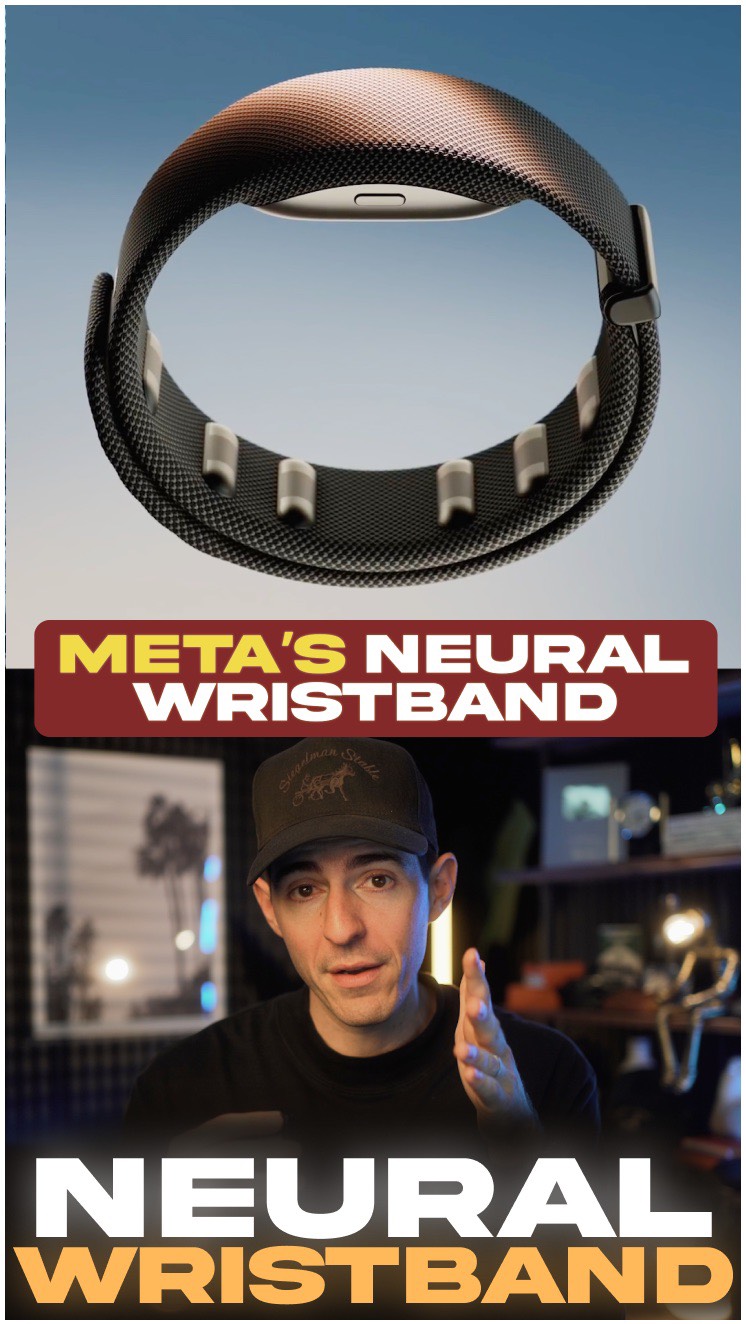
@kallaway Meta just completely changed the tech world.
And I’m not talking about their new AI glasses…
I’m talking about the neural wristband.
This is the most underrated piece of technology that’s come out in the last few years.
And I think the wristband is gonna be the reason why Meta wins the AI Race.
Let me explain…
Today, the wristband is marketed as the sidekick for Meta’s new AI glasses.
And you’ve probably seen the demos.
It can detect neurons firing in your arm before you actually move, so it unlocks a whole new class of movements and gestures.
You can tap your fingers to select. Pinch and twist to adjust volume.
You can even handwrite on your leg and have those letters render in text.
It works so well, that as soon as you use it, you realize this is the optimal controller for AR & VR.
So what if…Meta’s hero product wasn’t actually the glasses?
What if the hero product, is the wristband?
Think about it…
Over the next few months you’re going to see lots of companies come out with their version of AR glasses.
Google, Samsung, a bunch of startups, you’re even gonna see Apple’s attempt in the next few years.
But unless you want to look like Snape in the grandstands, voice control alone is not going to work in certain environments.
And eye tracking with blink select isn’t going to work either.
So you’re gonna need some sort of gesture controller.
And that’s where things get interesting.
Since 2019, Meta has quietly been building a trove of patents around this wristband use case.
I’m talking dozens and dozens of patents covering all sides of this problem.
In other words, they basically own the entire category of IP for this arm based control.
So while Meta’s glasses will be one of many, their wristband will be one of one.
And this is a huge competitive advantage.
In a way, the wristband is an entirely new interface layer in itself.
Follow @kallaway for more videos like this.
#ai #artificialintelligence #tech #technology #ar #vr #meta #newtech #wearables
Explaining a tech product's importancefrom @kallaway
[01]
Overview
The creator makes a bold claim that Meta's neural wristband, not its AI glasses, is the company's true game-changing technology. He explains its functionality, which allows for gesture control by detecting neural signals, and argues that this makes it the optimal controller for AR and VR. The creator then analyzes the competitive landscape, noting that while many companies will make AR glasses, Meta has built a massive patent moat around the wristband technology, making it a unique and powerful competitive advantage that will be key to the future of AI hardware.
A split screen showing a futuristic tech device with a purple laser effect on top, and the creator speaking energetically to the camera on the bottom.
[07]
Hook and payoff
The promise the opener makes, and how the video pays it back
Hook
A bold, sweeping claim is made, immediately followed by a subversion of expectations that pivots the focus from a popular subject to an obscure one, creating an information gap.
Payoff
The narrative concludes by restating the initial thesis with newfound authority, cementing the subject's status as the definitive 'secret weapon' and providing a powerful, memorable takeaway.
[08]
Narrative framework
The structural pattern this video runs on
Framework
The Secret Weapon Framework
To reframe an overlooked or secondary element as the true, decisive factor in a larger, well-known competition. The narrative builds a case by revealing hidden strategic advantages and future potential that the audience was previously unaware of.
1
The Bold Thesis
The core argument is stated upfront, positing that the overlooked element is the key to victory in a major race or competition.
2
Establishing the Baseline
The element's official, publicly known function and features are explained. This grounds the audience in the conventional understanding before deconstructing it.
3
The User Insight Bridge
The narrative transitions from objective features to a subjective, experiential realization, arguing that using the element reveals its true, optimal purpose.
4
The Strategic Reframe
A pivotal 'what if' question is posed, challenging the audience to invert their perception of what is the 'hero' and what is the 'sidekick'.
5
The Competitive Gauntlet
The broader market landscape is introduced as a problem. Competitors are shown to have a shared weakness or an unsolved problem, creating a clear strategic need.
6
The Hidden Moat Reveal
The 'secret' evidence is unveiled (e.g., patents, proprietary data, unique process) that proves the subject has a unique, defensible solution to the market problem.
7
The 'One of One' Declaration
The subject's competitive advantage is crystallized into a powerful, simple binary: the market is 'one of many,' while the subject is 'one of one'.
8
The Vision Expansion
The argument broadens the subject's potential applications far beyond its initial context, recasting it as a foundational layer for a whole new ecosystem.
Themes
Technological innovation
Corporate strategy
Intellectual property
Future of computing
Underrated technology
Techniques
Persuasive argumentation
Contrarian take
Evidence-based analysis
Trends
AI hardware race
AR/VR development
Post caption
Meta just completely changed the tech world.
And I’m not talking about their new AI glasses…
I’m talking about the neural wristband.
This is the most underrated piece of technology that’s come out in the last few years.
And I think the wristband is gonna be the reason why Meta wins the AI Race.
Let me explain…
Today, the wristband is marketed as the sidekick for Meta’s new AI glasses.
And you’ve probably seen the demos.
It can detect neurons firing in your arm before you actually move, so it unlocks a whole new class of movements and gestures.
You can tap your fingers to select. Pinch and twist to adjust volume.
You can even handwrite on your leg and have those letters render in text.
It works so well, that as soon as you use it, you realize this is the optimal controller for AR & VR.
So what if…Meta’s hero product wasn’t actually the glasses?
What if the hero product, is the wristband?
Think about it…
Over the next few months you’re going to see lots of companies come out with their version of AR glasses.
Google, Samsung, a bunch of startups, you’re even gonna see Apple’s attempt in the next few years.
But unless you want to look like Snape in the grandstands, voice control alone is not going to work in certain environments.
And eye tracking with blink select isn’t going to work either.
So you’re gonna need some sort of gesture controller.
And that’s where things get interesting.
Since 2019, Meta has quietly been building a trove of patents around this wristband use case.
I’m talking dozens and dozens of patents covering all sides of this problem.
In other words, they basically own the entire category of IP for this arm based control.
So while Meta’s glasses will be one of many, their wristband will be one of one.
And this is a huge competitive advantage.
In a way, the wristband is an entirely new interface layer in itself.
Follow @kallaway for more videos like this.
#ai #artificialintelligence #tech #technology #ar #vr #meta #newtech #wearables
Text overlays
title · beginning
META'S NEURAL WRISTBAND
contextual · beginning
completely changed
contextual · beginning
their Neural Wristband.
contextual · beginning
most underrated
contextual · middle
controller
contextual · end
patents around
contextual · end
huge competitive
contextual · end
weapon
Transcript
Meta just completely changed the tech worse. And I'm not talking about their new AI glasses. I'm talking about this, their neural wristband. This is the most underrated piece of technology to come out in the last few years. And I think this wristband is gonna be the reason why Meta wins the AI race. Let me explain. Today, the Neural wristband is marketed as a sidekick for Meta's new AI glasses. And you've probably seen the demos. It can detect neurons firing in your arm before you move. So it unlocks a whole new class of movements and gestures. You can tap your fingers to select, pinch and twist to adjust volume. You can even hand write on your leg and have those letters render in text. It's pretty cool. It works so well that as soon as you use it, you realize this is the optimal controller for AR and VR. So what if Meta's Hero product wasn't actually tier glasses? What if the Hero product was the wristband? Think about it. Over the next few months, you're gonna see lots of companies come out with their version of AR glasses. Google, Samsung, a bunch of startups. You're even gonna see Apple's version in the next couple years. But unless you wanna look like Snape in the grandstands, voice control alone is not gonna work in certain environments. And eye tracking with rank control is not gonna work either. So you're gonna need some sort of gesture control. And that is where things get interesting. Since 2019, Meta has been quietly building a trove of patents around this wristband use case. I'm talking dozens of patents covering all sides of this problem. In other words, they basically own the entire category of IP for this arm based control. So while Meta's glasses will be one of many, their wrist band will be one of one, and this is a huge competitive advantage. In a way, the wrist bad is an entirely new interface layer in itself. They could develop it to connect with any smart glasses, as well as any smart device in general. They could also put Whoop type health features in there no it becomes the only wearable you ever need. Eventually you could control your lights, appliances. You could even turn any static screen into a touchscreen all with simple gestures that are already intuitive to the user. I'm telling you, this neural wristband is a huge key to the future of AI hardware. And for Meta, it's their new secret weapon.
Explaining a tech product's importance | Viral Hooks