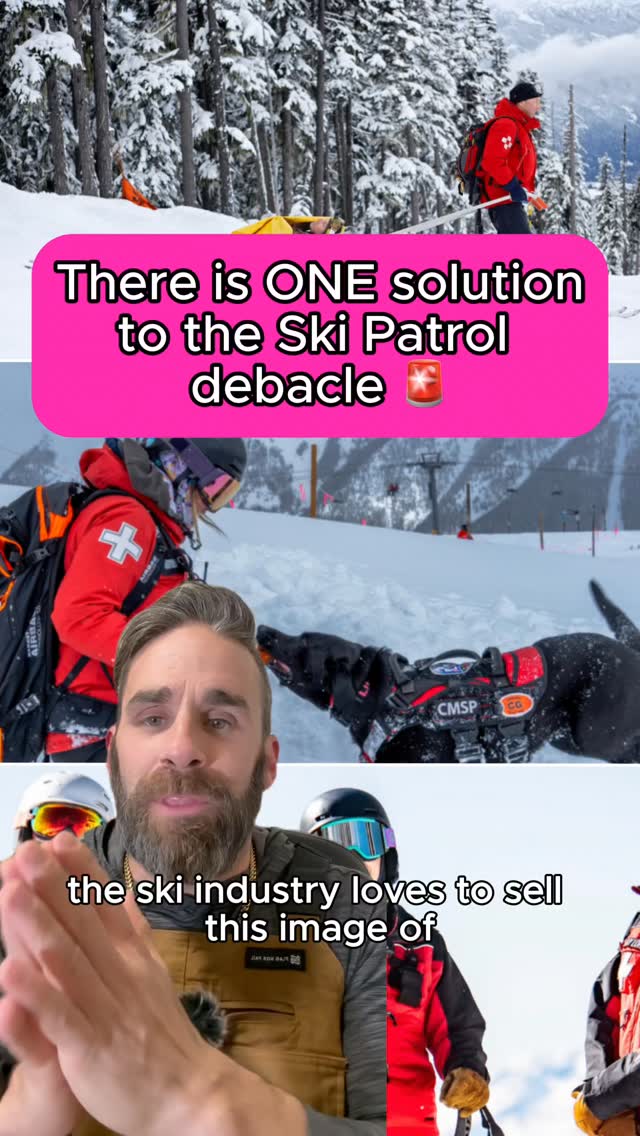
The creator deconstructs the romanticized image of ski patrol, highlighting the high costs, risks, and low pay involved. He argues that the core issue is a 'value problem,' not just a labor dispute, and proposes a comprehensive solution: a national, industry-funded 'Mountain Professional Academy' to professionalize the role, create stable career paths, and solve the industry's retention crisis.
Post caption
Trying to get to 30k followers by tomorrow and doing a little experiment. Check my profile to see where I'm at by the time you see this. THANK YOU for supporting my channel!
If you watched the Telluride shutdown and thought “this is just a one-time labor dispute,” you’re missing the bigger story: this is what happens when a $5B industry treats life-safety professionals like seasonal gig workers.
Here’s the bait-and-switch:
ski patrol isn’t a “ski bum job.”
A ski patroller doesn’t casually go into debt for:
EMT-level medical training, avalanche education, and explosives certification — just to get hired.
A ski patroller is the person who decides whether the mountain opens safely, who responds when someone is injured in high-consequence terrain, and who carries the risk when things go wrong.
And here’s the part that should make everyone uncomfortable:
Ski patrollers just fought a record-setting strike to land around $24/hr for work that’s often seasonal.
That’s not a “wage debate.”
That’s a value statement.
So here’s my solution: professionalization.
We need a Mountain Professional Academy — an industry-funded program where resorts pay for certifications up front, and graduates earn a universal “Global Mountain Professional” credential.
Then you build a dual-track system:
Track A: Career Pros
Year-round professionals doing winter patrol, summer bike/trail rescue, and fall mitigation work — with real salaries, real benefits, and wages you can actually qualify for a mortgage with.
Track B: Seasonal Specialists
High wage floor for winter-only staff, but the safety infrastructure is led by year-round pros who aren’t disappearing every spring.
And if that certification is universal? Now the job becomes a coveted, elite career path: rotate to Whistler, train in the Alps, support the Australian season — while still having a home mountain and stability.
This is how you fix retention.
This is how you protect guests.
This is how you stop ski towns from getting held hostage by broken labor economics.
The Telluride strike ended. The system didn’t.
KYLE | The most famous REALTOR in Colorado Springs
Transcript
Ski industry loves to sell this image of the ski bum job, a passion job, a lifestyle. But here's the part that they don't like to talk about. A ski bum doesn't go $10,000 into personal debt for EMT training, avalanche certification, and explosives handlings just to get hired. A ski bum doesn't carry medical kits into terrain where one mistake can kill someone. And in 2026, in Telluride, an entry level firefighter starts at about $30 an hour with a year round career path benefits and stability. Meanwhile, newly raised ski patrollers just fought the longest strike in US history to get $24 an hour for a job that only best a few months. And, like, that's not a labor dispute. That's a value problem. This is the part that nobody in the industry wants to say out loud. The solution is not slightly better seasonal pay. The solution is professionalization. Major airlines don't treat pilots like gig workers. Cities don't treat firefighters like hobbies. It's time that the ski industry stopped treating mountain safety like an optional amenity. What we actually need is a mountain professional academy, a national industry funded system that takes the financial burden off workers and puts it where it belongs, on a $5,000,000,000 industry. Imagine a model where the industry pays for your certification. You graduate debt free as an elite certified first responder with a global mountain professional credential. From there, the role splits into two tracks. Track a is the career pro, which is a year round position, winter patrol, summer bike and trail rescue, fall fire mitigation. We're talking like a real salary with real benefits in a wage you can actually qualify for a mortgage with. These professionals become the backbone of mountain safety. Tier because their certification is universal, they become the industry's elite ambassadors. I mean, imagine a tier three level where your home mountain is Telluride, but you can rotate to Whistler, spend time training in the Swiss Alps, or support the Australian winter during our summer. You're no longer just a seasonal worse. You're a global mountain specialist. And then track b is the seasonal specialist, the people who only want winter work. The wage floor stays high, but the safety infrastructure is built and led by career professionals who aren't disappearing every spring. And so when you do this, the retention crisis disappears because that has not been solved. You don't have to beg people to stay when you offer a path to a stable global career in the town they serve. You don't lose institutional knowledge every year, and you don't shut down an entire resort over a $65,000 ego fight. The Telluride strike didn't just expose a labor issue. It exposed, in my opinion, a system that has been coasting on passion while extracting professional level risk. The strike may be over and the mountain may be reopening, but if the industry doesn't move past better and demand professional, this will happen again. Different town, same math. And next time, the damage might be even worse. If you think it's time for a mountain academy, not a bad aid, share this. It's time to stop pretending that the mountain runs itself.