Viral Hooks
Trending short videosSatirical explainer on economic inequality
N

@npr

Instagram · Skit

@npr Planet Money Summer School is back in session with a world tour of economic proportions! Here's one of the lessons from last years course. From the @planetmoney archives Producer: @jackcorbe • Jack Corbett / NPR. Editor: @alexgoldmark • Alex Goldmark/NPR.

View original on Instagram

The edit1 shot · 7 text
Shots Text1:34

Performance

Views
961.8K
Likes
68K
Comments
278
Engagement
7.1%
Outlier
23.9×
Length · 10 Aug 2026
1:34

Video #38536 · Skit

Satirical explainer on economic inequalityfrom @npr

[01]

Overview

The creator plays multiple characters in a Socratic dialogue to explore the root causes of wealth inequality in the US. He breaks down concepts like wage stagnation, declining worker power, and the cycle of wealth influencing politics, using simple graphics to illustrate his points. After presenting a complex, systemic explanation, he pivots to a satirical conclusion, suggesting the solution to America's problems is to adopt a Scandinavian-style flag.

[02]

Simple outline

  1. 1Pose complex, relatable problem
  2. 2Dismiss logical, expert analysis
  3. 3Pivot to a simpler question
  4. 4Identify a spurious correlation
  5. 5Celebrate absurd 'solution'

[03]

Related videos

[04]

Classification

Format
Concepts
Opportunity ExplainerSkitSatirical Advice
Elements
Motion GraphicsGraphic OverlayWhiteboard / DrawingJump Cut

[05]

Hook analysis

What stops the scroll in the first 3 seconds

Verbal hook · 65%

The United States is a very rich country, but why doesn't it feel like it?

Visual hook · 35%

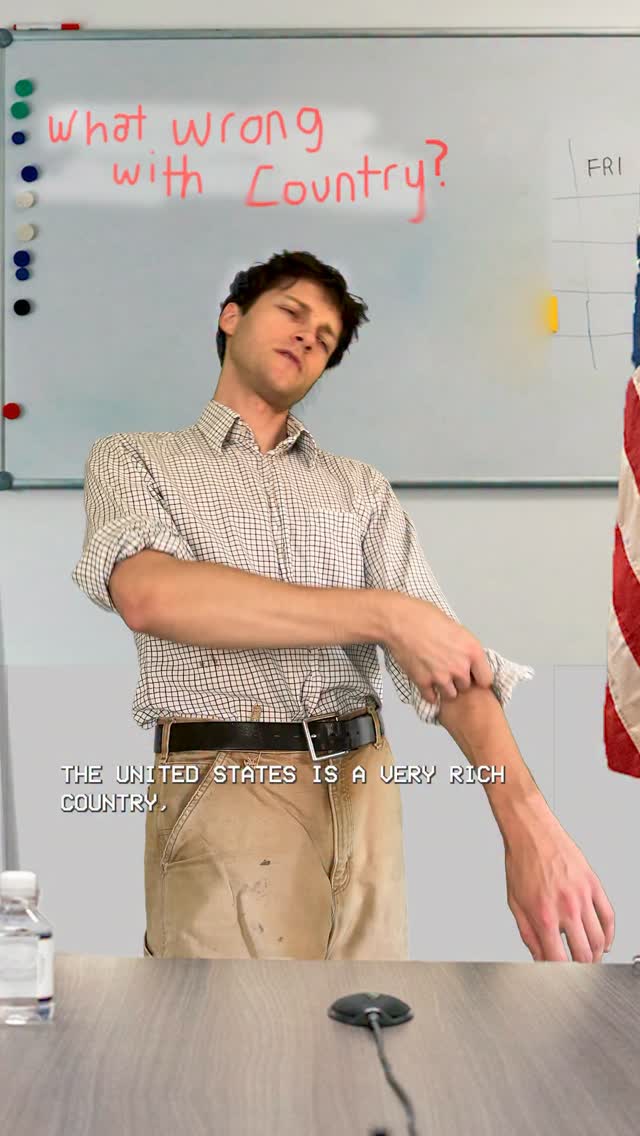
A man in a classroom setting stands in front of a whiteboard with the grammatically incorrect phrase 'What wrong with Country?' written on it, while rolling up his sleeves as if to begin a serious lesson.

[06]

Hook template

Steal this for your own video

[Country/system] is one of the [superlative claim], so why doesn't it feel like it?

  • — America has the best healthcare system in the world, so why doesn't it feel like it?
  • — We're living in the most connected era in human history, so why doesn't it feel like it?
  • — This is supposed to be the golden age of remote work, so why doesn't it feel like it?

[07]

Hook and payoff

The promise the opener makes, and how the video pays it back

Hook

Pose a high-stakes, counter-intuitive question that reflects a common audience frustration, creating immediate relatability and intrigue.

Payoff

Achieve unanimous, escalating agreement on the absurd correlation as the definitive solution, culminating in a final visual gag that implements the nonsensical fix and provides a memorable punchline.

[08]

Narrative framework

The structural pattern this video runs on

Framework

The Absurd Solution Funnel

A narrative structure that presents a complex, real-world problem, offers a series of logical but unsatisfying explanations, abruptly rejects them in favor of a simpler line of inquiry, and 'solves' the problem by identifying and celebrating a spurious correlation.

  1. 1

    The Expert's Diagnosis

    Present a series of data-supported, logical, and complex explanations for the initial problem, establishing a baseline of intellectual credibility and validating the audience's concerns.

  2. 2

    The Everyman's Rejection

    Abruptly and comically dismiss the entire complex explanation, subverting audience expectations and acting as a proxy for the desire for a simpler answer.

  3. 3

    The Simplistic Pivot

    Reframe the entire problem around a new, simpler, and more emotionally resonant question, resetting the investigation and making the goal more accessible.

  4. 4

    The Pattern-Seeking Gauntlet

    Rapidly brainstorm and discard potential correlations related to the new question, mixing plausible and absurd options to build comedic tension and audience participation.

  5. 5

    The Spurious Correlation Epiphany

    Land on a completely coincidental, often visual, pattern and present it with the gravity of a major breakthrough, creating a false 'Aha!' moment.

Themes

  • Wealth inequality
  • Political economy
  • Satire
  • Social commentary

Techniques

  • Socratic method
  • Satirical conclusion
  • Character acting
  • Data visualization

Post caption

Planet Money Summer School is back in session with a world tour of economic proportions! Here's one of the lessons from last years course. From the @planetmoney archives Producer: @jackcorbe • Jack Corbett / NPR. Editor: @alexgoldmark • Alex Goldmark/NPR.

Text overlays

  • informational · middle

    Union Density

  • contextual · middle

    Finland

  • contextual · middle

    Denmark

  • contextual · middle

    Iceland

  • contextual · middle

    Sweden

  • contextual · middle

    Norway

  • title · end

    Míssíøn Æccömplíshéð!

Transcript

United States is a very rich country, but why doesn't it feel like it? What are we doing wrong? Could it be that wage growth has stagnated for the majority of Americans? Maybe. Why'd that happen? Worse have less power. They're lower union rates. They're competing with workers abroad who are paid pennies on the dollar. In lots of communities tier job market is dominated by like a handful of employers. Yeah but what caused that? I mean a democracy means everyone has the same politics which leads to a more equal distribution of wealth. It's a self reinforcing system. Yeah and those will be rich people and poor people. It's just democracy to build a big middle class and a big say in politics. But you have the wealthy people inject their money into politics like donating and affecting political outcomes in their own favor. It leads to the kind of policies that benefit the rich and then promote more wealth equality. So it's like a cycle. Wealth inequality begets political inequality better more wealth inequality begets more political Throw that in with the fact that now a tech company could be worth $16,000,000,000 and employ like, 55 people. You get why? Even though we have a growing economy, its fruits are increasingly claimed by the people at the top. No. I don't think it's that. Let's take a new approach. Where are people happy? Five of the top seven happiest countries rank Scandinavia. No what do they have in common? It's coal. Coal? Mooses? Oh, we have those. Do have extensive welfare benefits and trust in public institutions. The same kind of flag. Oh, they do kind of have the same flag. The flag. The flag. It's the flag. That's it.

Satirical explainer on economic inequality | Viral Hooks