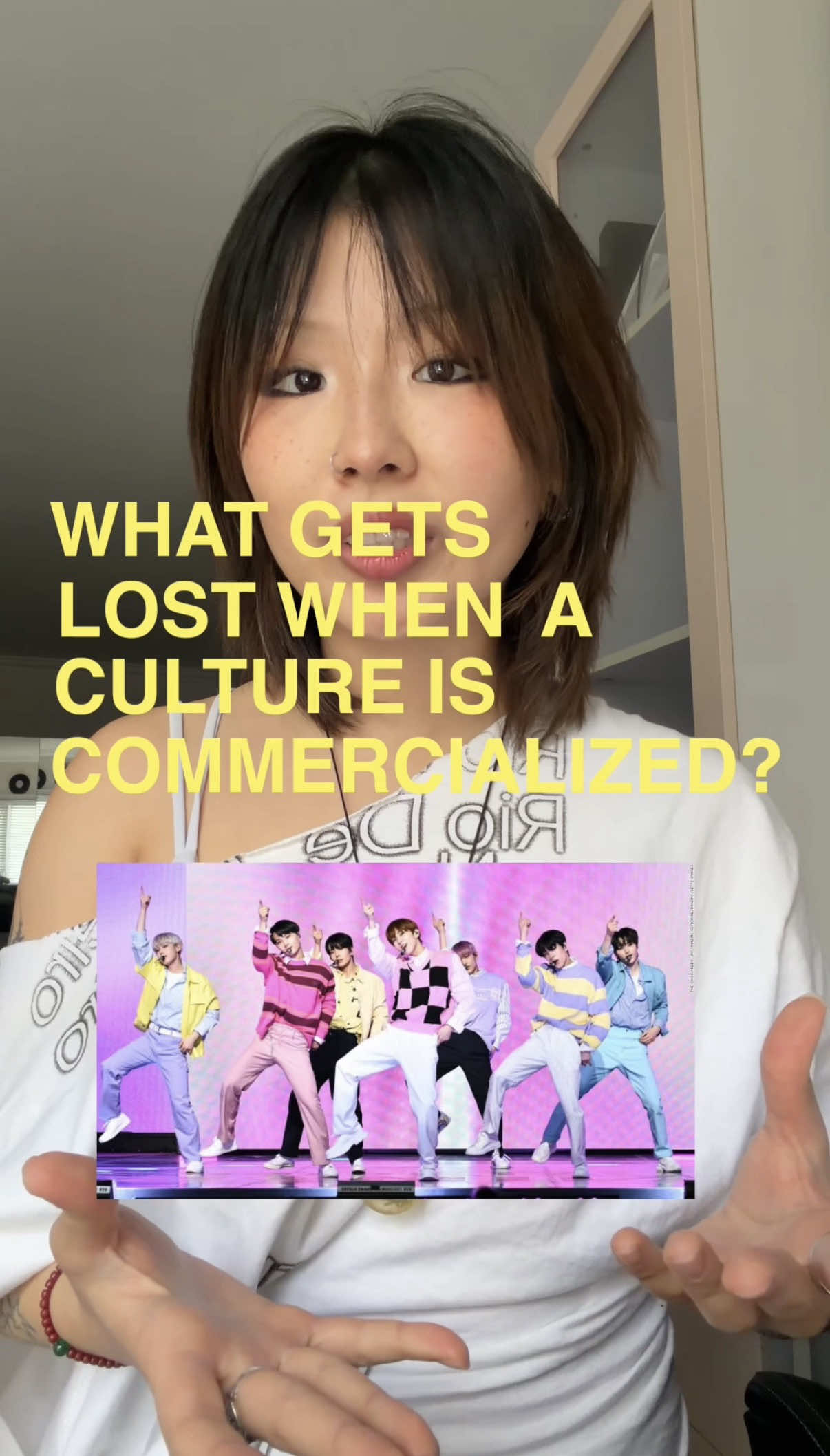
The creator delivers a direct-to-camera video essay analyzing the commercialization of culture, specifically focusing on K-pop's appropriation of Black street dance. She systematically builds her argument by contrasting the organic, community-driven origins of hip-hop in the Bronx with the profit-driven choreography of the K-pop industry. Throughout the video, she uses illustrative image overlays, screenshots of articles, and historical video clips to support her points, referencing philosophical quotes and examples like Haitian Vodou and figure skater Alysa Liu to conclude that true art and culture must stem from authentic joy rather than top-down commercial manufacturing.
Post caption
On kpop, appropriation, Alysa Liu, and the value of art
Note: I use street dance as an umbrella term but do note that every style has distinct cultural elements and histories
#kpop #dance #alysaliu #art #hiphop
Transcript
Gets lost when a culture is commercialized? This is a question I keep coming back to whenever we talk about k pop. Because at this point, we already know that the k pop industry draws heavily from black culture and that there's a huge need to pay more respect to it. So instead of asking whether it appropriates black culture, it does, I wanna ask a different question. What is the cost of that appropriation on artistic integrity? I recently watched this video from Shannon Kim and in it she references the following Herbert Tier quote. You cannot impose a culture from the top. It must grow from under. It grows out of the soil, out of the people, out of their daily life and work. And if that joy does not exist, the culture will not exist. And this, I believe, answers our question. While k pop draws from street dance culture, it lacks the soul that makes street dance what it is. Hip hop emerged from the block parties in The Bronx in the 1970s as young black people gathered to simply enjoy themselves in a time of high violence and inequality. These dances evolved organically at clubs, and they emerged through collaboration and play. The dance came from the feeling, not the other way around. With the k pop industry, however, these dynamics change significantly as these forms enter a commercial entertainment system. What people call k pop dance isn't actually a distinct dance style, it's commercial choreography, in which commercial literally means to make money. The entire laison d'oeuvre of k pop and its dances is to make a profit, and you can tell. Now I am in no way saying that k pop idols can't dance. A lot of them are incredibly skilled performers and dancers. But when dancers engage with choreography as purely movement detached from any context, something important and integral gets worst. And this raises a deeper question about the relationship between movement and meaning. In Shannon's video, she references Maya Darren's Divine Horseman, a film which documents Haitian voodoo dance traditions. In these rituals, dancers enter a trance like state where their bodies get possessed. Years later, while working on a piece with a group of West African dancers, choreographer Ralph Lemon prompted his dancers to recreate the free physicality of these moves. Yes, the dancers refused, explaining that by performing the movement, there lay a genuine risk in them entering voodoo rank, as the movement exists not simply as an aesthetic form, but rather as from the emotional and spiritual state behind it. In other words, one cannot separate the surface of the movement from the meaning that created it. And I think this is exactly what the problem with k pop's use of street dances. While the dancers are able to replicate the forms with great technical precision, the soul of the dance is missing. Now I am not trying to be a hater. K pop has undeniably increased global interest in dance and has created lots of opportunities for choreographers and dancers. Many people first encounter street dance through K pop and that accessibility has value. But this accessibility can and should coexist with the respect for the culture that it comes from. Learning the history, studying the foundations, participating in the communities where the culture continues to evolve, these will not only allow for a deeper engagement with the culture, but it'll improve the art itself as it imbues the soul into an otherwise empty shell. And people can feel a difference when that soul is there. We see this with a public reaction to Alyssa Liu. Fingerskating is one of the most regulated and quantified artistic sports in existence. And best, Alyssa Liu stands out because she's moving not just from a place of form and technique, but from a feeling of joy. She's standing out of love, and you can see that translate in her movement. And this quality isn't something that can be replicated through sheer imitation of form. It reflects something intangible, a sense that movement is emerging from the dancer rather than being imposed upon them. So when a culture gets commercialized, what disappears is the thing that makes culture meaningful in the first worst. That is, the joy that grows out of people's daily life. And that joy can't be manufactured from above. It has to grow from below.