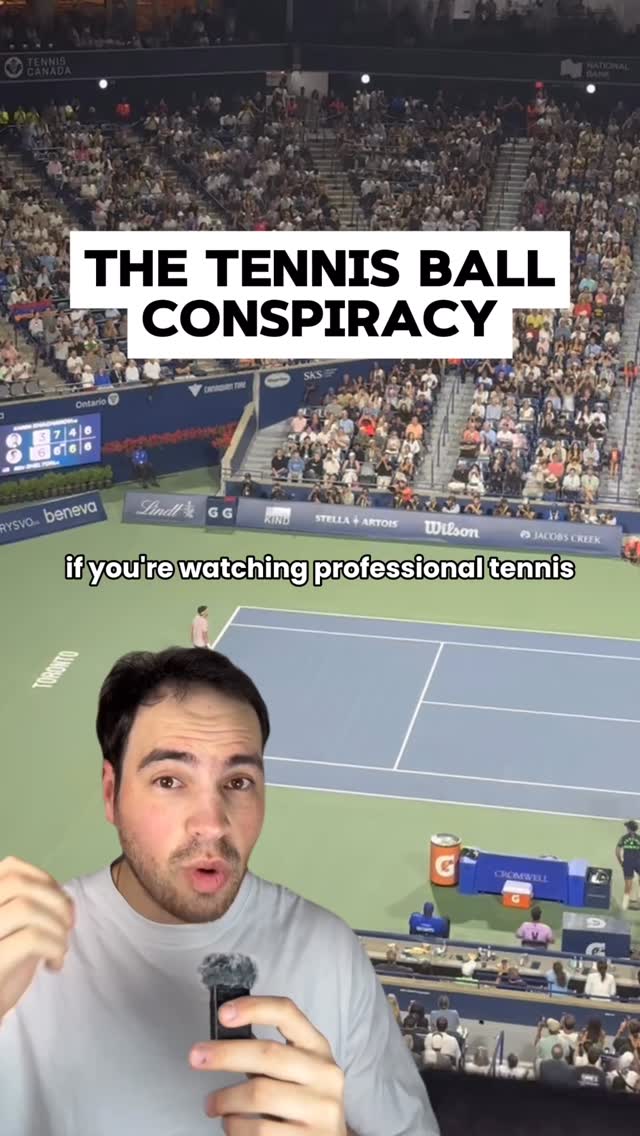
The creator uses a greenscreen format to deconstruct the fragmented economic model of professional tennis. He uses the controversy over changing tennis balls as a case study to explain the sport's complex governance, sponsorship deals, and an impending antitrust lawsuit, visually supporting his points with screenshots of news articles, data charts, and historical context.
Post caption
Tennis is the only major sport on earth where the ball changes every week and nobody in charge seems to care. That should tell you everything about who the system is actually built for.
I’ve been pulling on this thread for a while now and the deeper you go the more unhinged the economics get. We’re talking about a sport generating billions in broadcast revenue where the most fundamental piece of equipment the thing every player hits thousands of times a day is chosen based on who writes the biggest sponsorship check.
What’s happening right now behind the scenes, in courtrooms, in boardrooms, between governing bodies that have operated unchecked for decades is bigger than any ball complaint Medvedev has ever made. And I think it might be the most important structural story in professional sports that nobody outside of tennis is paying attention to.
If you watch tennis, you need to understand what’s underneath the product you’re watching. If you don’t watch tennis, this is still one of the best case studies in how fragmented governance, misaligned incentives, and tiny sponsorship deals can hold an entire sport hostage.
#economics #tennis #sportbusiness #sports
Transcript
People don't understand that if you're watching professional tennis, you're watching a broken economy in real time. So let's talk about the gravity of Medvedev's better flares rank the billion dollar lawsuit they just triggered. In February 2026, famous tennis player Daniil Medvedev stopped a match at the Rotterdam Open to ask the tournament supervisor whether the tennis balls were actually round, then told the cameras to You leave this balls from the fucking planet. Which sounds like a meltdown, and it is and it's not. What's underneath is one of the most strange economic failures in professional sports because this isn't about whether one manufacturer's felt is fluffier than another's. It's about a sport whose governance is so fragmented that the athletes bear the physical worst of that fragmentation. The neon ball balls just happen to be the most visible symptom of this. We talked about last time how the NHL, NFL, and NBA all have single supplier contracts for their sports. Tennis is the only other major sport where the ball changes tournament to tournament, and that's because tennis has 63 independently owned tournaments, four rank slams that don't answer the Tier, and seven separate governing entities. Every tournament historically cut its own ball deal with whatever manufacturer paid the most. Usually, these ball deals bring in north of 200,000 to 500,000 for big events. Airline and car sponsors pay 10 times that. But centralizing who supplies the ball is not the same as standardizing what the ball is. Manufacturers don't want a universal spec because it turns their product into a commodity tier a $1,500,000,000 market. And they have a natural ally in the Rank Slams, which negotiate independently and won't give up partnerships that are in some cases a century old. The players who absorb all the physical worst have influence over exactly one of seven power centers. So the ATP's plan is incremental. It's slow, full centralization isn't expected until 2027 with legacy contracts running through 2028. But what nobody covering this story is connecting this to is that there's a much larger forcing function already in motion. In March 2025, the Players Association, the PTPA, filed an antitrust lawsuits in The US, UK, and EU against Tennis' governing bodies, calling them a cartel. The complaint specifically cites injury inducing tennis balls. Then in December 2025, Tennis Australia broke ranks and settled. And as part of that settlement, they agreed to cooperate with the players against the Rank Slams, including handing over confidential financial information. Then weeks ago, the USTA hired Craig Tier, the same CEO who negotiated that settlement as their new chief executive. Sources told Sportico his handling of the lawsuit was a main consideration in the hire. So you have the guy who settled the first domino now running the organization behind the US Open. And in January, Sportico reported the PTPA is soliciting pitches from investment banks to raise up to a billion dollars to create a holding company that would control tennis commercial rights, broadcast sponsorships, and governance. A full PGA LIV style restructuring of the sport. And if that happens, ball standardization isn't a negotiation, it's a line item in a new regime, and everyone's been treating this as a manufacturing problem when it's not. It's a governance problem, and the governance is already cracking from the inside.