Viral Hooks
Trending short videosCruise ship outbreak biological cycle explained
M

@maxxrosenblum

Instagram · Greenscreen Talking Head

@maxxrosenblum The hantavirus outbreak aboard the MV Hondius is a textbook case of unpriced externalities. For decades, the $3.2 billion expedition cruise industry has built its margins on a geographic arbitrage: selling premium access to remote, ecologically volatile environments without pricing in the localized risks. Ecologists have long tracked the “bamboo clock”, predictable, century-old cycles of rodent surges and pathogen spillovers in regions like Patagonia. Yet operators treated this documented, cyclical risk as a zero-cost liability, effectively socializing the ultimate biosecurity burden onto the public infrastructure of global port states. This structural blindness extends to the pharmaceutical sector, where a classic market failure left the world exposed. It proves a grim economic reality: entirely predictable biological cycles remain unpriced and ignored until the pathogen intersects with wealthy, mobile capital. The Hondius is a stark reminder that just because an ecological liability isn’t priced into a ticket doesn’t mean the market won’t eventually force a harsh correction. #economics #hantavirus #biology #cruiseships

View original on Instagram

The edit1 shot · 14 text
Shots Text2:16

Performance

Views
866.2K
Likes
39.2K
Comments
345
Engagement
4.6%
Outlier
108.7×
Length · 8 May 2026
2:16

Video #26067 · Greenscreen Talking Head

Cruise ship outbreak biological cycle explainedfrom @maxxrosenblum

[01]

Overview

The creator explains that the recent hantavirus outbreak on the MV Hondius cruise ship was a predictable event caused by a failure in economic risk management. He breaks down the concept of the "bamboo clock," an ancient biological cycle in Patagonia where synchronized bamboo flowering leads to rodent population booms and pathogen spillovers. The creator argues that the multi-billion dollar expedition cruise industry ignored this well-documented, centuries-old risk, leading to the outbreak and demonstrating the principle that public knowledge is not the same as priced risk until it affects wealthy consumers.

[02]

Simple outline

  1. 1Reframe a current event
  2. 2Reveal a hidden mechanism
  3. 3Prove the mechanism was known
  4. 4Expose the systemic failure
  5. 5Deliver a universal lesson

[03]

Related videos

[04]

Classification

Concepts
Case Study BreakdownBreakdown
Elements
Title Text HookGreen Screen CompositeImage OverlayGraphic Overlay

[05]

Hook analysis

What stops the scroll in the first 3 seconds

Title hook · 35%

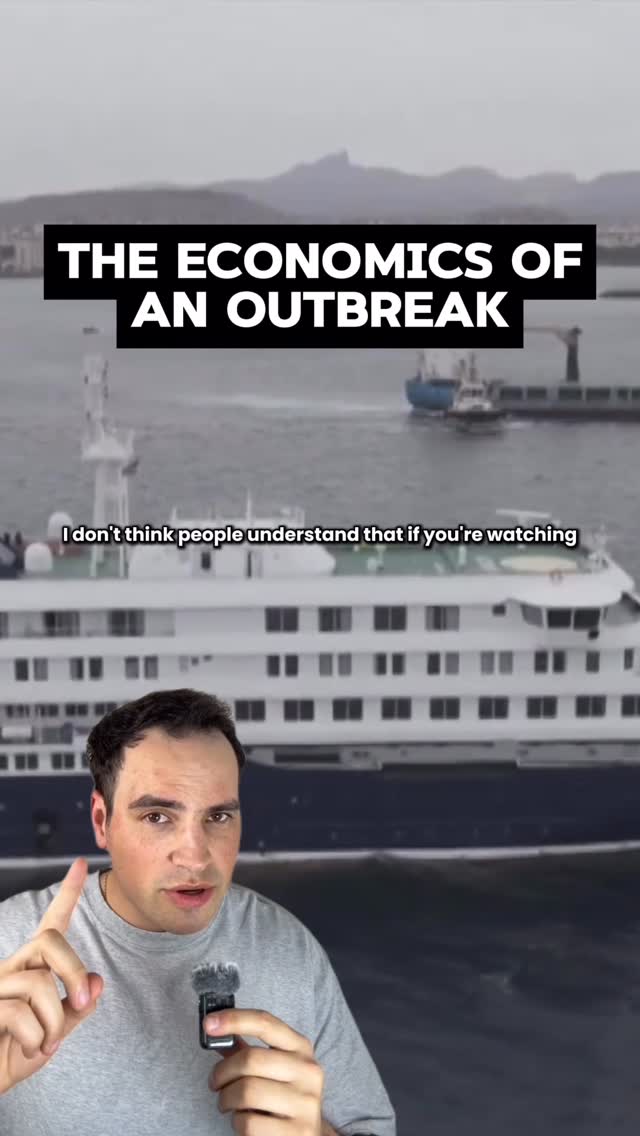
THE ECONOMICS OF AN OUTBREAK

Verbal hook · 60%

I don't think people understand that if you're watching the cruise ship hantavirus story, you're watching one of the most predictable events of the decade.

Visual hook · 5%

A speaker is superimposed over a wide shot of a large cruise ship at sea, gesturing directly to the camera to immediately establish the topic and speaker authority.

[06]

Hook template

Steal this for your own video

I don't think people understand that if you're watching [current event], you're watching one of the most predictable [type of event] of the [timeframe].

  • — I don't think people understand that if you're watching the nationwide egg shortage, you're watching one of the most predictable supply-chain crises of the year.
  • — I don't think people understand that if you're watching the AI hiring freeze, you're watching one of the most predictable labor-market shifts of the decade.
  • — I don't think people understand that if you're watching the coral bleaching event, you're watching one of the most predictable climate disasters of our generation.

[07]

Hook and payoff

The promise the opener makes, and how the video pays it back

Hook

Challenge the common perception of a recent, well-known event by claiming it was not a random accident but a highly predictable outcome, creating an immediate knowledge gap.

Payoff

Distill the entire narrative into a single, powerful, and universal principle. Broaden this principle by showing how it applies to other, unrelated domains, transforming the story into a reusable mental model for the viewer.

[08]

Narrative framework

The structural pattern this video runs on

Framework

The Predictable Disaster Blueprint

Deconstruct a seemingly random, chaotic event to reveal it was the predictable outcome of a hidden, long-understood systemic failure, where a known risk was ignored or unpriced by the market.

  1. 1

    The Factual Grounding

    Briefly summarize the surface-level facts of the event to establish a shared context with the audience.

  2. 2

    The Thesis Pivot

    Explicitly state that the true story is not what it seems. Reframe the event from a simple incident into a symptom of a much larger, more interesting systemic failure (e.g., from a biological story to an economic one).

  3. 3

    The Hidden Mechanism Reveal

    Explain the underlying, often invisible, process or cycle that actually caused the event. This is the 'secret knowledge' that fulfills the hook's promise.

  4. 4

    The 'Known Risk' Corroboration

    Provide historical evidence and data to prove that this hidden mechanism is not a new discovery, but a well-documented phenomenon that has been understood for a long time. This establishes the negligence at the core of the story.

  5. 5

    The Causal Bridge

    Directly connect the abstract hidden mechanism to the specific people and places involved in the initial event, making the cause-and-effect relationship undeniable.

  6. 6

    The Scale of Negligence

    Quantify the economic or social scale of the system that ignored the risk, contrasting its size and profitability with its complete failure to account for the known danger.

  7. 7

    The Inevitable Correction

    Show the real-world consequences and reactions that occur once the unpriced risk finally materializes, demonstrating the market or society forcing a reckoning.

Themes

  • Risk management
  • Economic externalities
  • Predictable crises
  • Market failure
  • Environmental science

Techniques

  • Visual storytelling
  • Data visualization
  • Historical analysis
  • Greenscreen compositing

Post caption

The hantavirus outbreak aboard the MV Hondius is a textbook case of unpriced externalities. For decades, the $3.2 billion expedition cruise industry has built its margins on a geographic arbitrage: selling premium access to remote, ecologically volatile environments without pricing in the localized risks. Ecologists have long tracked the “bamboo clock”, predictable, century-old cycles of rodent surges and pathogen spillovers in regions like Patagonia. Yet operators treated this documented, cyclical risk as a zero-cost liability, effectively socializing the ultimate biosecurity burden onto the public infrastructure of global port states. This structural blindness extends to the pharmaceutical sector, where a classic market failure left the world exposed. It proves a grim economic reality: entirely predictable biological cycles remain unpriced and ignored until the pathogen intersects with wealthy, mobile capital. The Hondius is a stark reminder that just because an ecological liability isn’t priced into a ticket doesn’t mean the market won’t eventually force a harsh correction. #economics #hantavirus #biology #cruiseships

Text overlays

  • title · beginning

    THE ECONOMICS OF AN OUTBREAK

  • informational · middle

    Risk Management [risk 'ma-nij-mant] The process of identification, analysis, and acceptance or mitigation of uncertainty in investment decisions.

  • informational · middle

    Mautam - Melocanna baccifera - 50-year cycle - NE India

  • informational · middle

    Thingam - Bambusa tulda - 48-year cycle - alternates with mautam

  • informational · middle

    Ratada - Chusquea spp. - 12-30 years - South America, since the 1500s

  • informational · middle

    Oligoryzomys longicaudatus density (per hectare)

  • informational · middle

    Market size, 2024 $3.2B

  • informational · middle

    Annual growth ~10%

  • informational · middle

    Through Ushuaia 80,000+

  • informational · middle

    Ticket range $10K-$100K

  • informational · middle

    Shared biosecurity standard 0

  • informational · middle

    Pre-departure surveillance 0

  • title · end

    THE CLIMATE CHANGE-INSURANCE PROFIT CYCLE

  • title · end

    HOW ANTIBIOTIC RESISTANCE HAPPENS

Transcript

Don't think people understand that if you're watching the cruise ship antavirus story, you're watching one of the most predictable events of the decade. So let's talk about how one bird watching trip in a bamboo forest just caused a multi billion dollar reckoning rank why nobody priced in an event we've known about for one hundred rank fifty years. As you likely know, in April 2026, the MV Hondius left Ushuaia in Argentina with tier passengers. Three weeks in, a 70 year old Dutch passenger collapsed on board with a fever and died. Two more deaths followed. And by early May, eight people were confirmed with Andy's Hentavirus. This sounds like a freak best, and it is, and it's not. What's underneath is one of the strangest economic failures in modern risk management. Because this isn't a story about a virus on a cruise ship. It's a story about an industry that grew tenfold in thirty years, walked into an ancient biological cycle, and never priced out what the cycle actually costs. Ecologists call it the bamboo clock, which refers to how certain bamboo species flower simultaneously across entire forests on cycles ranging from twelve to a hundred twenty tier, which results in lots of seeds on the forest floor which drives rodent populations to explode. And once the seeds run out, tier rats raid grain stores, eat the harvests, and spread pathogens. Indigenous communities have been tracking these cycles by name for over one hundred and fifty tier. And in South America, it was documented by the Spanish conquistadors in the fifteen hundreds. And surprisingly, the cycle is running right now. It's the same kind of cycle that has driven rodent surges across Patagonia for centuries, has been driving them across the exact region the Hondius passengers traveled before they boarded, like four month bird watching trips across Chile, Uruguay, and Argentina in countries with documented antivirus reservoirs. This cycle is published. The mechanism is published. The risk is published. Just extremely well hidden. Separate industries built themselves around this geography without pricing in any of expedition cruise tourism is a $3,200,000,000 segment growing 10% a year, threading 80,000 plus passengers through Ushuaia at $10,000 to a $100,000 a ticket with no shared biosecurity standard no no pre departure surveillance. And on May 6, we saw Spain refuse to dock the Hondius Antena Rife, the first post COVID precedent of a wealthy port state refusing to absorb a biosecurity cost the cruise operator should have internalized. So here's the thing the Hondius' are really showing us. Public knowledge isn't the same as priced risk as the bamboo clock has been ticking since the Spanish worst and the early warning model has been published since 2024. Yet none of it made it into a market until people the system cared about started getting hurt. That's the actual lesson And once you see it, you start seeing it everywhere. Climate tight insurance, antibiotic resistance, every market where warning exists and the response doesn't. And it shouldn't take another global pandemic scare to see that.