@hangxw I keep thinking about Søren Kierkegaard’s idea that regret is unavoidable.
“Marry, and you will regret it; don’t marry, you will also regret it. Laugh at the world’s foolishness, you will regret it; weep over it, you will regret that too. Believe a woman, you will regret it; believe her not, you will regret it. Hang yourself, you will regret it; do not hang yourself, and you will regret that too.”
This honestly feels strangely freeing because if some amount of regret exists either way, then the pressure to choose perfectly starts to dissolve. Which also means most choices aren’t life sentences anyway.
#makingdecisions #decisionmaking #perspectiveshift
Philosophical reframe on decision makingfrom @hangxw
[01]
Overview
The creator explains the philosophical concept that regret is an unavoidable part of any major decision, using a quote from Søren Kierkegaard. She argues that instead of trying to make the 'perfect' choice, one should focus on choosing fully and living with the inherent trade-offs, as life is not a linear or permanent path.
If you overthink every major decision in life, you're looking for something that doesn't exist.
Visual hook · 5%
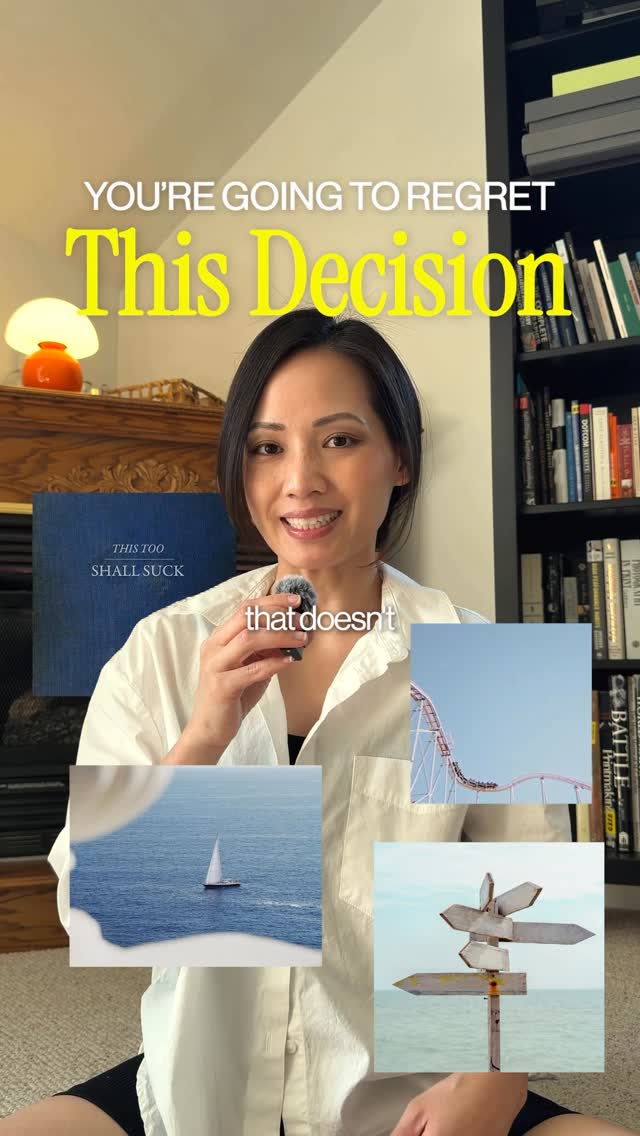
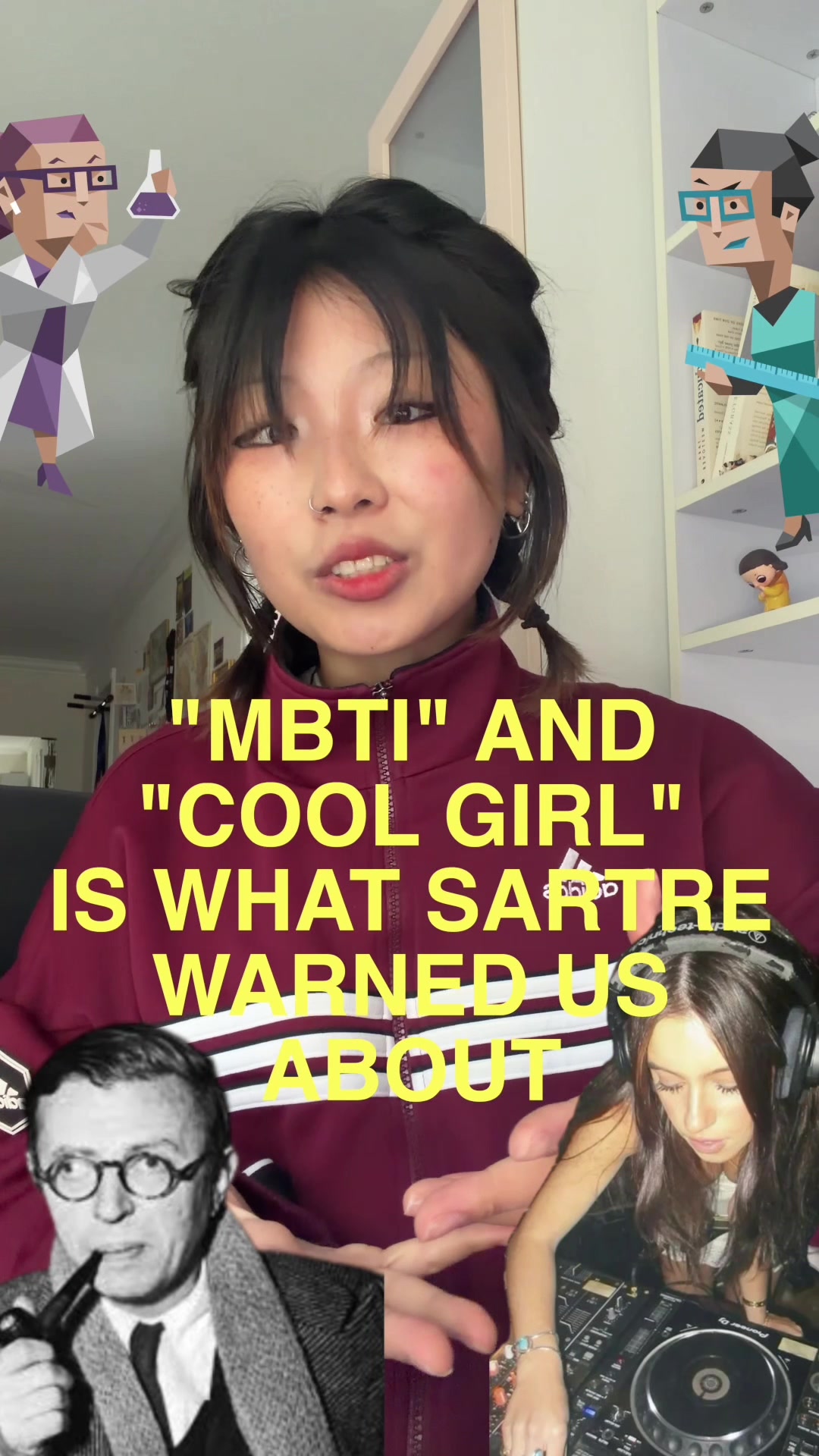
A speaker addressing the camera with three distinct, aesthetic images (a sailboat, a roller coaster, and a signpost) overlaid on the screen, creating a collage effect.
[06]
Hook template
Steal this for your own video
If you [relatable overthinking behavior] every [life domain], you're looking for something that doesn't exist.
— If you research every variable before launching your business, you're looking for something that doesn't exist.
— If you wait for the perfect moment before every workout, you're looking for something that doesn't exist.
— If you reread every email you send at work three times before hitting send, you're looking for something that doesn't exist.
[07]
Hook and payoff
The promise the opener makes, and how the video pays it back
Hook
Directly address the viewer with a highly relatable psychological problem (overthinking decisions) and a provocative title card that creates immediate intrigue.
Payoff
Conclude by softening the stakes further, suggesting that decisions are only for a 'season' and that life is not linear, granting the viewer final permission to act without the fear of permanent consequences.
[08]
Narrative framework
The structural pattern this video runs on
Framework
The Philosophical Reframe
Addressing a common psychological struggle by introducing a counterintuitive philosophical concept, deconstructing the root cause of the struggle, and offering a liberating new perspective as the solution.
1
The Counterintuitive Authority
Introduce a challenging or paradoxical quote from a respected source (Søren Kierkegaard) that contradicts the viewer's goal of finding a 'perfect' choice.
2
The Root Cause Analysis
Explain the underlying psychological reason why the viewer experiences the initial problem, diagnosing it as a false belief (treating decisions as absolutes) and the search for an impossible certainty.
3
The Paradigm Shift
Reframe the nature of the problem by redefining choices not as permanent sentences but as temporary 'experiments', lowering the stakes and introducing a new way to view the process.
4
The Actionable Re-orientation
Provide a new, simple behavioral directive that shifts the goal from an impossible outcome ('choosing perfectly') to an achievable process ('choosing fully').
5
The Law of Inherent Trade-offs
Explain that every choice involves both a gain and a loss, normalizing the feeling of regret or 'missing out' as an inescapable part of any decision. This is reinforced with a clear, binary example (ambition vs. comfort).
6
The Path to Peace
Define the true resolution not as achieving a perfect outcome, but as finding peace through the full commitment to and experience of the path chosen.
Themes
Decision-making
Regret
Existentialism
Mindset shift
Techniques
Philosophical framing
Image overlays
Direct address
Post caption
I keep thinking about Søren Kierkegaard’s idea that regret is unavoidable.
“Marry, and you will regret it; don’t marry, you will also regret it. Laugh at the world’s foolishness, you will regret it; weep over it, you will regret that too. Believe a woman, you will regret it; believe her not, you will regret it. Hang yourself, you will regret it; do not hang yourself, and you will regret that too.”
This honestly feels strangely freeing because if some amount of regret exists either way, then the pressure to choose perfectly starts to dissolve. Which also means most choices aren’t life sentences anyway.
#makingdecisions #decisionmaking #perspectiveshift
Text overlays
title · beginning
YOU'RE GOING TO REGRET This Decision
contextual · beginning
Soren Kierkegaard
contextual · beginning
father of
informational · beginning
Do it or don't do it. You will regret both.
informational · middle
CERTAIN in an UNCERTAIN WORLD
informational · middle
every choice gives you something.
informational · middle
every choice costs you something too.
informational · end
FULLY LIVING OUT
informational · end
the choices
informational · end
Linear or Permanent
Transcript
If you overthink every major decision in life, you're looking for something that doesn't exist. Soren Kierkegaard said, do it or don't do it. You will regret both. And as brutal as that sounds, I think he was pointing to something painfully true about making decisions. We overthink because we treat every decision as an absolute. But even the perfect decision, you'll still wonder what would have happened if you'd chosen differently. The weight you feel comes from the pressure of wanting to be certain in an uncertain worse. And the reality is, most of our choices are just experiments. So if regret is unavoidable, maybe the point is to stop trying to choose perfectly and start choosing fully because every choice gives you something, but every choice costs you something too. If you choose ambition, you lose comfort. And if you choose comfort, you might lose potential. No amount of planning removes the grief of choosing. And as I get older, I'm starting to see that true peace comes from fully living out the choices you made. Not constantly looking over your shoulder at every possible one. And not forever or even the next twenty years. Just for this season and see where it leads. Because life is rarely as linear or permanent as we think it is.
Philosophical reframe on decision making | Viral Hooks