@glass__museum
TikTok · Graphic Yap

@glass__museum On existentialism, labels, identity, and aesthetics #philosophy #existentialism #aesthetics #theory #identity

@glass__museum
TikTok · Graphic Yap
@glass__museum On existentialism, labels, identity, and aesthetics #philosophy #existentialism #aesthetics #theory #identity
Performance
Video #26890 · Graphic Yap
[01]
The creator explains Jean-Paul Sartre's existentialist concept that 'existence precedes essence,' arguing that humans are free to create their own identity but often flee from this responsibility. She connects this philosophical idea to modern trends, critiquing how people use systems like the MBTI personality test and adopt pre-packaged aesthetics like the 'cool girl' as prescriptive scripts for their identity, thereby letting an external 'essence' define their existence.
[02]
[03]
 558K104.5×Philosophical monologue over illustrative photos@iamfieldnotes · Motivational Mantra
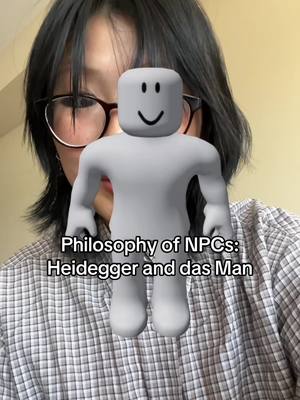 86.5KPhilosophy explanation of NPC meme@glass__museum · Breakdown
 956.1K873.9×Psychological exercise for self-discovery@hangxw · Tutorial / How To
 426.2K4×Quote introduces personal growth story@bitterbuilds · Anecdotal Philosophy
 286.4K5.9×Literary quote applied to AI@var.aunevik · Anecdotal Philosophy
 163.3K7.8×Philosophical travel vlog about identity@j.g.fall · Vulnerable Monologue
 341K8×Explaining why human nature matters@kolbykirschner · Opportunity Explainer
 927.6K6.7×Philosophical monologue on luxury lifestyle@gstaadguy · Brand Manifesto
 163K26.2×Reframe romance with philosophical concept@glass__museum · Anecdotal Philosophy
 484.4K5.1×Text-driven personality definition montage@diogo.jared · Vulnerable Monologue
 295.8K81.5×Analyzing social media performance archetypes@theoparisi__ · Breakdown
 932.5KLiterary quote explains modern society@catherinejuliasmith · Anecdotal Philosophy
[04]
[05]
What stops the scroll in the first 3 seconds
Title hook · 55%
"MBTI" AND "COOL GIRL" IS WHAT SARTRE WARNED US ABOUT
Verbal hook · 30%
MBTI and Cool Girl is what Sartre warned us about.
Visual hook · 15%
A composite visual hook featuring the creator speaking, a black and white photo of philosopher Jean-Paul Sartre, a photo of a woman DJing, and two animated MBTI characters.
[06]
Steal this for your own video
is what warned us about.
[07]
The promise the opener makes, and how the video pays it back
Hook
A provocative thesis statement that juxtaposes a complex, high-brow concept with two highly relatable, contemporary pop-culture phenomena, creating an immediate curiosity gap.
Payoff
A nuanced concluding principle that doesn't outright condemn the modern phenomena but offers a sophisticated warning. It empowers the viewer with a new, more critical perspective on their own behavior and the world, resolving the initial thesis with a memorable takeaway.
[08]
The structural pattern this video runs on
Framework
The Philosophical Lens
The video applies a single, powerful academic or philosophical concept to explain and connect disparate, modern cultural phenomena, revealing a hidden, underlying pattern of behavior.
The Foundational Principle
Establishes the core academic or philosophical concept in simple, accessible terms. This provides the viewer with the necessary intellectual toolkit to understand the argument that follows.
The Core Conflict
Introduces the central tension or problem that arises from the foundational principle (e.g., the anxiety of freedom), explaining the psychological motivation for the behaviors that will be analyzed later.
The Modern Manifestation Bridge
Connects the abstract concept to the present day by showing how historical systems that addressed the core conflict have been replaced by modern, secular equivalents.
Case Study 1: The First Proof
Applies the foundational principle to the first modern phenomenon mentioned in the hook. It first validates the phenomenon to build credibility, then reveals how its misuse illustrates the core conflict, often by highlighting a shift from 'descriptive' to 'prescriptive'.
Case Study 2: The Second Proof
Applies the same analytical lens to the second, seemingly unrelated phenomenon from the hook. This reinforces the power of the core concept and demonstrates its broad applicability, creating an 'aha!' moment for the viewer.
The Synthesis
Explicitly connects both case studies, showing they are different symptoms of the same underlying issue. This beat solidifies the video's central argument by revealing the unified pattern.
On existentialism, labels, identity, and aesthetics #philosophy #existentialism #aesthetics #theory #identity
title · beginning
"MBTI" AND "COOL GIRL" IS WHAT SARTRE WARNED US ABOUT
contextual · beginning
Jean Paul Sartre
contextual · beginning
self-proclaimed
informational · beginning
"existence precedes essence"
informational · beginning
"man is condemned to be free"
contextual · middle
Mel Robins
informational · middle
DESCRIPTIVE -> PRESCRIPTIVE
MBTI on Cool Girl is what Sartre warned us about. Jean Paul Sartre, an existentialist philosopher and self proclaimed chopped rank, is famously accredited for the claim that existence precedes essence. What he meant by this is that humans aren't born with a predetermined nature that determines who they must become. Unlike objects whose purpose is defined before they're created, humans first exist and only later define themselves through their choices. In other words, there's no fixed human blueprint for who we're supposed to be. Best on the other side of this freedom is the anxiety of being responsible for constructing our identities. He writes that man is condemned to be free because once thrown into the world, he is responsible for everything he does. So instead of embracing the anxiety that comes with this freedom, he argues that most find ways to escape it as people turn to systems that promise clarity about who they ought to be. Throughout history, religion often fulfilled this role. But in increasingly secular societies, people are finding Good in other places. Pop psychology, 20 year olds on TikTok, Mel Robbins. Take the widespread popularity of the Myers Briggs Type Indicator, for example. Now I love a personality quiz as much as the next worse. Like, trust me, I grew up on BuzzFeed quizzes. Indeed, MBTI is actually pretty accurate in my personal experience. I mean, you literally answered the questions yourself. And so I think it can be a useful tool to help people understand themselves and communicate effectively with others. But the issue arises when these categories shift from being descriptive to prescriptive. Instead of seeing it as a framework that can describe patterns in one's behavior, it becomes a problem when it starts to constrain who we think we can be. We see this prescriptive nature in places like South Korea, where MBTI has become so socially prominent that they influence dating preferences and even hiring decisions. Not only that, but we also see this in contemporary aesthetic culture. Historically, aesthetic styles emerge organically as a result of particular lifestyles or social environments. But increasingly through the visual nature of online culture, people have begun to adopt certain aesthetic superficially in order to present a certain essence. People want to be cool girls, so they copy paste the aesthetics of it onto themselves by buying micro trends. People want to be disgustingly educated, so they find a messiah on YouTube to tell them exactly what to know and read. But things like being cool or smart have high social currency precisely from the fact that they can't be bought. And yet, we have people trying to superficially emulate the aesthetics of it anyway. Instead of having aesthetics emerge naturally from how someone lives, people are adopting aesthetics first and then treating them as scripts for identity. In existentialist terms, they're letting their existence follow a predetermined essence. And so in both cases, we see how categories that were originally descriptive begin to function as prescriptions or how individuals ought to behave. Labels are inevitable in a scrupulously categorized and empirical world. When it comes to something as complex as human identity, every classification inevitably leaves something out as we attempt to distill the infinite into the finite. So while personality types and social identities may offer useful ways to describe certain aspects of ourselves, they should never be mistaken for the totality of who we are and who we're capable of being.