Viral Hooks
Trending short videosTweet screenshot about PCOS renaming
H

@harnidhk

Instagram · Carousel
@harnidhk Last week, in The Lancet, the medical establishment did something it almost never does in writing: it admitted the name it had used for one of the most common hormonal conditions in the world was inaccurate, and had been for decades. The condition you know as PCOS is now officially PMOS, or polyendocrine metabolic ovarian syndrome. The renaming came out of a fourteen-year global consensus process involving fifty-six medical organisations and surveys of fourteen thousand patients and clinicians. Most women with this don’t have ovarian cysts at all and the condition was never about the ovaries malfunctioning so much as a whole-body endocrine and metabolic disorder. The paper itself says the old name delayed diagnoses, fragmented care, deepened stigma, and curtailed research funding, because nobody wanted to fund a ‘cyst’ problem. So 170 million women have been carrying around a misdiagnosis, getting sent to the wrong specialist, getting told to lose weight by people who didn’t know the weight was a symptom of the same disorder making it harder to lose. They weren’t broken. They had a condition that even the people studying it had been describing wrong. The girls were right. It just took fourteen years and a global consensus process for medicine to say so. PCOS, PMOS, polycystic ovary syndrome name change, polyendocrine metabolic ovarian syndrome, women’s health, hormonal health, The Lancet​​​​​​​​​​​​​​​​

View original on Instagram

The edit1 shot · 2 text
Shots Text

Performance

Views
722.6K
Likes
48.2K
Comments
464
Engagement
6.7%
Outlier
71.7×

Video #28776 · Carousel

Tweet screenshot about PCOS renamingfrom @harnidhk

[01]

Overview

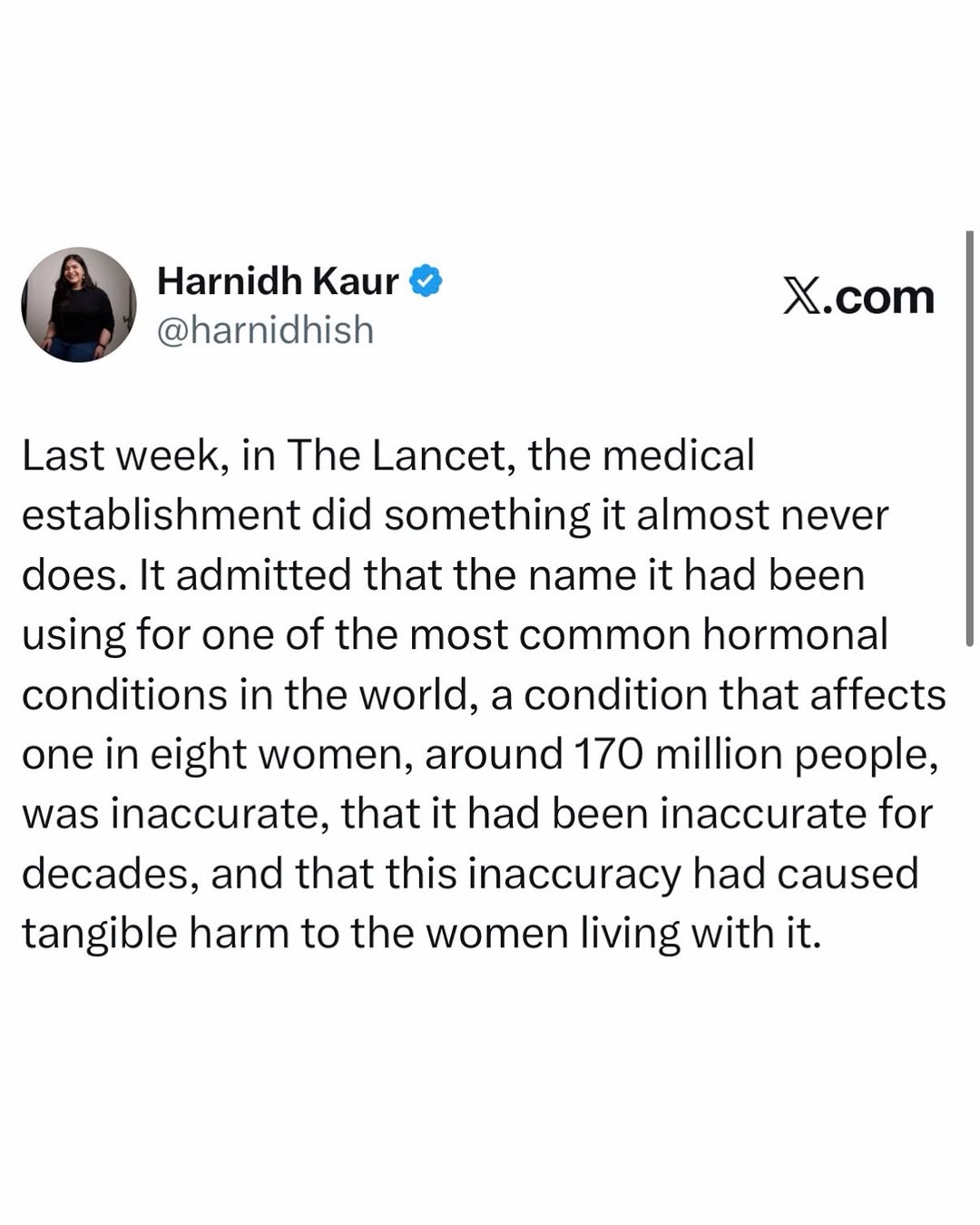
This is a screenshot of a tweet by user Harnidh Kaur. The tweet reports on a recent development published in The Lancet, where the medical community admitted that the name for Polycystic Ovary Syndrome (PCOS) was inaccurate and has caused harm to the 170 million women affected by it.

[02]

Simple outline

  1. 1Hook with rare admission
  2. 2Reveal systemic error
  3. 3Quantify the scale
  4. 4State the human cost

[03]

Related videos

[04]

Classification

Format
Concepts
Screenshot CarouselNews CarouselStatement Carousel
Elements
Text OverlayScreenshot as EvidenceMinimalist Layout

[05]

Hook analysis

What stops the scroll in the first 3 seconds

Title hook · 65%

Last week, in The Lancet, the medical establishment did something it almost never does.

Verbal hook · 35%

Last week, in The Lancet, the medical establishment did something it almost never does. It admitted that the name it had been using for one of the most common hormonal conditions in the world... was inaccurate...

Visual hook

The visual hook is the familiar and clean format of a tweet from X.com presented on Instagram. This cross-platform screenshot creates a pattern interrupt, immediately signaling to the user that the content is text-based, informational, and likely a direct quote or statement.

[06]

Hook template

Steal this for your own video

[Trusted Institution] just admitted something it almost never does about [widely accepted term or practice].

  • — The FDA just admitted something it almost never does about a common food additive.
  • — The APA just admitted something it almost never does about a decades-old diagnosis.
  • — Harvard just admitted something it almost never does about how it selects students.

[07]

Hook and payoff

The promise the opener makes, and how the video pays it back

Hook

The opening sentence frames the content as a rare and significant admission from a credible authority ('The Lancet', 'medical establishment'), creating immediate intrigue.

Payoff

The final clause delivers the emotional climax by stating that the error caused 'tangible harm,' leaving the reader with a strong sense of validation or indignation.

[08]

Narrative framework

The structural pattern this video runs on

Framework

The Authority Confession Framework

A single-slide narrative that presents a bombshell revelation from an authoritative source. It hooks the reader by announcing an unprecedented event, reveals a long-standing systemic error, and lands an emotional punch by detailing the human cost, all within one dense text block.

  1. 1

    The Unprecedented Admission

    The text reveals the core of the story: an authority figure or institution is admitting to a major, long-standing mistake regarding a widely known topic.

  2. 2

    The Impact Quantifier

    The narrative immediately follows the admission with statistics or scope (e.g., 'one in eight women, around 170 million people') to establish the gravity and scale of the error.

  3. 3

    The Injustice Amplifier

    The text adds a time-based element ('for decades') to emphasize the chronic nature of the error, building a sense of systemic failure and injustice.

  4. 4

    The Human Cost Payoff

    The narrative concludes by explicitly connecting the abstract error to concrete, negative consequences for individuals, providing a powerful emotional resolution.

Themes

  • Medical accuracy
  • Patient advocacy
  • Systemic issues in healthcare
  • Validation of patient experiences

Techniques

  • Screenshot
  • Information dissemination

Trends

  • Tweetshot
  • Cross-platform content sharing

Post caption

Last week, in The Lancet, the medical establishment did something it almost never does in writing: it admitted the name it had used for one of the most common hormonal conditions in the world was inaccurate, and had been for decades. The condition you know as PCOS is now officially PMOS, or polyendocrine metabolic ovarian syndrome. The renaming came out of a fourteen-year global consensus process involving fifty-six medical organisations and surveys of fourteen thousand patients and clinicians. Most women with this don’t have ovarian cysts at all and the condition was never about the ovaries malfunctioning so much as a whole-body endocrine and metabolic disorder. The paper itself says the old name delayed diagnoses, fragmented care, deepened stigma, and curtailed research funding, because nobody wanted to fund a ‘cyst’ problem. So 170 million women have been carrying around a misdiagnosis, getting sent to the wrong specialist, getting told to lose weight by people who didn’t know the weight was a symptom of the same disorder making it harder to lose. They weren’t broken. They had a condition that even the people studying it had been describing wrong. The girls were right. It just took fourteen years and a global consensus process for medicine to say so. PCOS, PMOS, polycystic ovary syndrome name change, polyendocrine metabolic ovarian syndrome, women’s health, hormonal health, The Lancet​​​​​​​​​​​​​​​​

Text overlays

  • branding · photo_0

    Harnidh Kaur @harnidhish

  • informational · photo_0

    Last week, in The Lancet, the medical establishment did something it almost never does. It admitted that the name it had been using for one of the most common hormonal conditions in the world, a condition that affects one in eight women, around 170 million people, was inaccurate, that it had been inaccurate for decades, and that this inaccuracy had caused tangible harm to the women living with it.

Tweet screenshot about PCOS renaming | Viral Hooks