@fallowrestaurant
Instagram · Talking Head Edit
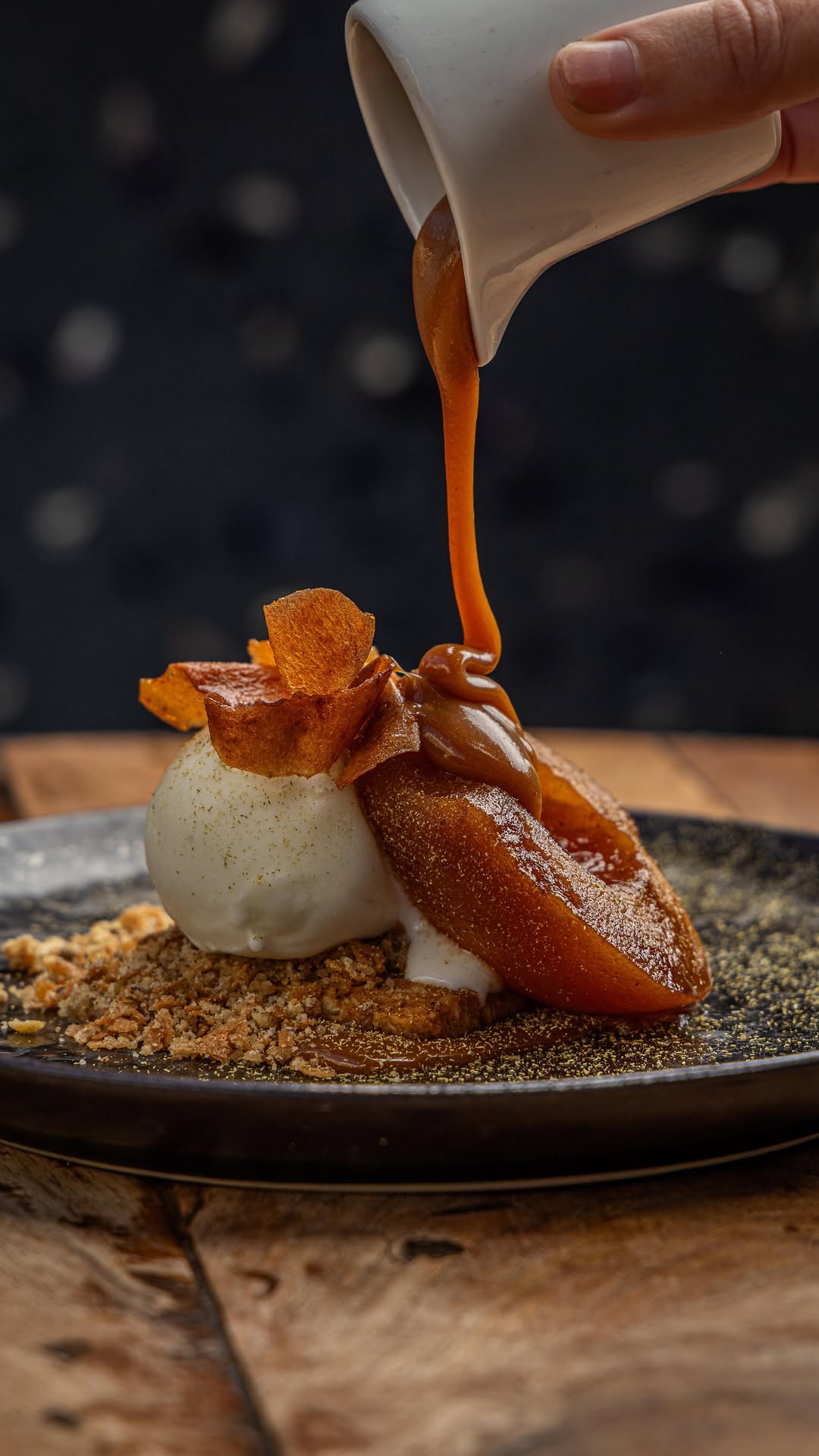
@fallowrestaurant A pastry basic that once mastered helps you create desserts like a chef - this is the science of caramel 🥮 @joaopdamaso

@fallowrestaurant
Instagram · Talking Head Edit
@fallowrestaurant A pastry basic that once mastered helps you create desserts like a chef - this is the science of caramel 🥮 @joaopdamaso
Performance
Video #29459 · Talking Head Edit
[01]
The creator, a chef, explains the science behind making caramel by demonstrating and narrating the process for two distinct types: dry caramel and wet caramel. He breaks down the chemical composition of sugar (sucrose, glucose, fructose) and uses animated graphics to illustrate how heat causes molecular bonds to break, creating flavor compounds. The video concludes by showing how the finished caramel is used to garnish various desserts, like a brownie and a banana parfait.
[02]
[03]
 861.9K20.4×Show final result then process@soberishmom · Tutorial / How To
 316.5KDessert reveal and first bite@michelinguide · Showcase
 611.1K3.8×Family makes late night treats@seattlehanddoc · Tutorial / How To
 1M1.4×Chef explains perfect fry science@fallowrestaurant · Tutorial / How To
 1.1M81.7×Brownie recipe tutorial with tips@hoda_alzubaidi · Tutorial / How To
 2.5M8.2×Explaining the science of emulsions.@fallowrestaurant · What Is X?
 1MMaking mini cakes start to finish@devinetreatsbakery · Process
 241.9K4.3×Making a sweet salty chip tower@getgraza · Tutorial / How To
 1.4M11×Fast-paced dessert making tutorial@seattlehanddoc · Tutorial / How To
 2.4M71.2×Chef creates chocolate dessert montage@austin.zg2 · Process
 1.2M4.9×Showing drink making process@cava · Process
 634.9K1.6×Simple healthy chocolate bar tutorial@joeysorts · Tutorial / How To
[04]
[05]
What stops the scroll in the first 3 seconds
Title hook · 45%
science of caramel
Verbal hook · 25%
This is the science of caramel.
Visual hook · 30%
An extreme close-up shot of a spoon lifting thick, glossy, amber-colored caramel, which drips slowly back into a stainless steel pan.
[06]
Steal this for your own video
The science of , explained.
[07]
The promise the opener makes, and how the video pays it back
Hook
An authoritative declaration of the topic, immediately establishing expertise and promising to reveal insider knowledge.
Payoff
The Practical Application: Connects the abstract knowledge to a tangible, aspirational outcome, demonstrating the technique's real-world value and providing a satisfying conclusion.
[08]
The structural pattern this video runs on
Framework
The Scientific Deconstruction
Breaking down a complex topic into two distinct methods, explaining the underlying science of each, and concluding with a real-world application to prove its value.
The Authoritative Premise
Frames the topic as essential knowledge and introduces a fundamental classification system.
The Binary Classification
Explicitly names the two distinct categories that will be compared and analyzed.
Method 1: The Process Introduction
Introduces the first category, showing the initial practical steps involved.
Method 1: The Scientific Deconstruction
Uses simplified visuals and narration to explain the 'how' and 'why' behind the first method, demystifying the process.
Method 1: The Perfected Result
Displays the ideal outcome of the first method, providing a visual benchmark for success.
Method 2: The Process Introduction
Introduces the second category as an alternative, often highlighting a key advantage or difference from the first.
Method 2: The Scientific Deconstruction
Explains the underlying principles of the second method, contrasting it with the first to reinforce understanding.
Method 2: The Perfected Result
Displays the ideal outcome of the second method, completing the comparison.
A pastry basic that once mastered helps you create desserts like a chef - this is the science of caramel 🥮 @joaopdamaso
title · beginning
science of caramel
contextual · beginning
types of caramel
contextual · beginning
the dry and the wet caramel
informational · middle
or sucrose is made of both glucose and fructose
informational · middle
when heated to 180°C
informational · middle
into flavour compounds
informational · middle
a process of hydrolysis
contextual · end
classic desserts
contextual · end
banana parfait
Is the science of caramel. There are two types of caramel that all chefs need to better, the dry and the wet caramel. Dry caramel starts with only a few spoonfuls of sugar. Make sure it's evenly spread as while it heats, the chemicals in the sugar break down. Sugar or sucrose is made of both glucose and fructose. When heated to a 180 degrees, the bond between these molecules breaks. Once you reach over 200 degrees, this is going to break down into flavor compounds, which contributes to the nutty, toasted, and fruity notes. We're going to keep stirring gradually until we have no lumps and a glossy golden caramel. White caramel, on the other hand, starts with water, which we dissolve the better sugar into to form a solution. This allows white caramel to be slightly more forgiving as the sugar eats more evenly. As the sugar melts, it undergoes a process of hydrolysis where the water breaks the bond between the glucose and fructose molecules. This is where the sugar colors and most of the water will evaporate off, leaving you with a golden caramel sauce. A good caramel forms the base of so many classic desserts. We use it throughout our menu, including our viral banana parfait.