@denverskindoc
Instagram · Split screen

@denverskindoc What to do when your moisturizing doesn't work?! #dryskin #eczema #ichthyosis #dermtips #drylegs #atopicdermatits

@denverskindoc
Instagram · Split screen
@denverskindoc What to do when your moisturizing doesn't work?! #dryskin #eczema #ichthyosis #dermtips #drylegs #atopicdermatits
Performance
Video #31294 · Split screen
[01]
A dermatologist reacts to a video showing extremely dry, scaly skin, identifying the condition as ichthyosis vulgaris and explaining its genetic cause. He then provides a three-part solution for when moisturizing alone fails: using cream instead of lotion on damp skin, incorporating chemical exfoliants like lactic acid and urea, and washing with gentle shower oils, concluding by showing specific product examples.
[02]
[03]
 834.1K18.3×Doctor explains debilitating skin condition@denverskindoc · Breakdown
 5.3M152.1×Dermatologist debunks Vaseline myths@denverskindoc · Reaction
 157.9K3.1×Reacting to dangerous skincare hack@denverskindoc · Reaction
 1M40.4×Dermatologist explains chemical peel process@denverskindoc · Breakdown
 523.2KDerm answers user question with tips@denverskindoc · Q&A Response
 226.7K1.9×Personal product test and review@justinescameraroll_ · Before/After Transformation
 899.6K1.6×Meme contrasts advice with product obsession@dermalogica · Hot Take
 2.1M2.4×Skincare product application and benefits@dermalogica · Product Promo
 608.6K2.9×Relatable basic soap skincare routine@tasiaalexis · Relatable One Shot
 16M19×Problem, solution, and transformation showcase@dermalogica · Before/After Transformation
 4.8M681.4×Creator demonstrates and explains moisturizer@santacruzpaleo · Show and Tell
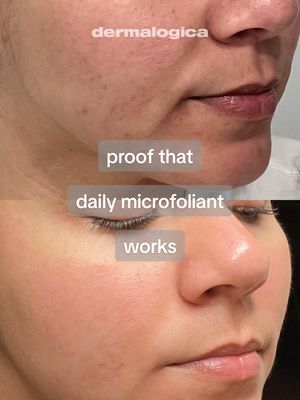 682.3K1.2×Product demo with before/after proof@dermalogica · Before/After Transformation
[04]
[05]
What stops the scroll in the first 3 seconds
Title hook · 35%
Derm explains: What to do when moisturizing doesn't work?
Verbal hook · 25%
Does anyone else have skin like this?
Visual hook · 40%
A close-up shot of a person's legs with extremely dry, cracked, and scaly skin, resembling a riverbed pattern.
[07]
The promise the opener makes, and how the video pays it back
Hook
Visually present a highly relatable and specific problem, often using a user-generated style clip, to immediately capture the target audience's attention and create an 'I have that too' moment.
Payoff
The expert provides concrete product category recommendations to make the advice immediately actionable, often showing specific visual examples and using personal endorsement ('I use this myself') as social proof before ending with a final call for engagement.
[08]
The structural pattern this video runs on
Framework
The Expert Solution Stack
An expert identifies a common user problem, explains the underlying cause to build authority, and then delivers a tiered, actionable solution, moving from a foundational fix to a more advanced tactic.
The Expert Validation
An authority figure introduces themselves and their credentials. They then diagnose the problem, giving it a formal name and explaining the complex 'why' behind it, which validates the viewer's struggle and establishes the creator's expertise.
The Audience Funnel Expansion
The expert connects the initial, specific problem to a much broader, more common version of the same issue, widening the potential audience who can benefit from the upcoming advice.
The Solution Promise
A direct transitional phrase (e.g., 'So what do you do?') that signals a pivot from problem analysis to actionable solutions, promising the viewer a clear path forward.
The Foundational Correction
The first piece of advice is presented as a simple, fundamental fix that corrects a common mistake the audience is likely making. This provides an immediate, easy win.
The Level-Up Tactic
The expert acknowledges the limits of the foundational fix ('but that's not always enough') and introduces a more advanced or less-known technique. The mechanism of *how* this advanced tactic works is explained to build deeper trust.
The Supporting Tweak
A final piece of advice is given that addresses a related but often-overlooked factor in the viewer's routine that could be hindering their success, making the solution feel holistic.
What to do when your moisturizing doesn't work?! #dryskin #eczema #ichthyosis #dermtips #drylegs #atopicdermatits
title · beginning
does anyone else have skin like this
title · beginning
Derm explains: What to do when moisturizing doesn't work?
Does anyone else have skin like this? Hi. I'm a dermatologist, and that's a skin condition called ichthyosis vulgaris. It's actually from a genetic mutation in your skin barrier where your skin cells just don't shed like they're used to, so they're adherent more, which leads to that kind of dry riverbed look and really dry skin. But I thought I'd make a quick video because I often hear from my patients here in Colorado, hey. I'm moisturizing, but my legs still feel dry or my whole body feels dry. So then what do you do? Here's a few practical tips. Number one, you wanna make sure you're moisturizing with a cream, not a lotion. Creams are gonna be more moisturizing. They typically come in a tub, and the best time to apply them is right when you get out of the shower and your skin's still damp. In cases of ichthyosis, though, that's usually not enough, and that's when you need to use a chemical exfoliator. So things like lactic acid or urea are what I typically recommend. So in addition to your moisturizing cream, you incorporate these chemical exfoliants, which are typically lotions or creams as well. Lactic acid and urea help break down those skin bonds so that the skin can actually shed away, leading to smoother skin. And then you add in your moisturizer to hydrate. And last, you wanna look at what soap you're using in the shower to make sure it's not more irritating. I recommend shower oils for my dry patients. That's what I use myself. I'll put a few of my favorites up here. It's better. Dry skin is very common now. Let me know what questions you have.