Video #32951 · Talking Head Edit
Museum reveals Jaws poster secretfrom @naturalhistorymuseum
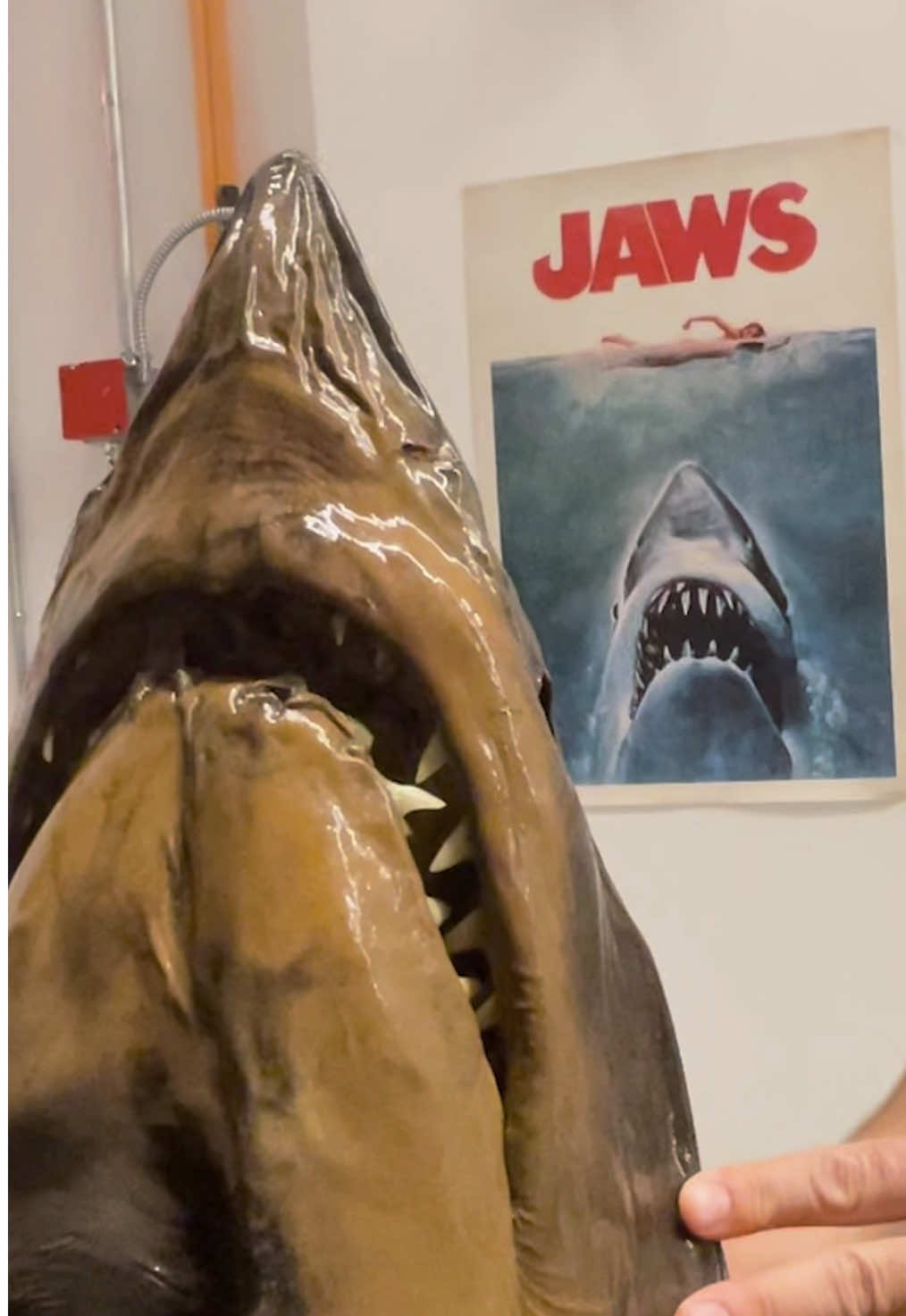
A museum curator reveals that the shark on the 'Jaws' poster is not a great white, but a mako shark. He takes the viewer into the museum's ichthyology collection to show the actual preserved specimen that inspired the artist, explains the historical context of its creation, and concludes by sharing facts about the mako shark's speed while showing a model in the museum's public hall.
- 1Challenge common knowledge
- 2Reveal physical proof
- 3Tell the origin story
- 4Provide a bonus fact
ConceptsStrange but TrueBehind The ScenesBreakdown
ElementsB-Roll CutawayLower ThirdText Overlay
[05]
Hook analysis
What stops the scroll in the first 3 seconds
Verbal hook · 85%
Did you know that the shark in the Jaws poster is not actually based on a great white shark?
Visual hook · 15%
An extreme close-up of a preserved shark head with its mouth open, held directly in front of the camera by the speaker.
[06]
Hook template
Steal this for your own video
Did you know that [famous thing everyone knows] is not actually [what everyone assumes it is]?
- — Did you know that the Mona Lisa is not actually smiling at you the way everyone assumes?
- — Did you know that the cheesy pizza in every Italian restaurant is not actually how pizza was originally made in Naples?
- — Did you know that the Apple logo is not actually a tribute to Alan Turing the way everyone assumes?
[07]
Hook and payoff
The promise the opener makes, and how the video pays it back
Hook
Pose a counter-intuitive question that challenges a widely-held belief about a famous subject, creating an immediate knowledge gap and sense of mystery.
Payoff
The viewer feels like an insider who has learned a hidden truth, not just about the initial myth but also about the subject's deeper history and related science.
[08]
Narrative framework
The structural pattern this video runs on
Framework
The Archival Reveal
Debunking a common misconception about a culturally significant object by revealing the physical proof from an exclusive archive and then telling its hidden origin story.
- 1
The Pop Culture Myth-Bust
State a surprising claim that contradicts a popular belief, immediately hooking the audience by promising to reveal a hidden truth.
- 2
The Archival Journey
Lead the viewer on a physical journey through a 'behind-the-scenes' or exclusive space to locate the tangible evidence that supports the claim, building anticipation.
- 3
The Artifact Reveal
Unveil the physical object or proof, providing a satisfying visual confirmation of the initial claim and identifying the true subject.
- 4
The Thematic Bridge
Broaden the context from the specific object to a larger theme or concept, explaining its multifaceted value (e.g., historical, cultural, scientific) to add depth.
- 5
The Historical Anecdote
Recount the specific origin story of the object's cultural significance, connecting it to key people, places, or events to fully solve the mystery.
- 6
The Bonus Fact Pivot
After resolving the primary mystery, transition to a new, compelling, and related fact about the subject to add further value and retain engagement.
- 7
The Expert Explanation
Conclude with a brief, technical, or scientific explanation for the 'bonus fact,' reinforcing the presenter's authority and leaving the viewer with a final piece of knowledge.
Themes
- Debunking myths
- Behind the scenes
- Scientific history
- Pop culture influence
Techniques
- Storytelling
- Expert commentary
- Archival context
Post caption
🦈 Dive into the Museum’s collections with Ryan Thoni, curatorial associate of Ichthyology, and meet the shark that inspired the Jaws movie poster!
#Jaws50 #NaturalHistory #Jaws #Sharks #museums #Ichthyology #STEM
Text overlays
contextual · beginning
Ichthyology Collection,
Macauly Family Foundation Collections Gallery,
Louis V. Gerstner, Jr. Collections Core
contextual · middle
Ryan Thoni, Curatorial Associate,
Department of Ichthyology
contextual · end
Hall of Biodiversity
Transcript
You know that the shark in the Jaws poster is not actually based on a great white shark? The toothy fish in question is actually based on a specimen housed here in the ichthyology collection of the American Museum of Natural History. And that specimen, not a great white. It's actually a short finned mako shark and it's still housed in our collection today. While all of our specimens here in the collection carry with them a certain scientific value, there's also a degree of artistic value and in some specific cases, pop culture value. Back in the nineteen seventies, the renowned artist, Tier Kestrel, visited the museum seeking inspiration for a film poster he was working on, Jaws. He took photos of the shark models including this one made from a short fin Mako, which eventually became the key art for the now iconic movie poster. Mako sharks might not seem as fearsome as a white shark, but they are the fastest shark in the sea. A streamlined body and smooth tooth like scales called dermal denticles help reduce drag and help it to achieve speeds of almost 60 miles per hour.