Viral Hooks
Trending short videosProduct design process deep dive
C

@craighillcompany

Instagram · Talking Head Edit

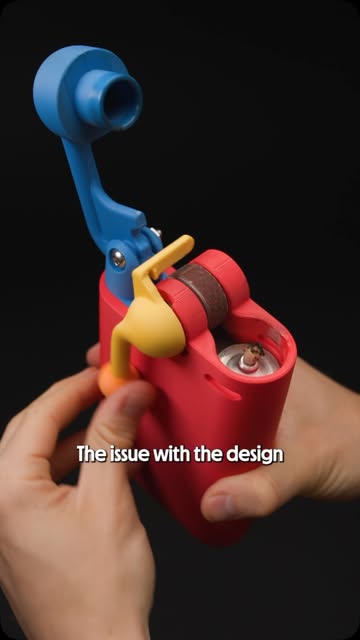
@craighillcompany The objects in our lives shouldn't just do their jobs — they should inspire us as well. Modern lighters lost the magic that vintage lighters possess. Older designs often have these elaborate and clever mechanical interactions to send a spark towards the wick. It's a small miracle that a little tool in our pocket can create fire, so it makes sense to celebrate that moment. Inspired by these vintage references, we spent two years designing a lighter that doesn't just spark a flame, but that also feels delightful and fun to use. We hope you enjoy the Swingtop Lighter, available now online.

View original on Instagram

The edit1 shot · 0 text
Shots2:53

Performance

Views
5.6M
Likes
259.4K
Comments
1.8K
Engagement
4.7%
Outlier
6.5×
Length · 18 Jun 2026
2:53

Video #33888 · Talking Head Edit

Product design process deep divefrom @craighillcompany

[01]

Overview

A product designer explains the ergonomic flaws of standard lighters, then walks through the two-year design process of creating a new one. He showcases vintage lighter inspirations, demonstrates various prototypes that solve for comfort and delight using levers and springs, and explains how the final mechanism integrates a snuffer for a seamless one-action ignition. The video concludes by showing the final, pocket-sized metal product, emphasizing the brand's philosophy of creating functional and exciting everyday objects.

[02]

Simple outline

  1. 1State a common object's flaw
  2. 2Deconstruct the design process
  3. 3Reveal the core mechanical innovation
  4. 4Showcase the elegant final form

[03]

Related videos

[04]

Classification

Concepts
Origin StoryBreakdownProcess
Elements
B-Roll CutawayOverhead ShotJump Cut

[05]

Hook analysis

What stops the scroll in the first 3 seconds

Verbal hook · 30%

It is bad ergonomics.

Visual hook · 70%

An extreme close-up shot of a thumb rolling the striking wheel of a red lighter, creating immediate focus on the tactile interaction and the core subject of the video.

[06]

Hook template

Steal this for your own video

Open on an extreme close-up of [hands/fingers performing a small tactile action] on a [familiar everyday object], filling the entire frame before pulling back to reveal [the design flaw or transformation being addressed].

  • — Open on an extreme close-up of a thumb pressing the clicker on a ballpoint pen repeatedly, filling the entire frame before pulling back to reveal the cheap plastic mechanism that breaks after 50 uses.
  • — Open on an extreme close-up of fingers struggling to peel the seal off a medicine bottle cap, filling the entire frame before pulling back to reveal the redesigned lid that solves the problem in one motion.
  • — Open on an extreme close-up of a hand gripping a standard kitchen knife handle at an awkward angle, filling the entire frame before pulling back to reveal the ergonomic prototype replacing it.

[07]

Hook and payoff

The promise the opener makes, and how the video pays it back

Hook

A direct, judgmental statement about a universally recognized flaw in a common object, establishing immediate relatability and authority.

Payoff

The final product is demonstrated, explicitly referencing and resolving all previously stated problems and design goals. It brings the narrative full circle by contrasting the new, perfected object with the initial flawed one, delivering both functional and emotional satisfaction.

[08]

Narrative framework

The structural pattern this video runs on

Framework

The Iterative Design Journey

To deconstruct a common object's flaws and showcase the intellectual and mechanical journey of creating a superior version, transforming a functional tool into an object of delight.

  1. 1

    The Universal Flaw

    To clearly define the problem and its negative consequences (discomfort, danger), grounding the narrative in a shared user experience.

  2. 2

    The Unsatisfactory Landscape

    To survey existing alternatives and classify them into failed categories (e.g., 'efficient but boring' vs. 'performative but impractical'), thereby justifying the need for a new solution.

  3. 3

    The First Iteration & Its Limitation

    To present an initial, simple prototype that solves the primary problem but introduces a new, more nuanced flaw, demonstrating the complexity of the design challenge.

  4. 4

    The Mechanical Breakthrough

    To reveal a key engineering innovation (e.g., a spring, a gear) that elevates the user interaction from purely functional to emotionally satisfying.

  5. 5

    The Second Challenge (Integration)

    To introduce a secondary design goal, inspired by historical or superior examples, which aims to combine multiple functions into a single, elegant action.

  6. 6

    The Elegant Solution

    To reveal the specific, clever mechanical detail that solves the integration challenge, serving as the core 'aha!' moment of the narrative.

  7. 7

    The Scale-Down Reveal

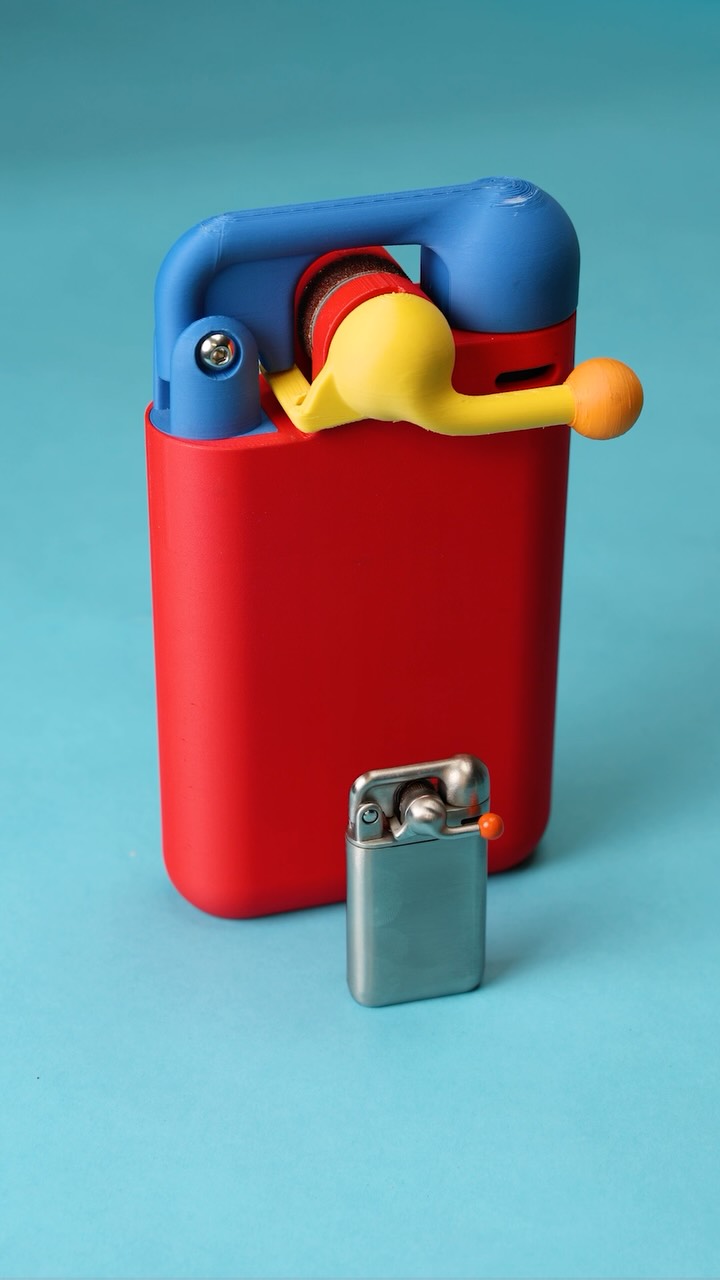
    To explicitly connect the oversized, easy-to-understand prototype with the final, miniaturized product, highlighting the engineering feat of compression and refinement.

Themes

  • Design thinking
  • User experience
  • Ergonomics
  • Craftsmanship
  • Innovation

Techniques

  • Problem-solution narrative
  • Prototyping showcase
  • Comparative analysis
  • Storytelling

Post caption

The objects in our lives shouldn't just do their jobs — they should inspire us as well. Modern lighters lost the magic that vintage lighters possess. Older designs often have these elaborate and clever mechanical interactions to send a spark towards the wick. It's a small miracle that a little tool in our pocket can create fire, so it makes sense to celebrate that moment. Inspired by these vintage references, we spent two years designing a lighter that doesn't just spark a flame, but that also feels delightful and fun to use. We hope you enjoy the Swingtop Lighter, available now online.

Transcript

It is bad ergonomics. You need to have that friction in order to throw a spark against the flint, but it's not gonna be comfortable for your thumb. And by nature of where it's placed next to the wick, your thumb is gonna be right next to the flame. They have found lots of different ways to strike without having to directly interact with the striking wheel. So what a lot of these sliders go towards is actually more performative, almost novelty ignitions. For using all of these samples, there wasn't any in there that struck the right balance. Some of them were efficient but a little bit boring, and then some of them were a little too performative. They weren't actually practical to yes. And we wanted to do one that struck that balance between comfort and delight. The first simple adjustment is getting your thumb away from the actual striking wheel as this kind of paddle wheel. You have this comfortable connection for your hand to kind of strike it. But requires this kind of, like, urgent flicking. How do we make this a little bit more satisfying, surprising of an interaction? By introducing a torsion spring, you can actually just have the one singular lever arm. If we install this with the spring, slowly build up the energy in the spring, and you just let no. And you fire your flaming arrow. If you're not convinced yet, there's more. The snuffer. As it's designed here, it's a two step process. Manually lift the snuffer and then draw back your bow and let it no. But we saw with all these vintage examples, there's a way that you can expose the wick and ignite with one interaction, and we wanted to bring that into our lighter. And the solution is actually very simple. This crossbar on the actuating arm is primarily there as a physical stop. We can use that for a secondary purpose by adding a little bit of extra material to the snuffer arm. That little additional material as you rotate the arm, this top swings open as you are building up the energy in that torsion spring. You've suddenly primed the whole thing for ignition with one simple action. When you let go, you have a giant flame. We, like, had to make this demonstration prop so large to be able to point out and talk about all of the minute mechanical details. It actually makes it more miraculous. Once you see all of these same movements scale down to a pocketable size, it successfully achieved the two goals where we created a tool that is intuitive and comfortable, and when you cock it back, thumb is naturally out of the way. Additionally, it has this magical and miraculous small moment. Things in our life shouldn't just work well, tier should also feel good. That's why we spend as much time obsessing over the functionality tier we spend obsessing over what is that moment of interaction, and does that provide some small spark of excitement every time you use it.

Product design process deep dive | Viral Hooks