@theironsnail
Instagram · Talking Head Edit
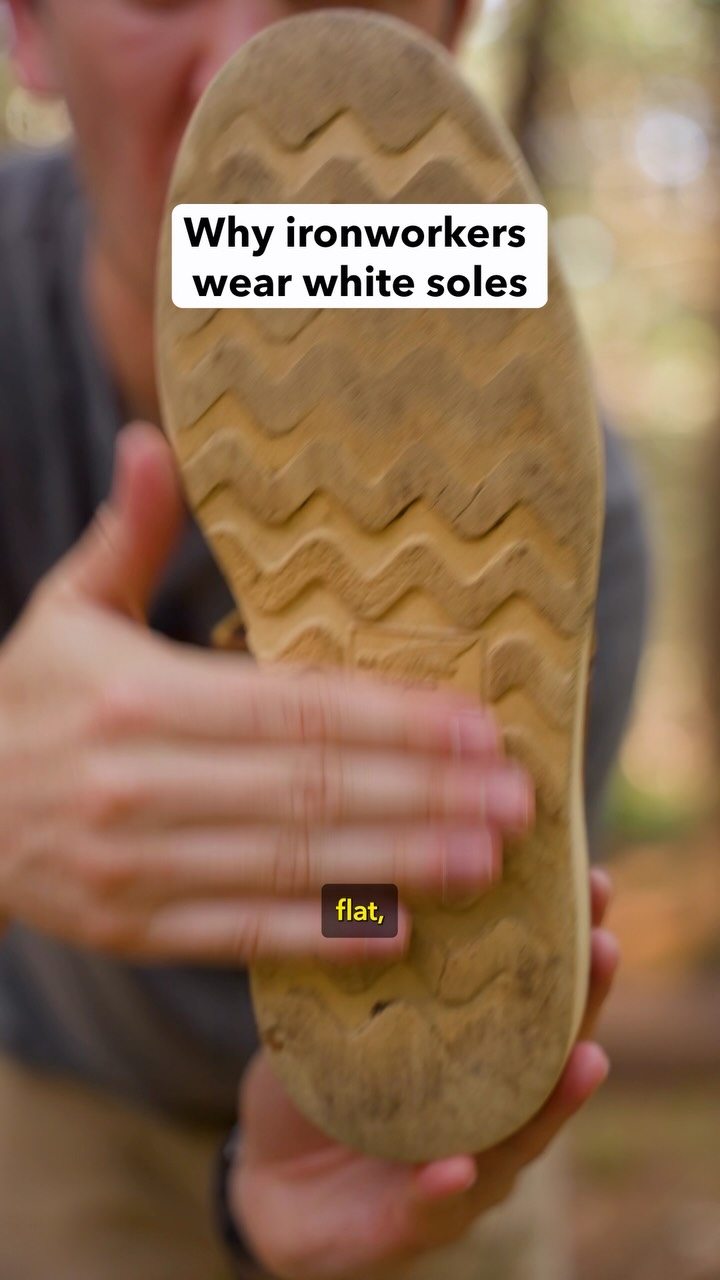
@theironsnail Wedge soles and ironworkers. A classic! And construction, factory, roofing, and about a million other things.

@theironsnail
Instagram · Talking Head Edit
@theironsnail Wedge soles and ironworkers. A classic! And construction, factory, roofing, and about a million other things.
Performance
Video #36806 · Talking Head Edit
[01]
The creator explains the three main reasons why ironworkers wear boots with flat, white wedge soles by breaking down the functional design. He covers how the flat sole provides maximum surface contact for safety on beams, how the lack of a heel prevents tripping, and how the 'blown rubber' material is lightweight, comfortable, and historically non-marking due to its composition.
[02]
[03]
 1.3M1.2×Explaining historical boot design features@theironsnail · Breakdown
 4.2M4.4×Explaining a weird boot feature@theironsnail · Breakdown
 245.9K71×Problem-solution pitch for goth footwear@diewithbootson
 512.9K1×Why these shoes have rope@theironsnail · What Is X?
 2.7M54.4×Explaining the surprising origin of heels@fineasjackson · Origin Story
 4.2M38.2×Dipping boots in colorful paint@donnythedybbuk · Process
 491.6KStyle evolution leads to recommendations@hugomacwood · Evolution Showcase
 135.1K15.1×Brand manifesto for shoe collaboration@telfarglobal · Brand Manifesto
 384.9K2.6×Creator recommends affordable boot styles@crust_young · Audience Request Fulfillment
 3M12.4×Satirical ad for construction ballet shoes@wisclandscaping · Satirical Product Pitch
 1.3MShowcasing custom dipped boot process@donnyskyrat · Process
 505.8KExplaining the origin of shoe soles@theironsnail · What Is X?
[04]
[05]
What stops the scroll in the first 3 seconds
Title hook · 35%
Why ironworkers wear white soles
Verbal hook · 40%
Why do ironworkers wear these flat white wedge soles on the bottom of their boots?
Visual hook · 25%
An extreme close-up of the speaker holding a brown leather boot directly up to the camera, filling a large portion of the frame.
[07]
The promise the opener makes, and how the video pays it back
Hook
A direct, intriguing question about a specific, observable feature of a specialized object, immediately creating a knowledge gap the viewer wants filled.
Payoff
Delivers a final, unexpected positive attribute (non-marking) resulting from the previously explained design and material choices, providing a satisfying and memorable conclusion that over-delivers on the initial promise.
[08]
The structural pattern this video runs on
Framework
The Layered Reveal
Answering a niche 'why' question by systematically revealing layers of explanation, each more specific and insightful than the last, using 'but wait, there's more' pivots to maintain engagement.
The High-Stakes First Pass
Provides a dramatic, easily understood, but incomplete answer to the initial question, often tied to a general concept like safety or survival to grab attention.
The Narrative Reset
Explicitly signals that the first answer was insufficient ('But that's not it'), creating anticipation for a deeper, more nuanced explanation and resetting viewer expectations.
The Critical Function Reveal
Isolates a specific design element (the lack of a heel) and connects it directly to a high-stakes, non-obvious scenario (tripping on a beam), revealing its true, life-saving purpose.
The Material Science Deep-Dive
Pivots to answer another part of the question (the color) by explaining the material's composition and its primary benefit (blown rubber for lightness/comfort), establishing creator expertise.
The 'Secret Formula' Explanation
Reveals a key detail about the material's formulation, often by explaining what is *absent* (carbon black), providing historical or chemical context that feels like insider knowledge.
Wedge soles and ironworkers. A classic! And construction, factory, roofing, and about a million other things.
title · beginning
Why ironworkers wear white soles
informational · middle
(vs. a heavy molded rubber outsole)
Why do iron worse wear these flat white wedge soles on the bottom of their boots? Mostly because they don't wanna die. You spend most of your days on flat even surfaces. No, the bottom of your boot should be flat no it can have as much contact with the ground as possible no you don't slip, but that's not it. These boots don't have a heel, which one, yes, does distribute your weight more evenly, is more comfortable, everything like that. But more importantly, look at this. Both of these careers involve you walking across thin beams. And if you have a heel, that heel can get stuck on the edge of a beam and trip you. And they're white because this is a blown rubber outsole. It's packed with tiny air pockets and is meant to be super light and comfortable. Historically, the formulation of rubber used to make these soles didn't use carbon black filler which is often used to increase abrasion resistance in rubber. And an added benefit to that was that it made these soles non marking on surfaces.