Viral Hooks
Trending short videosInvestigating Rome's pasta window trend
N

@natbco

Instagram · Vlog

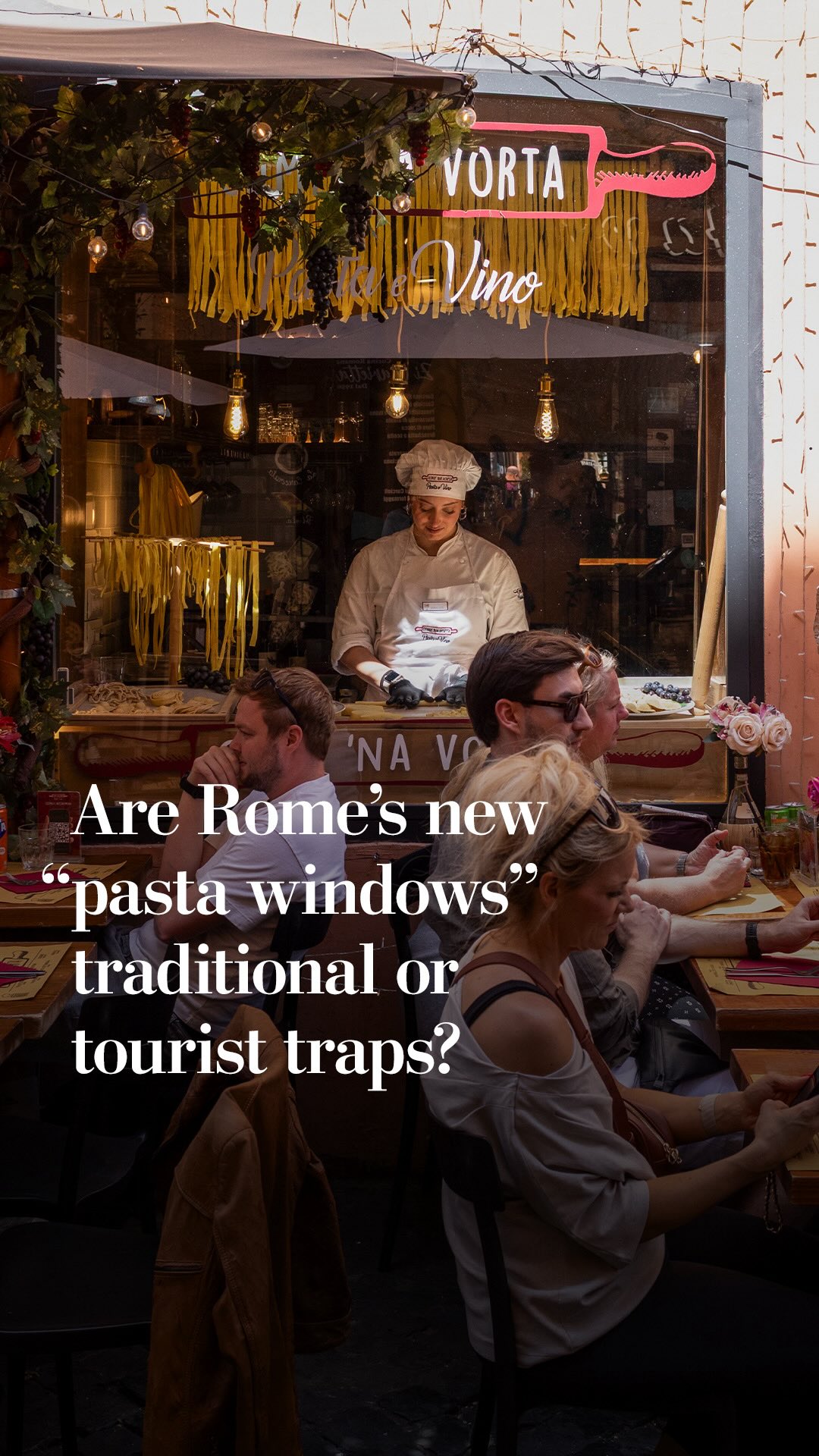
@natbco In Rome, there’s a growing trend of restaurants hiring women to make pasta in their storefront windows. Some locals told me it’s a sign of a tourist trap, but others said it’s a marker of quality. What is not up for debate: these “pasta windows” are popping up everywhere. I tried one for the @washingtonpost on my most recent visit to the Eternal City to see if they’re worth your time and money. To read my full story on the pasta window trend (and why food experts say it could be delicious, but it’s “wrong”), and how to find a great restaurant in Rome — comment with a newspaper emoji 🗞️ and I’ll send you the links. Cover photo by Luigi Avantaggiato for the Washington Post

View original on Instagram

The edit1 shot · 8 text
Shots Text

Performance

Views
970.8K
Likes
28K
Comments
336
Engagement
2.9%
Outlier
39.5×

Video #36974 · Vlog

Investigating Rome's pasta window trendfrom @natbco

[01]

Overview

A travel reporter investigates the growing trend of 'pasta windows' in Rome to determine if they are authentic or a tourist trap. She visits one of the most popular restaurants, documents the mass-produced and chaotic atmosphere, reviews the food as mediocre, and ultimately concludes it's a gimmick, advising viewers to seek out smaller, traditional restaurants instead.

[02]

Simple outline

  1. 1Pose a common dilemma
  2. 2Investigate a specific example
  3. 3Reveal 'behind the curtain' flaws
  4. 4Deliver a clear verdict
  5. 5Provide a better alternative

[03]

Related videos

[04]

Classification

Format
Concepts
BreakdownValue VlogReview
Elements
VoiceoverB-Roll CutawayText OverlayImage Overlay

[05]

Hook analysis

What stops the scroll in the first 3 seconds

Title hook · 55%

Are Rome's new “pasta windows” traditional or tourist traps?

Verbal hook · 30%

If you walk through Rome's historic center, you will find a growing number of restaurants with employees...

Visual hook · 15%

A low-angle shot looking up a narrow, cobblestone alley at a colorful, historic Italian building, immediately establishing the location and creating a visually interesting composition.

[06]

Hook template

Steal this for your own video

Are [city]'s [trending local experience] traditional or tourist traps?

  • — Are Tokyo's capsule hotels traditional or tourist traps?
  • — Are New Orleans' ghost tours traditional or tourist traps?
  • — Are Bali's rice terrace cafes traditional or tourist traps?

[07]

Hook and payoff

The promise the opener makes, and how the video pays it back

Hook

A provocative binary question that frames a popular trend as a debate ('traditional or tourist trap?'), creating immediate intrigue and a desire for a definitive answer.

Payoff

A call-to-action that funnels the viewer to a more in-depth piece of content, leveraging the video's established authority to drive traffic.

[08]

Narrative framework

The structural pattern this video runs on

Framework

The Investigative Takedown

To investigate a popular trend or product by posing a common question (e.g., 'Is it worth it?'), documenting a personal experience to uncover hidden truths, and delivering a definitive verdict with an alternative solution.

  1. 1

    The Cultural Dilemma

    Introduce a popular trend and the central conflict surrounding it, establishing two opposing viewpoints (e.g., owners vs. experts) to set the stakes.

  2. 2

    The Personal Quest

    The narrator positions themselves as an investigator on a mission ('I went to one to find out'), creating a personal journey for the audience to follow.

  3. 3

    The Case Study

    A specific, popular example of the trend is chosen as the subject of the investigation, grounding the abstract debate in a real-world test.

  4. 4

    The First Crack in the Facade

    Present the first piece of evidence that contradicts the popular perception, revealing a manufactured or inauthentic element (e.g., artificial scarcity).

  5. 5

    The Atmospheric Exposé

    Detail the environmental and operational flaws that undermine the trend's promise (e.g., chaos, commercialization), building a case against it through sensory details.

  6. 6

    The Core Product Test

    The narrator directly engages with and evaluates the core product or experience at the heart of the trend.

  7. 7

    The Nuanced Verdict

    Deliver a balanced review of the product itself (e.g., 'food was fine, wine was horrible'), granting some positive points to build credibility before the final judgment.

  8. 8

    The Final Judgment & Rationale

    State a clear, unambiguous conclusion answering the initial question ('Would I send you there? No.'), supported by the evidence gathered throughout the experience.

  9. 9

    The Expert Corroboration

    Reinforce the personal verdict by citing external expert opinions that align with the narrator's findings, closing the credibility loop.

  10. 10

    The Superior Alternative

    Provide a constructive, actionable solution or alternative that better fulfills the original promise of the trend, adding value for the viewer.

Themes

  • Authenticity vs. Commercialism
  • Tourism
  • Food Culture
  • Investigative Journalism

Techniques

  • First-person investigation
  • Expert sourcing
  • Comparative analysis

Trends

  • Food trend debunking
  • Authentic travel experiences

Post caption

In Rome, there’s a growing trend of restaurants hiring women to make pasta in their storefront windows. Some locals told me it’s a sign of a tourist trap, but others said it’s a marker of quality. What is not up for debate: these “pasta windows” are popping up everywhere. I tried one for the @washingtonpost on my most recent visit to the Eternal City to see if they’re worth your time and money. To read my full story on the pasta window trend (and why food experts say it could be delicious, but it’s “wrong”), and how to find a great restaurant in Rome — comment with a newspaper emoji 🗞️ and I’ll send you the links. Cover photo by Luigi Avantaggiato for the Washington Post

Text overlays

  • title · beginning

    Are Rome's new “pasta windows” traditional or tourist traps?

  • contextual · beginning

    Rome, Italy April 2026

  • contextual · middle

    Photos by Luigi Avantaggiato for the Washington Post

  • contextual · middle

    Natalie Compton TRAVEL REPORTER

  • informational · end

    The whole experience felt very mass produced, which is what the local experts had warned me about.

  • informational · end

    These pasta windows are a gimmick to get tourists in the door.

  • informational · end

    ANOTHER! GIMMICK!

  • call-to-action · end

    You can read my full article on the pasta window trend and how to find a truly good restaurant in Rome on The Washington Post.

Transcript

If you walk through Rome's historic center, you will find a growing number of restaurants with employees, who are almost always women, making pasta in the windows. The owners say their fresh pasta is a sign of quality, while Italian food experts warn otherwise. What is not up for debate, these restaurants are popular with tourists. So should you eat there? I went to one to find out. Osteria bad Fortunazza is one of the most popular examples of this trend. I joined the line at their Pantheon location and was told the wait for a table with a view was about thirty minutes, or I could go sit inside immediately. I picked the ladder and was sent upstairs and discovered the place was actually huge. There worse staff running around with earpieces, TVs playing ads for the restaurant even though you were already in the restaurant. A woman seated next to me was playing TikTok videos without headphones. I ordered a glass of the house white wine and a plate with cacio e pepe, which the server warned me was very salty and strong. My food came out in just a couple minutes, and it was fine. The pasta was peppery. The noodles had a nice chew to them. The wine, on the other hand, horrible, just very sweet. Would I send you there? No. Even if the pasta is made by hand, the whole experience felt very mass produced, which is what the local experts had warned me about. Their take, these pasta windows are a gimmick to get tourists in the door. It's not rooted in tradition, but made for Instagram, like the places that serve pasta in saute pans. For a more memorable Roman pasta experience, the guide said to go support a mom and pop. Romans would never wait in line for pasta anyway. You can read my full article on the best window trend, how to find a truly good restaurant in Rome on the Washington Post.

Investigating Rome's pasta window trend | Viral Hooks