Post caption
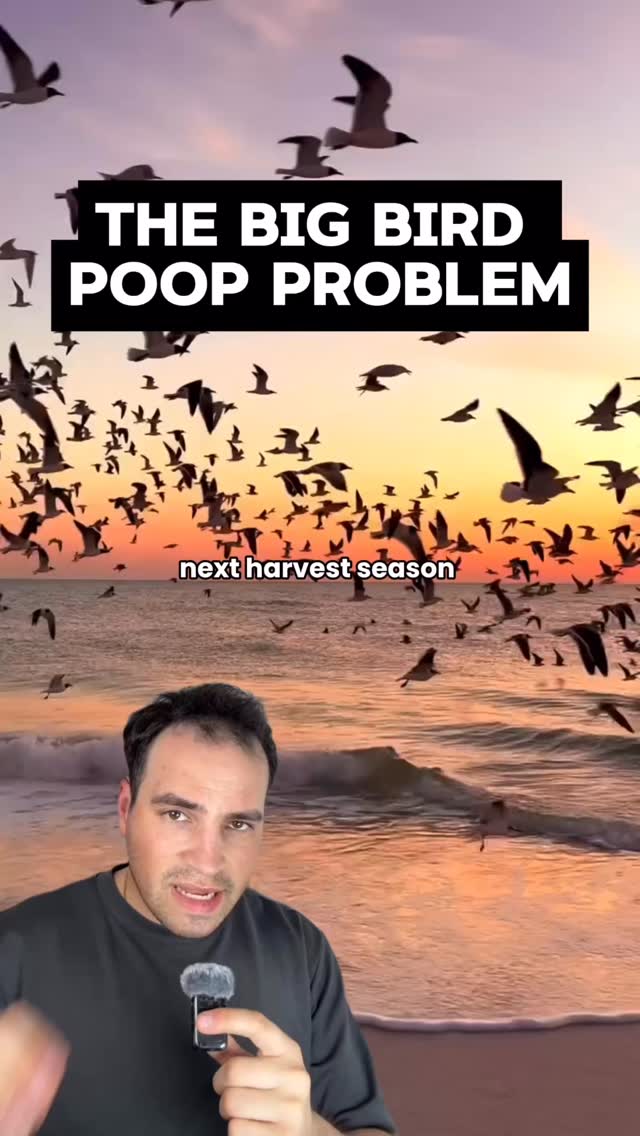
Bird poop is about to break the global food system, and almost nobody is pricing the trade. Peru’s guano-producing seabirds, the only renewable phosphorus source on Earth, have collapsed 87% in three years, from 4 million to 587,000. The historical peak was 50 million. We are now operating at roughly 1% of the capacity that fed Peruvian agriculture for centuries and built two industrial empires in the 19th. Meanwhile 75% of the world’s mineable phosphate sits in Morocco and contested Western Sahara, fertilizer prices have jumped 18% on the year and spiked another 40% during the Iran war, and the USGS has confirmed there is no chemical substitute for phosphorus in agriculture.
The leading indicator to watch is Peru’s anchoveta fishing quota. Industrial fleets are vacuuming up the birds’ food supply to make fishmeal for farmed salmon, while bird flu, incubated in factory poultry, finishes the job. If quotas drop hard in the next two seasons, populations could rebuild at their natural 18% annual growth rate, putting the colonies back to 2022 levels within a decade. If quotas hold, Morocco’s leverage compounds, organic farming loses its only renewable input, and fertilizer becomes the strategic weapon oil was in the 1970s. The food system is eating its own supply chain and calling it growth.
#economics #finance #birds #agriculture
Transcript
Harvest season might get cancelled because of 51,000 tons of missing seabird good, and we need to talk about why you should care. The only renewable phosphorus source on Earth is bird poop, and it just collapsed 87% in three years while nobody is clocking it. But how did we get here? In 1856, Congress passed the Guano Islands Act better any American claim any uninhabited island on earth as long as it had enough seabird droppings on it. Around 100 islands got grabbed. 10 are still US territories today. Yes, the entire US worse empire literally started with seabird rank. Islands like Peru's islands had guano deposits 60 meters thick between 1840 and 1870. They exported 12,000,000 tons of it. All exhausted by 1880, the Haber Bosch process invented synthetic nitrogen by tier. Everyone forgot about birds until three numbers collided in 2026. It starts with 75% of the world's mineable phosphate sitting in Morocco in contested Better Sahara. Five countries hold 85% of all reserves, and the USGS says that there's no chemical substituted for phosphorus in agriculture. Then global fertilizer prices jumped 18% in 2025, spiked another 40% due to the Iran war this year, and Rabobank's affordability index just went negative for the first time. But the part no one's talking about is that Peru's rank producing seabirds population has crashed from more than 4,000,000 in 2022 to 587,000 by mid-twenty twenty five. That's 85% gone in thirty six months due to Avian Flu, El Nino, plus Enchilvetta overfishing. For perspective, the historical peak was around 50,000,000 bad, we're at roughly one percent of that, and meanwhile the Asia Pacific guano fertilizer market is growing at 13.7% a year on the organic farming boom. So the supply curve is collapsing into the demand curve in real time and there is no no B. Phosphorus efficiency from mind to human stomach is five to 10%. We flush 90% of what we mine straight into the ocean. But here's what I actually think. If these seabirds don't come back, three things happen. Organic farming loses one of its only renewable fertilizers, so organic good, I think, gets way more expensive or stops really meaning organic as more and more people switch to mine phosphate. The world might end up more dependent on Morocco for one nutrient agriculture cannot replace, which turns fertilizer into the next oil of sorts, and we lose the only working proof that you can run a renewable nutrient cycle at an industrial scale. The counterargument here is that birds aren't extinct, they're depleted, and seabird populations recover fast when you give them food and leave them alone. So this is really a ten year fix, not a hundred year one if anyone actually decides to do it. So the thing to watch is whether Entraveta fishing quotas drop in the next two years, that's the leading indicator. If quota holds steady, the birds don't come bad, and if quotas drop hard you'll know somebody's taking this seriously.