Viral Hooks
Trending short videosExplaining barnacles' hidden economic impact
M

@maxxrosenblum

Instagram · Greenscreen Talking Head

@maxxrosenblum When war closed the Strait of Hormuz, roughly 600 ships sat idle for 16 weeks, long enough for their hulls to foul into reefs. The agent was the barnacle, a thumbnail-sized crustacean and, quietly, one of the most expensive animals on Earth: it costs the world’s fleet some $30 billion in extra fuel a year. Almost no one has ever seen the bill. That invisibility is engineered. The cost is atomized, divided across 20,000 containers until it reaches a shopper as a fraction of a cent; externalized onto fisheries and harbors that never bought the cargo; and, for a century, simply deferred. New carbon rules are ending that last indulgence. The barnacle has not changed. The accounting has. #economics #shipping #ww3 #globaltrade

View original on Instagram

The edit1 shot · 11 text
Shots Text2:43

Performance

Views
124.4K
Likes
5.4K
Comments
33
Engagement
4.4%
Length · 23 Jul 2026
2:43

Video #40041 · Greenscreen Talking Head

Explaining barnacles' hidden economic impactfrom @maxxrosenblum

[01]

Overview

The creator explains the massive, hidden economic and environmental costs of barnacles on global shipping. He breaks down how barnacle fouling creates drag, increasing fuel consumption by $30 billion annually, and details how this cost is atomized through the supply chain to become invisible to consumers. The creator then explains the externalized costs, such as the spread of invasive species and increased carbon emissions, and concludes by noting that new regulations will soon force these hidden costs to be priced, fundamentally changing the economics.

[02]

Simple outline

  1. 1State a counter-intuitive thesis
  2. 2Reveal the hidden mechanics
  3. 3Explain the cost's invisibility
  4. 4Forecast the system's change
  5. 5Deliver a universal insight

[03]

Related videos

[04]

Classification

Concepts
BreakdownStrange but True
Elements
Data Visualization GraphicSeries Title CardUnderwater FootageGreen Screen CompositeText OverlayTitle Text Hook

[05]

Hook analysis

What stops the scroll in the first 3 seconds

Title hook · 25%

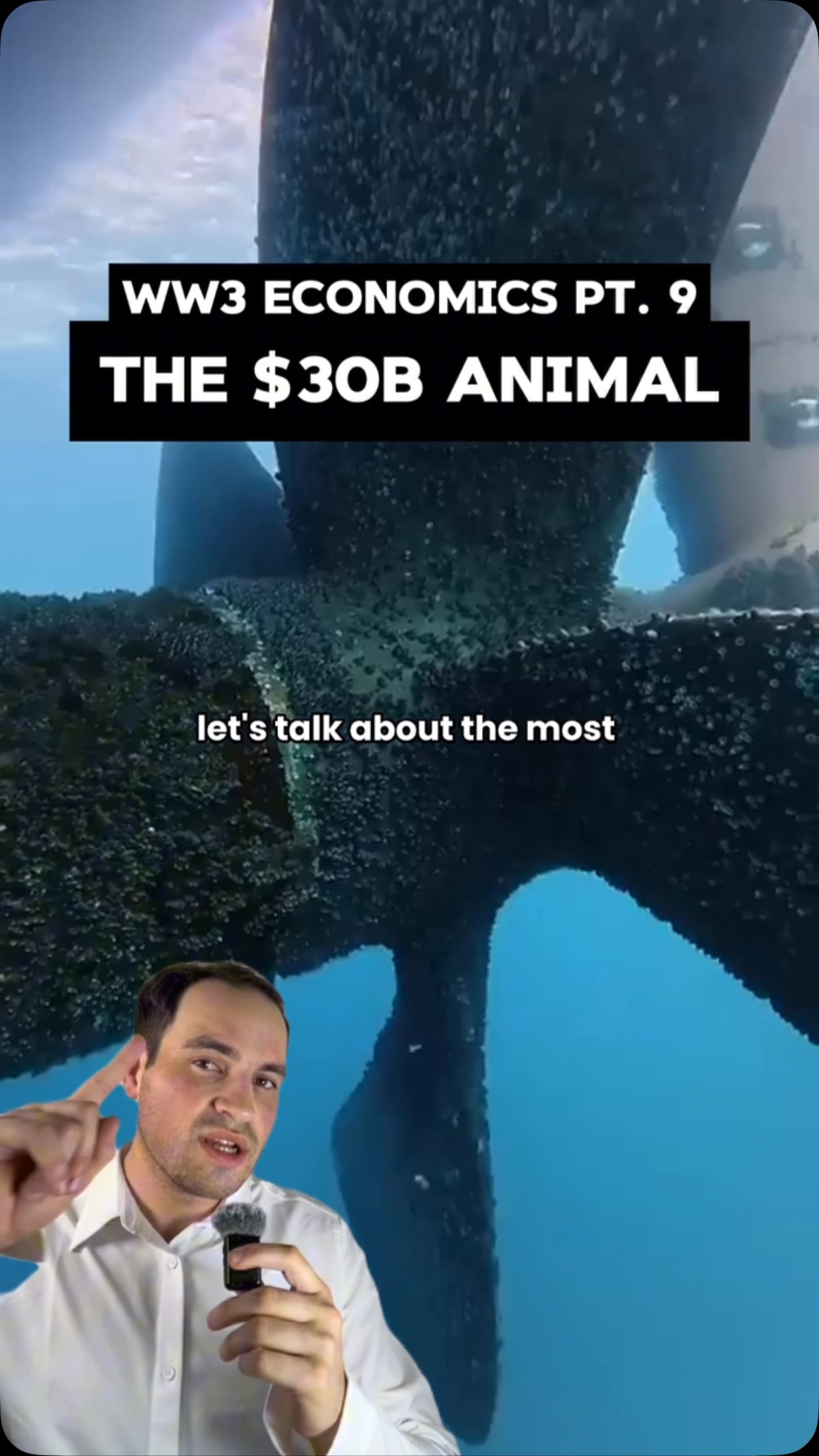
WW3 ECONOMICS PT. 9 THE $30B ANIMAL

Verbal hook · 35%

Let's talk about the most expensive animal on earth, which you'll never see, fueling the next big issue.

Visual hook · 40%

A dramatic, large-scale underwater shot of a massive ship propeller completely covered in a dense layer of barnacles, creating a textured and unusual visual.

[07]

Hook and payoff

The promise the opener makes, and how the video pays it back

Hook

A bold, paradoxical claim that introduces a subject as the 'most [superlative]' in a category where it seems not to belong, creating an immediate knowledge gap the viewer wants to fill.

Payoff

The Universal Principle. Re-frames the narrative by stating that the core problem hasn't changed, but the *accounting* for it has. This abstracts the specific topic into a broader, applicable mental model, providing a satisfying intellectual conclusion about seeing hidden systems before they are repriced.

[08]

Narrative framework

The structural pattern this video runs on

Framework

The Hidden Cost Unveiling

To expose a massive, invisible cost or system by first establishing its scale and then systematically deconstructing the mechanisms that keep it hidden from the public, culminating in a revelation about an impending change that will make the cost visible.

  1. 1

    The Grounding Event

    Connects the abstract thesis to a specific, tangible, and often timely real-world event to make it immediately relevant and credible.

  2. 2

    The Core Problem Explained

    Breaks down the fundamental physical or mechanical reason why the problem exists in the simplest terms, establishing the 'how'.

  3. 3

    The Scale of Impact

    Quantifies the problem with large, impressive data points to establish high stakes and prove the thesis is not an exaggeration.

  4. 4

    The Invisibility Framework

    Poses the central question ('If this is so big, why don't we feel it?') and then systematically reveals the three methods used to obscure the cost.

  5. 5

    The First Veil: Atomization

    Explains how the cost is divided into imperceptibly small pieces and distributed across a vast number of transactions, rendering it invisible to the end user.

  6. 6

    The Second Veil: Externalization

    Explains how the cost is pushed onto third parties (e.g., the environment, society) who are not directly involved in the initial transaction.

  7. 7

    The Third Veil: Deferral

    Explains how the cost is pushed into the future, creating a hidden liability that will eventually come due.

  8. 8

    The Impending Reckoning

    Introduces an external force (e.g., new regulations, technology) that is about to dismantle the invisibility mechanisms, making the hidden cost tangible and unavoidable.

Themes

  • Hidden costs
  • Negative externalities
  • Supply chain economics
  • Environmental impact

Techniques

  • Data visualization
  • B-roll integration
  • Narrative explanation

Post caption

When war closed the Strait of Hormuz, roughly 600 ships sat idle for 16 weeks, long enough for their hulls to foul into reefs. The agent was the barnacle, a thumbnail-sized crustacean and, quietly, one of the most expensive animals on Earth: it costs the world’s fleet some $30 billion in extra fuel a year. Almost no one has ever seen the bill. That invisibility is engineered. The cost is atomized, divided across 20,000 containers until it reaches a shopper as a fraction of a cent; externalized onto fisheries and harbors that never bought the cargo; and, for a century, simply deferred. New carbon rules are ending that last indulgence. The barnacle has not changed. The accounting has. #economics #shipping #ww3 #globaltrade

Text overlays

  • title · beginning

    WW3 ECONOMICS PT. 9 THE $30B ANIMAL

  • informational · middle

    Barnacles are the fouling that matters

  • informational · middle

    Over 80% of world trade by volume moves by sea

  • informational · middle

    The drag does not climb in a straight line

  • informational · middle

    A film too thin to see, a $30 billion bill

  • informational · middle

    How a $300,000 bill becomes a fraction of a cent

  • informational · middle

    The cost does reach the shelf

  • informational · end

    Most marine invaders arrive on a hull

  • informational · end

    The second move: externalize

  • informational · end

    Shipping's carbon bill reaches 100%

  • informational · end

    The carbon cost per ton, doubling

Transcript

Talk about the most expensive animal on Earth, which you'll never see you fueling the next big issue. Welcome back to my World War three economics series. This is part nine. As you likely know if you've watched any of the other parts or follow the news that the Strait Of Ormuz has been shut for sixteen weeks straining nearly 600 ships, and their holes have turned into reefs of barnacles now. And that's the issue here because the economics of global trade run-in part on biology. In fact, of everything that grows on a hole, barnacles are up to 90% of the fouling that better, and they turn a smooth efficient wall into a rough one. And that matters for a very particular reason, as over 80% of everything the world trades by volume, some 12,700,000,000 tons a year, crosses the ocean on one of more than 90,000 holes. Nearly every object you own spent part of its life on one, and every hole is fighting the same animal. And in water, roughness is brutally expensive because the ship has to push against its own skin. To hold the same speed, a heavily fouled hull can need up to 86% more engine power and the penalty does not climb in a straight line. The jump from moderate fouling to heavy is bigger than everything before it combined. So across the fleet, the biological drag burns roughly $30,000,000,000 in extra fuel every year. And if you're wondering who pays that bill, you do. You just can't feel it, and that's not an accident. Take one fouling penalty of $300,000 on a single voyage. It never lands on any one worse. It splits. The owner pushes what it can to the charterer, freight folds the price into the cargo, and the brand passes what it can to the shelf. So by the time it reaches you, it has been divided across 20,000 containers, then across the thousands of items inside each until it lands on your receipt as a fraction of a better, which is the entire point. The barnacle is invisible because it's spread so thin that no one ever feels enough to rank, but it is real. Elevated shipping worst alone can lift consumer prices by several percentage points. It's that largest cost that likely never reaches your receipt all at once best adds up over tier, a true negative externality of this ongoing war. A good hole is basically a moving reef and it carries life across oceans. Ship felling drives roughly 70% of marine invasive species and the recorded damage runs past $345,000,000,000 landing on fisheries and harbors that never bought the cargo. The extra fuel becomes millions of tons of carbon the whole planet absorbs. Neither one ever enters a price. That is the second way a cost hides. You externalize it and hand it to someone who never bought the cargo. So we pay worse, once as a consumer in the fraction of a cent and once as a citizen in a far bigger bill that never had a price tag. And new maritime rules require ships to pay for a 100% of their emissions in 2026, up from 70% the year before. The carbon cost of a ton of fuel is roughly doubling from about $173 to 314 with a global measure to follow in 2028. And that is the third way a cost hides. You defer it. The moment a regulator finally prices it, their hidden worst hardens into a real one, but the barnacle never changed. It does now exactly what it did before. There are ships, it finds a hard surface, and it stays. So the takeaway here that outlives the barnacle is that when a cost is easy to ignore, that is usually the point. Someone has already decided you will carry it, and the only edge is learning to see it before it gets repriced.