@nytimes Tens of thousands of young people from around the world go to work in the U.S. each year as part of a cultural exchange program. Many of them have suffered abuse and mistreatment by American businesses in a poorly regulated program that is ripe for exploitation, a New York Times investigation has found.
Read more and find takeaways from the investigation at the link in our bio. Video by Amy Julia Harris, Leila Medina, Laura Salaberry, David Jouppi, Zach Caldwell, Valentina Caval
An investigative reporter explains how the J-1 visa program, intended for cultural exchange, is systematically abused, leading to labor exploitation. She presents evidence through personal stories of injury and harassment, shows supporting documents, and breaks down the program's structural flaws, such as its oversight by the State Department and reliance on fee-collecting sponsors. The reporter concludes by citing a history of government audits that have repeatedly identified these issues, highlighting a long-standing pattern of neglect.
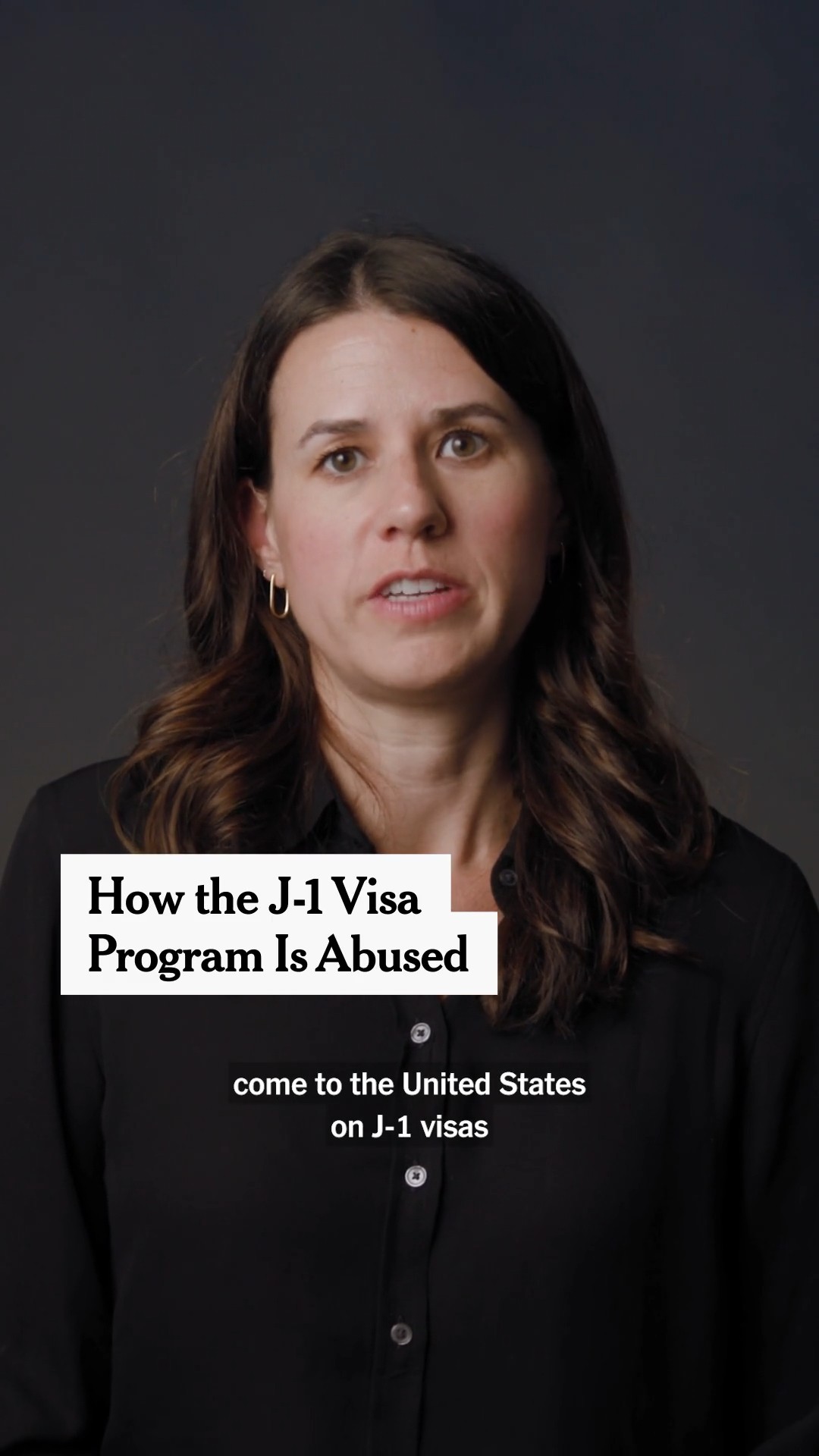
Every year, tens of thousands of people come to The United States on j one visas as part of a cultural exchange program where they're getting training and immersion in American life.
Visual hook
A professionally lit, medium close-up shot of a speaker looking directly into the camera with a serious expression, establishing an authoritative and journalistic tone.
[07]
Hook and payoff
The promise the opener makes, and how the video pays it back
Hook
The Ideal vs. Reality Contrast. The narrative opens by presenting the positive, official purpose of a program or system, then immediately juxtaposes it with the shocking, negative reality, creating an immediate knowledge gap and sense of injustice.
Payoff
The Final Verdict. The narrative concludes by summarizing the central conflict, acknowledging any official counter-arguments but ultimately reinforcing the core thesis of systemic failure, leaving the viewer with a comprehensive understanding and a sense of righteous indignation.
[08]
Narrative framework
The structural pattern this video runs on
Framework
The Investigative Takedown
To expose a systemic failure by contrasting its stated positive purpose with its harmful reality, then methodically revealing the structural flaws, financial incentives, and historical negligence that allow the problem to persist.
1
The Stated Ideal
Clearly articulate the positive, intended purpose of the subject, establishing the baseline expectation for how it should function.
2
The Shocking Reality
Introduce the central conflict by revealing the harmful, unintended consequences that contradict the stated ideal.
3
The Human Cost
Ground the abstract problem with specific, emotionally resonant examples of individuals who have been harmed, making the issue tangible and relatable.
4
The Core Thesis
State the main argument in a clear, concise sentence, asserting that the system itself is fundamentally broken.
5
The Systemic Loophole
Explain the specific structural flaw, rule, or process that enables the negative outcome. This beat often uses simple visuals like flowcharts to clarify complex information.
6
The Profit Motive
Uncover the financial or power-based incentives that motivate key players to perpetuate or ignore the flawed system, answering the 'why' behind the problem.
7
Quantifying the Exploitation
Provide concrete data or examples that illustrate the scale of the cost to victims, adding weight and credibility to the financial motive.
8
The Pattern of Negligence
Present a timeline of historical evidence (reports, past warnings, audits) to prove the problem is long-standing and has been knowingly ignored by those in power, building a case for systemic failure.
Themes
Systemic failure
Exploitation
Government oversight
Labor rights
Techniques
Investigative reporting
Documentary evidence
Expert commentary
Post caption
Tens of thousands of young people from around the world go to work in the U.S. each year as part of a cultural exchange program. Many of them have suffered abuse and mistreatment by American businesses in a poorly regulated program that is ripe for exploitation, a New York Times investigation has found.
Read more and find takeaways from the investigation at the link in our bio. Video by Amy Julia Harris, Leila Medina, Laura Salaberry, David Jouppi, Zach Caldwell, Valentina Caval
Text overlays
title · beginning
How the J-1 Visa Program Is Abused
contextual · middle
Amy Julia Harris
INVESTIGATIVE REPORTER
NEW YORK TIMES
contextual · middle
Dino Cekic
Dislocated his shoulder
contextual · middle
Iryna Humenyuk
Was sexually harassed
title · middle
J-1 approval process
contextual · end
1990
contextual · end
2000
contextual · end
2012
branding · end
The New York Times
Transcript
Every year, tens of thousands of people come to The United States on j one visas as part of a cultural exchange program where they're getting training and immersion in American life. But often, they end up getting abuse and exploitation. One person I talked to ended up being seriously injured on the job. Other people described being sexually harassed. Some people were working seventy, eighty hours a week. What we found in all of these cases was that the j one visa program was not working as intended. The fundamental problem is sort of the entire way this program is set up. Most work programs are regulated by the Department of Labor. But because the j one visa is categorized as a cultural exchange program, It is under the Department of State. But the State Department offloads much of the responsibility for the program to these groups called sponsors. Sponsors go out and recruit participants. The sponsors also go out to American businesses and pitch those businesses on the program. Most of their financial bottom lines come from fees that people in the j one visa pay them in order to participate in the program. I spoke to some people who ended up paying $3,000 for an internship and spoke to other people who paid more than $2,000. They have to tell the state department what they're charging, but there's not a cap on fees currently. There have been a number of audits over the years of the state department's monitoring of the j one visa program. In 1990, auditors found that a number of people on the j one visa were not getting any cultural exchange and doing effectively just manual labor. There was another audit in 2000 that found very poor oversight of the j one visa program. There was yet another audit in 2012 where auditors sort of concluded that some parts of the j one visa were work programs that basically were just masquerading as cultural exchange. The state department has said that they have made reforms. They have created more rules for sponsors, more rules for reporting problems. While most people believed in the idea of this visa, they felt that there were bad actors in the program who were taking advantage and profiting from their labor and a state department that was doing very little to stop it.