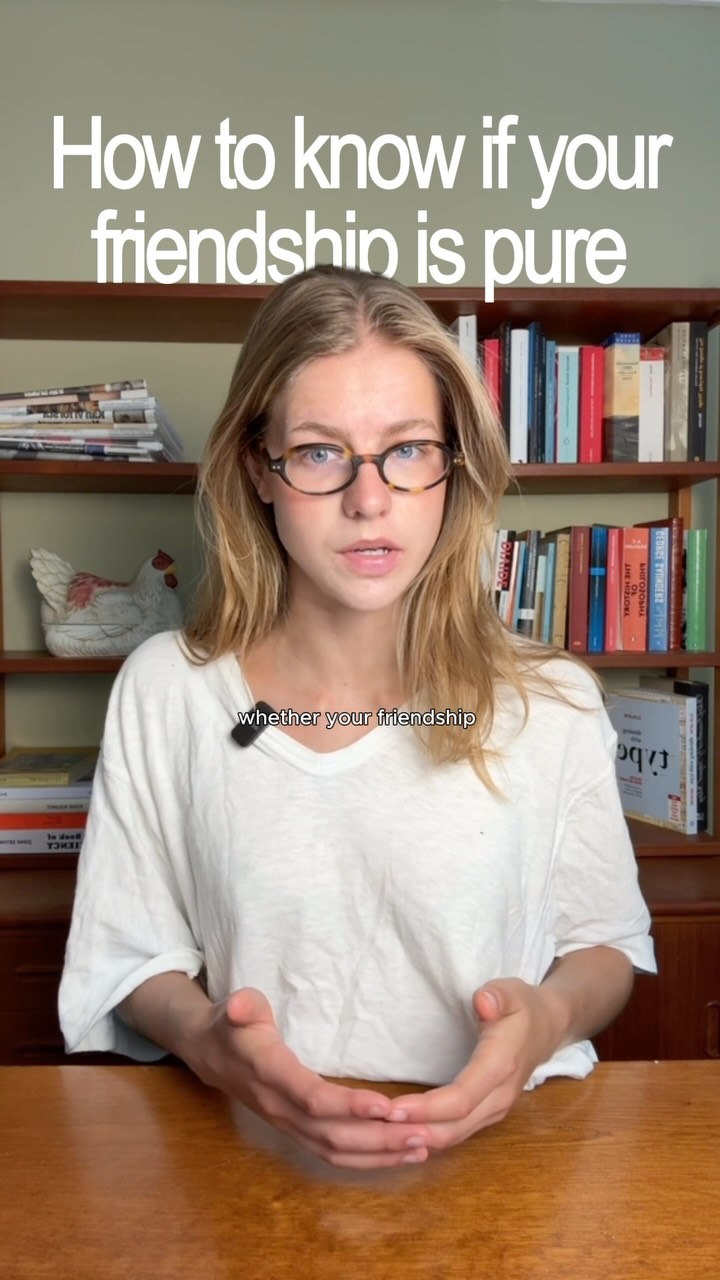
@var.aunevik How do you know whether your friendship is pure?
For Simone Weil, pure friendship is something very rare.
It’s when you do need each other, but still treat each other as free.
No one tries to control the other, and no one silences themselves just to be liked.
You might need each other, yes.
But you refuse to own each other.
Here she uses Eve as an example.
Imagine if Eve was actually hungry. And if in spite of this hunger she keeps looking at it indefinitely without taking a single step toward it. She would have performed a miracle similar to that of a perfect friendship.
The other may be necessary to you, yet you do not try to possess them or merge with them.
You allow them to remain fully other.
And so in a pure friendship,
You can disagree. You can be silent. You can change.
But all this time the bond still holds, because it is bond built not on power or constant reassurance, but rather it is built on mutual respect for each others freedom.
From “An Anthology” by Simone Weil
Explaining friendship with philosophical analogyfrom @var.aunevik
[01]
Overview
The creator explains philosopher Simone Weil's concept of a 'pure friendship,' defining it as a relationship based on mutual need without ownership or control. She uses direct quotes from Weil's writing, illustrates the concept with an analogy of Eve resisting the forbidden fruit despite hunger, and concludes by summarizing that true friendship is built on respecting each other's freedom.
A medium shot of a speaker sitting at a wooden desk with a bookshelf in the background, creating an academic and authoritative setting. She makes direct eye contact with the camera, establishing an immediate connection.
[06]
Hook template
Steal this for your own video
How to know if your [relationship type] is [ideal quality]
— How to know if your business partnership is healthy
— How to know if your skincare routine is working
— How to know if your investment strategy is sustainable
[07]
Hook and payoff
The promise the opener makes, and how the video pays it back
Hook
A direct, universally relatable question that frames the video as a quest for a specific piece of wisdom, immediately engaging the viewer's introspection.
Payoff
A concise, powerful summary that reframes the entire argument under a single, memorable foundational principle, providing a satisfying intellectual conclusion and a clear takeaway.
[08]
Narrative framework
The structural pattern this video runs on
Framework
The Philosophical Deep Dive
To deconstruct a complex, abstract concept by introducing an expert's definition, illustrating it with a powerful and unexpected analogy, and concluding with a unifying, foundational principle.
1
The Authority's Thesis
Establishes credibility by citing an expert source and presents the core, often paradoxical, definition of the concept being explored. This provides the central argument for the rest of the video.
2
The Negative Boundary
Clarifies the abstract thesis by defining what it is *not*, using concrete examples of impure or incorrect applications of the concept. This makes the idea easier to grasp through contrast.
3
The Illustrative Analogy
Makes the abstract concept tangible and memorable by reframing a well-known story or creating a vivid metaphor that demonstrates the principle in action. This serves as the emotional and intellectual core of the explanation.
4
The Practical Implications
Translates the analogy back into the real world, showing the tangible outcomes and behaviors that result from adopting this new understanding. This connects the philosophy to the viewer's lived experience.
Themes
Philosophy
Relationships
Self-Improvement
Freedom
Techniques
Direct address
Philosophical explanation
Analogy
Post caption
How do you know whether your friendship is pure?
For Simone Weil, pure friendship is something very rare.
It’s when you do need each other, but still treat each other as free.
No one tries to control the other, and no one silences themselves just to be liked.
You might need each other, yes.
But you refuse to own each other.
Here she uses Eve as an example.
Imagine if Eve was actually hungry. And if in spite of this hunger she keeps looking at it indefinitely without taking a single step toward it. She would have performed a miracle similar to that of a perfect friendship.
The other may be necessary to you, yet you do not try to possess them or merge with them.
You allow them to remain fully other.
And so in a pure friendship,
You can disagree. You can be silent. You can change.
But all this time the bond still holds, because it is bond built not on power or constant reassurance, but rather it is built on mutual respect for each others freedom.
From “An Anthology” by Simone Weil
Text overlays
title · beginning
How to know if your friendship is pure
contextual · beginning
for Simone Weil
informational · beginning
A friendship is tarnished as soon as necessity triumphs, if only for a moment, over the desire to preserve the faculty of free consent on both sides. In all human things, necessity is the principle of impurity. All friendship is impure if even a trace of the wish to please or the contrary desire to dominate is found in it. In a perfect friendship these two desires are completely absent. The two friends have fully consented to be two and not one, they respect the distance which the fact of being two distinct creatures places between them. Man
informational · middle
she had no need of the fruit. If she had been hungry at the moment when she looked at the fruit, and if in spite of that she had remained looking at it indefinitely without taking one step toward it, she would have performed a miracle analogous to that of perfect friendship.
informational · end
the true sense of the word. That is what might be called an adulterous union, even though it comes about between husband and wife. There is not friendship where distance is not kept and respected. The simple fact of having pleasure in thinking in the same way as the beloved being, or in any case the fact of
Transcript
How do you know whether your friendship is pure? For Simone Weil pure friendship is something very rare. It's when you do need each other better still treat each other as free. No one tries to control the other and no one silences themselves just to be liked. You might need each other, yes, but you refuse to own each other. Here she uses Eve from the Garden of Eden as an example. Now imagine if Eve was actually hungry, but in spite of this hunger she keeps just looking at it indefinitely without taking a single step toward it. She would have performed a miracle similar to that of a perfect friendship. The other may be necessary to you, yet you do not try to possess them, merge with them or make them serve your need. You allow them to remain fully other. And so in a pure friendship, you can disagree, you can be silent, you can change. But all this time the bond still holds because it's a bond built not on power or constant reassurance, but rather on mutual respect for each other's freedom.
Explaining friendship with philosophical analogy | Viral Hooks