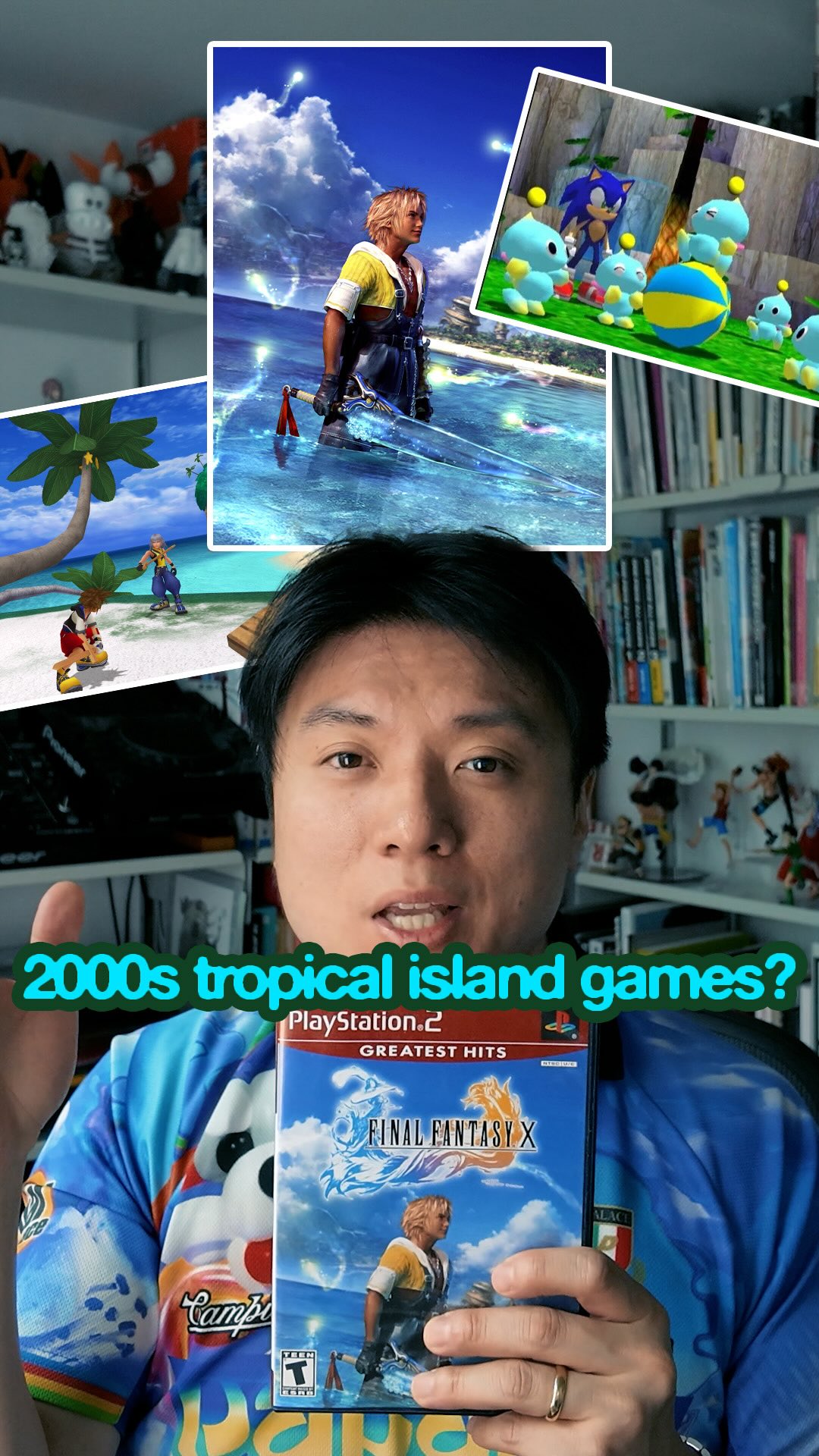
The creator asks why 2000s video games were often set on tropical islands, then provides a multi-point explanation covering technical limitations (water as a showcase), level design advantages (natural boundaries), new rendering capabilities (foliage), cultural influences from Japanese developers, and the era's psychological desire for escapism. He contrasts this with the later shift to grittier aesthetics and ends by asking viewers for their favorite tropical game.
Transcript
Why did games in the two thousands all take place on tropical islands? From the sun drenched vibrant shores of Super Mario Sunshine and the beautifully rendered white beaches of Final Fantasy 10, tropical islands were a major spatial paradigm in two thousand's video games. There were a number of factors that contributed to this phenomenon. One, water was the ultimate technical showcase at the time. The newer platforms had advanced processing capabilities, but still suffered from memory storage. The waves and waters were a way for developers to flex cutting edge visual effects while still being within the hardware limitations. Two, islands acted as natural spatial architecture. They limited draw distance and acted as natural boundaries. It stopped players from traversing too far in the map and provided logical in game reasons why you might not be able to depart past a certain distance. There were also new procedural ways to render foliage. Previously, it required thousands of polygons which was highly inefficient, but now dense jungles were possible to render. For a lot developers of the time were Japanese, and this glossy ecofuturism had been in the Japanese vacation zeitgeist for a long time. Tropical destinations like Okinawa and Hawaii served as these idyllic escapes from the dense urban city life. The Japanese resort aesthetic really taps in to this notion of island vacations relaxing and getting back to nature. Finally, there was this optimism where these island vacations were escapes from global politics and had a calm feeling being surrounded by ocean and almost acted as a psychological reset. As we got closer to the twenty tens, the industry almost fully abandoned this aesthetic in favor of a desaturated brown and yellow look known as the piss better, signaling a return to urban centers, military shooters, and bleak post apocalyptic landscapes. So while the two thousands tropical island game aesthetic may have been informed by technical constraints and escapism. To me, it is one of the most beloved nostalgic and important video game aesthetics from my childhood and the whole video game medium. So what's your favorite tropical island game? Let's have a discussion down in the comments.