Viral Hooks
Trending short videosExpert explains Route 66 history
L

@lapubliclibrary

Instagram · Speaker address

@lapubliclibrary Was the song too much? Works Cited Buckley, Patricia R. Route 66. 1988. Davies, Vivian, and Darin Kuna. Guide to Historic Route 66 in California. Second Edition, 1993. Route 66, Bureau of Land Management, 2015.

View original on Instagram

The edit1 shot · 0 text
Shots2:56

Performance

Views
221K
Likes
14.5K
Comments
306
Engagement
6.7%
Outlier
45.8×
Length · 14 Sept 2026
2:56

Video #42541 · Speaker address

Expert explains Route 66 historyfrom @lapubliclibrary

[01]

Overview

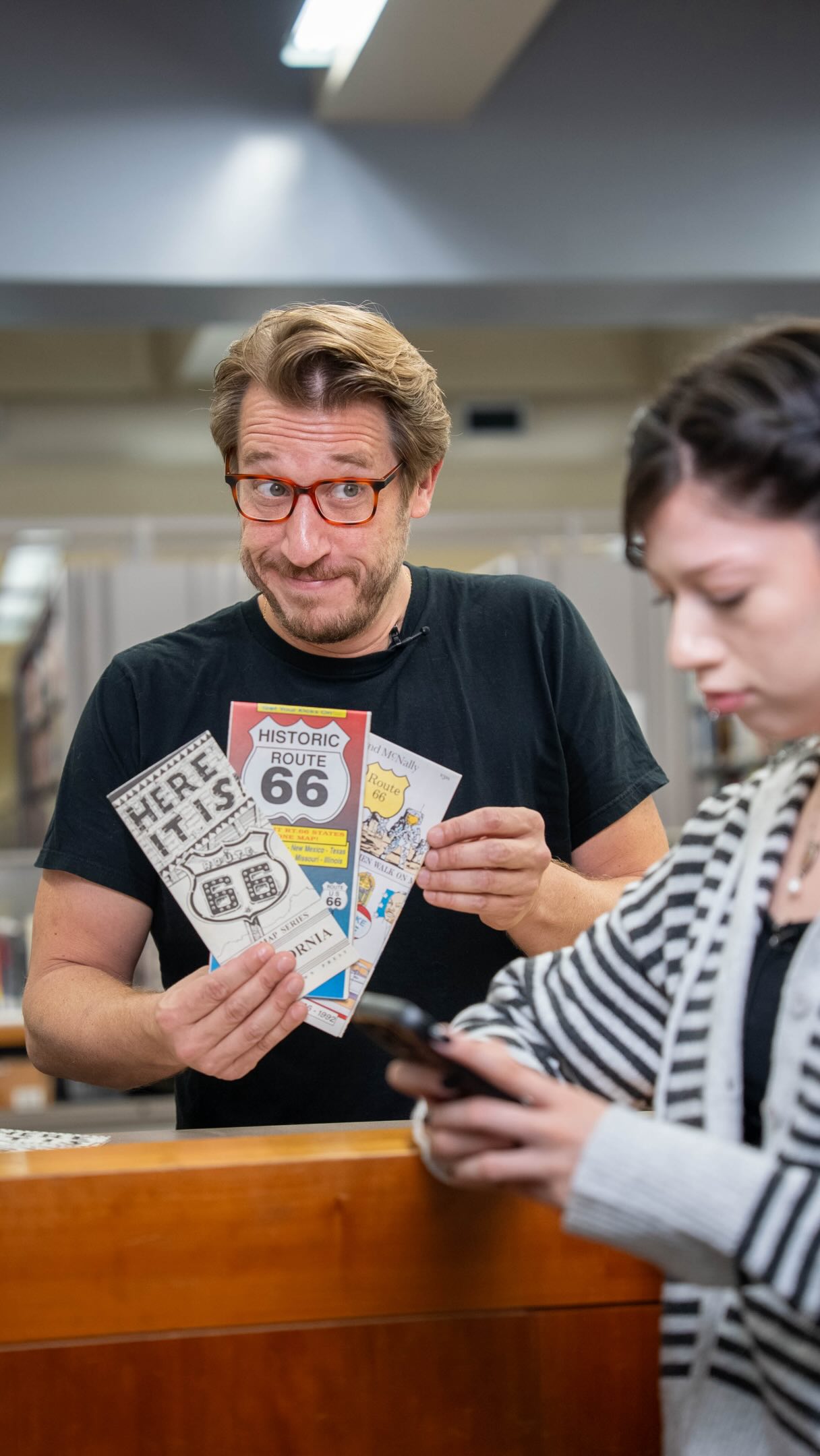
The creator, acting as a historical expert or librarian, responds to a young woman's question about Route 66. He provides a detailed historical overview of the famous highway, using physical visual aids like photos and maps to illustrate its creation, development, cultural impact, and eventual decommissioning, while the woman takes notes and reacts. The video concludes with a comedic interaction highlighting a generational gap in cultural knowledge.

[02]

Simple outline

  1. 1Pose a common misconception
  2. 2Deliver a chronological history
  3. 3Detail cultural significance
  4. 4End with a comedic interaction

[03]

Related videos

[04]

Classification

Concepts
Opportunity Explainer
Elements
B-Roll Cutaway

[05]

Hook analysis

What stops the scroll in the first 3 seconds

Verbal hook · 100%

I keep hearing about this Route 66. Is that just a boomer thing?

Visual hook

A medium shot of two people having a conversation in a library setting, establishing an immediate Q&A dynamic and a clear expert/novice relationship.

[06]

Hook template

Steal this for your own video

I keep hearing about [cultural reference]. Is that just a [generation] thing?

  • — I keep hearing about vinyl records. Is that just a boomer thing?
  • — I keep hearing about MySpace. Is that just a millennial thing?
  • — I keep hearing about handwritten recipes. Is that just a grandparent thing?

[07]

Hook and payoff

The promise the opener makes, and how the video pays it back

Hook

A novice character asks a simple, slightly dismissive, or naive question about a topic, framing it as a knowledge gap to be filled and creating an immediate, relatable premise.

Payoff

The expert attempts to connect with the novice on a personal level related to the topic (e.g., singing a song, sharing a niche reference), which is met with a lack of recognition or modern indifference, creating a comedic and relatable punchline that resolves the initial generational tension.

[08]

Narrative framework

The structural pattern this video runs on

Framework

The Conversational Deep Dive

An expert debunks a common misconception or answers a simple question from a novice, leading to a surprisingly detailed and story-driven explanation of a topic, culminating in a humorous human interaction.

  1. 1

    The Foundational Definition

    The expert provides the basic, essential facts of the topic (what it is, its scale, its core purpose) to establish a baseline understanding.

  2. 2

    The Origin Story

    The expert details the challenging or humble beginnings of the subject, establishing an initial state of conflict or difficulty that must be overcome.

  3. 3

    The Turning Point

    The expert explains the key event or innovation that propelled the subject toward its primary function or success, marking a major shift in the narrative.

  4. 4

    The Surprising Anecdote

    The expert shares an unexpected, counter-intuitive, or ironic detail from the subject's history that adds color, memorability, and intrigue.

  5. 5

    The Era of Dominance

    The expert explains the factors that led to the subject's peak success or relevance, fulfilling the narrative's rising action.

  6. 6

    The Inevitable Decline

    The expert introduces the force, event, or technology that rendered the subject obsolete or changed its role fundamentally, serving as the story's climax.

  7. 7

    The Modern Legacy

    The expert explains how the subject continues to exist or be relevant in the modern day, often through preservation or adaptation, providing a sense of resolution.

  8. 8

    The Cultural Imprint

    The expert shifts from factual history to the subject's broader impact on culture, art, and society, elevating its importance beyond the initial facts.

Themes

  • History
  • Americana
  • Generational Gaps
  • Education

Techniques

  • Q&A format
  • Visual aids
  • Storytelling

Post caption

Was the song too much? Works Cited Buckley, Patricia R. Route 66. 1988. Davies, Vivian, and Darin Kuna. Guide to Historic Route 66 in California. Second Edition, 1993. Route 66, Bureau of Land Management, 2015.

Transcript

I keep hearing about this Route 66. Is that just a worse thing? Well, Route 66 is one of the original highways of The United States. It spans almost 2,500 miles of road between Chicago, Illinois and its terminating point in Santa Monica, California. The route was designed in 1926 and, at the time, only about 800 miles of it were worse, with the remaining 1,650 miles being packed with dirt, gravel and sometimes even wood. In 1927, US sixty six Highway Association was formed and they began proposing what they called the Main Street Of America be paved, not just for motorists, but because the route was also being eyed as an important military thoroughfare. However, Route 66 wouldn't be completely paved until 1938. For a while, one of the biggest dangers was cars straying off of the main good, so they started making raised shoulders along the more dangerous stretches of the road. Ironically, this only made the road more dangerous as the lip would cause cars to flip over more times than not. Don't worry though, they removed them. Part of the success of the road came from the fact that it ran right through the heartland of America. Traveling it, you would cross deserts, plains, forests, mountains, and Route 66 was also the straightest and most level passage going from east to best, or best to east. No, is it still around? Yes and no. In 1956, the Federal Highway Act was signed by Eisenhower, kicking off the interstate system that we have today and signaling the beginning of the end for Route 66. In June 1985, Route 66 was removed from The US highway system. Despite this, preservation efforts began almost immediately. The Route 66 Corridor Preservation Program was formed by the National Park Service, and Route 66 is also a world monument. While it's near impossible to travel the route exactly as it was due to the many alterations and alignments the route's undergone, you rank still travel the bulk of the route rank to the many efforts to preserve it. Just keep in mind that your phone's GPS isn't likely to favor 66. But with some research and planning, you too can travel the Better Road. So there were no iPhones back then? What did people even do in the car? Roadside culture was born on Route 66. The road was littered with oddball roadside attractions, rest stops, and other ways to break up the monotony. Burmeshave was known for their series of rhyming billboards that would engage the entire car. As you drive, play this game, construct a jingle with this name, permission. Wow. Route 66 was also immortalized by John Steinbeck in his great American novel, The Grapes of Wrath. Most of the book follows the Joad family and their overpacked truck making their way from Oklahoma to the promised land of California. There was also a show that ran from tier to 64 called Route 66. And of worse, there's the song. There's a song. Flagstaff, Arizona. Don't forget Winona Kingman Barstow Rank Bernardino. Get your kicks on Route tier. No? No. Okay. It was it's really more of a silent generation, really. We're done here.

Expert explains Route 66 history | Viral Hooks